Bernedoodle Generations Explained: F1, F1B, F2, F2B & More
If you’ve spent more than ten minutes researching bernedoodles, you’ve probably run into a the following terms: F1, F1B, F1BB, F2, F2B, multi-gen.
It reads like a wifi password, and most breeder websites don’t make it any clearer.
The good news is that it’s not as complicated as it sounds.
Generation is just a label that tells you how a bernedoodle was bred. Specifically, how much Bernese Mountain Dog versus Poodle is in the mix. That ratio directly affects the two things prospective owners care about most: how much the dog will shed and how predictable the coat will be.
In this guide, we’ll break down every bernedoodle generation, explain what the letters and numbers actually mean, and help you figure out which one fits your household. If you’re brand new to the breed, start with our complete bernedoodle guide for the full picture, then come back here to get into the generation details.
How to Read Bernedoodle Generation Labels
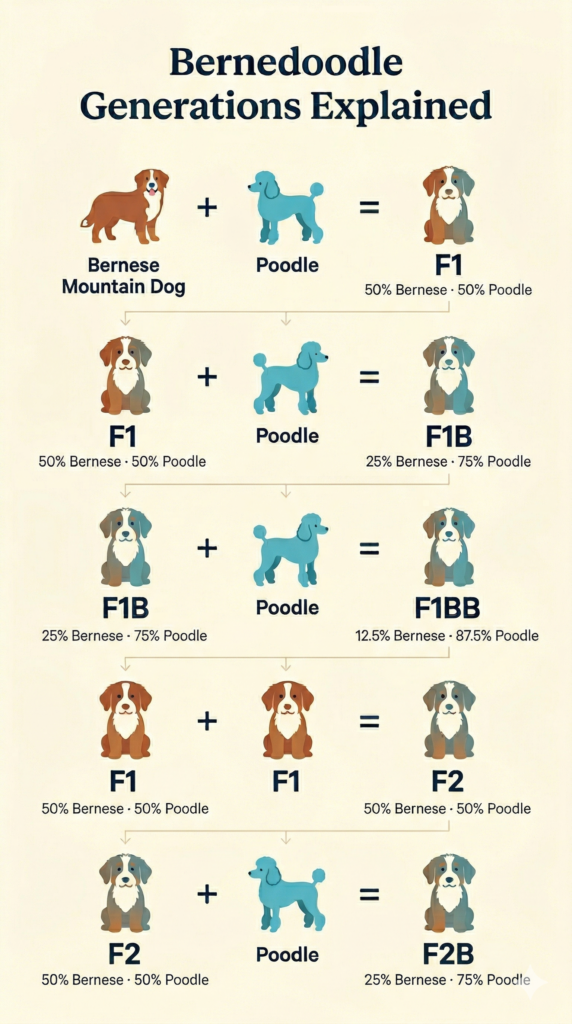
The naming system is simpler than it looks once you know three things.
One thing worth noting: backcrossing is almost always done to a Poodle, not a Bernese.
The entire purpose of the backcross is to increase coat predictability and reduce shedding. Breeding back to a Bernese would move in the opposite direction, so breeders rarely do it.
With that framework, every generation label in this article will make immediate sense. Let’s walk through them.
F1 Bernedoodle — The First Generation
Cross: Bernese Mountain Dog × Poodle
Genetic Split: 50% Bernese / 50% Poodle
The F1 is the original bernedoodle — one purebred parent from each side. It’s also where hybrid vigor is strongest, because you’re combining two completely unrelated gene pools. That genetic diversity is a real advantage for health.
Temperament is where F1s tend to shine. Because the genetic split is perfectly even, most F1 bernedoodles get a balanced blend of the Bernese’s calm, loyal disposition and the Poodle’s intelligence and trainability.
Owners and breeders frequently describe the F1 as having the most “Bernese-like” personality of any generation. They tend to have that deep attachment, gentle goofiness, and preference for being on the same piece of furniture as you.
The tradeoff is coat predictability.
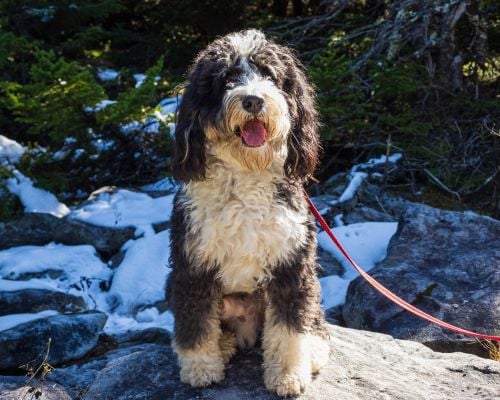
F1 litters are a mixed bag. Most puppies end up with the signature wavy or fleece coat that looks like what you picture when you hear “bernedoodle,” but some will come out with straighter, more Bernese-like coats, and a few will be curlier.
You can get all three textures in the same litter. An experienced breeder can usually identify coat types by four to six weeks, but if you’re choosing a puppy at birth, there’s an element of surprise.
Shedding ranges from light to moderate. If you’re coming from a purebred Bernese, an F1 will feel practically non-shedding by comparison.
If you have zero tolerance for dog hair, or if someone in your home has moderate-to-severe allergies, an F1 probably isn’t your best bet. It’s compatible with mild allergies for most people.
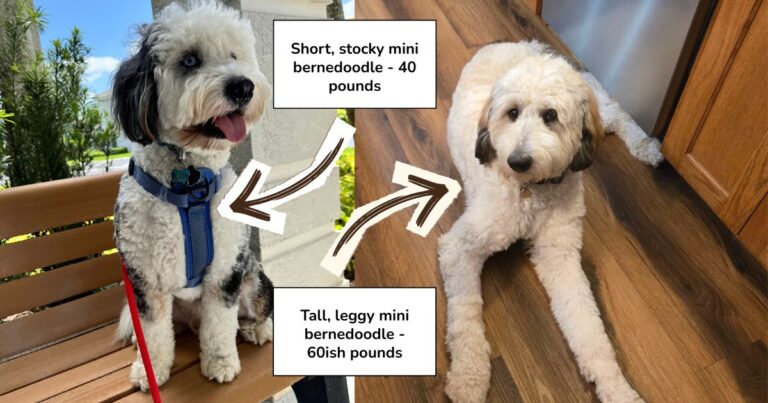
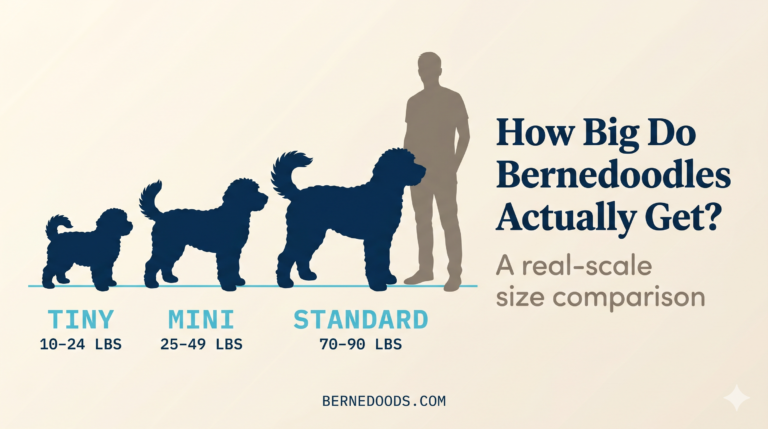
One more note: the Poodle parent’s size determines the bernedoodle’s size, and this is true across every generation.
A Standard Poodle parent produces a standard bernedoodle (70–90+ lbs). A Miniature Poodle brings it down to the mini range (25–49 lbs). A Toy Poodle produces a micro (10–24 lbs).
F1B Bernedoodle — The Most Popular Generation
Cross: F1 Bernedoodle × Poodle
Genetic Split: 25% Bernese / 75% Poodle
The F1B is the generation most breeders recommend, most families end up choosing, and for most people, it’s the sweet spot.
That extra dose of Poodle genetics translates directly to coat: F1B bernedoodles typically have curlier, more consistent coats than F1s, they shed significantly less, and they’re the most recommended generation for families with moderate allergies.
If you want a bernedoodle that’s as close to “non-shedding” as the breed gets without going all the way to an F1BB, this is your generation.
The “75% Poodle” Misconception
This is the most common misunderstanding about F1B bernedoodles, so let’s clear it up: 75% Poodle does not mean your dog will look or act like a Poodle.
The Poodle percentage primarily affects coat genetics: texture, curl pattern, shedding. It does not erase the Bernese temperament.
The vast majority of F1B bernedoodles retain the loyal, affectionate, slightly goofy personality that defines the breed. Many breeders report that the Bernese disposition carries through remarkably well even at the 75% Poodle mark.
And the look?
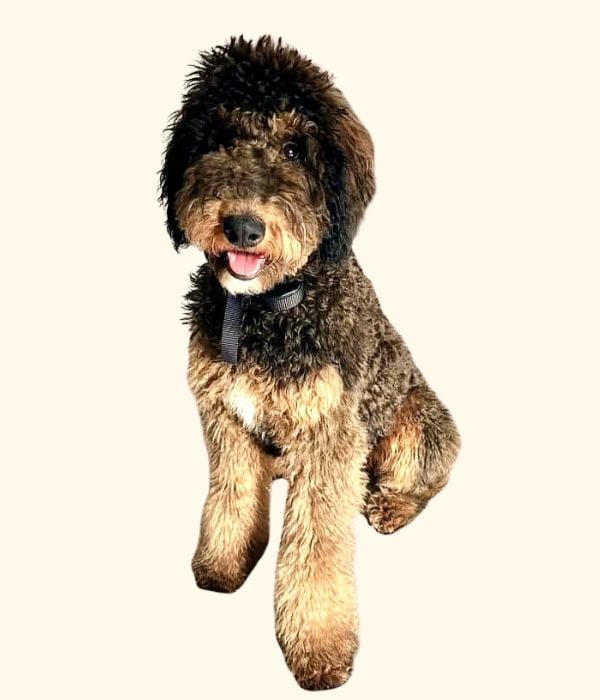
In every F1B litter, you’ll find puppies with loose wavy coats that are visually indistinguishable from F1 bernedoodles. Not every F1B has tight curls. The generation shifts the probability toward curlier coats, but wavy, teddy-bear-looking F1Bs are extremely common and highly sought after.
Reality Check on Grooming
Here’s the part that doesn’t make it into the Instagram photos. Lower shedding means higher grooming demands. The same curly coat that keeps hair off your couch mats and tangles if it’s not maintained.
An F1B with a curly or wavy coat needs brushing every day or every other day. Not once a week. Not when you remember.
Professional grooming every six to eight weeks is standard, and depending on your area and the dog’s size, expect to pay $80–$150 per session.
This is the tradeoff. Low shedding isn’t free. You’re paying for it in grooming time and cost. It’s worth it for most people, but go in with your eyes open.
F1BB Bernedoodle — The Double Backcross
Cross: F1B Bernedoodle × Poodle
Genetic Split: ~12.5% Bernese / ~87.5% Poodle
The F1BB is the best option for allergy sufferers who want to minimize their risk as much as possible while still owning a bernedoodle. Nearly all F1BB dogs have tight curly coats and shed minimally — about as close to a non-shedding bernedoodle as the breed produces.
But the tradeoff is real, and it’s worth being honest about.
With 87.5% Poodle genetics, some of the classic Bernese characteristics start to fade. The stocky build thins out. The iconic tri-color patterning is still possible but less common. And some F1BB bernedoodles lean more Poodle in temperament, which makes them a bit more alert, a bit more energetic, sometimes a touch more independent than their F1 or F1B counterparts.
None of this means F1BBs are lesser bernedoodles. They’re the right generation for a specific set of priorities. If allergies are your non-negotiable and you’re willing to embrace a curlier coat with the grooming demands that come with it, the F1BB delivers exactly what you need.
Grooming requirements are the highest of any generation. Those tight curls need daily brushing without exception, and professional grooming every six weeks is the bare minimum to prevent matting.
F2 Bernedoodle — The Second Generation (and Why It’s Rare)
Cross: F1 Bernedoodle × F1 Bernedoodle
Genetic Split: 50% Bernese / 50% Poodle (on paper)
F2 bernedoodles are the most unpredictable generation, and that’s why most experienced breeders don’t produce them.
On paper, the genetic split is the same as an F1: 50/50. But genetics doesn’t work like mixing paint. When two F1 bernedoodles are crossed, their combined genes can recombine in ways that swing hard in either direction. You might get an entire litter of flat, straight coats that look and shed like a purebred Bernese. Or you might get a litter of tight curls. Or you might get everything in between. The predictability that makes F1 litters manageable breaks down in the F2.
Shedding is equally variable. Some F2 bernedoodles shed almost nothing. Others shed heavily. Without genetic testing on the specific puppy, it’s hard to know what you’re getting.
This doesn’t make F2s “bad,” it just makes them hard to match with families who have specific expectations.
If you don’t care about coat type and just want a bernedoodle at a potentially lower price point (F2s often cost less because breeders have less control over outcomes), an F2 can be a great dog. But if shedding or allergies are factors in your decision, this is not the generation for you.
F2B Bernedoodle — The Second Generation Backcross
Cross: F2 Bernedoodle × Poodle (or sometimes F1 × F1B)
Genetic Split: ~37.5% Bernese / ~62.5% Poodle (varies by specific cross)
The F2B falls somewhere between an F1 and an F1B in terms of coat predictability and shedding, which makes it a reasonable middle-ground generation, though it comes with a caveat.
That caveat: the term “F2B” is used inconsistently across breeders. Some use it to describe an F2 crossed back to a Poodle. Others use it for an F1 crossed with an F1B. The percentages differ depending on the actual pairing, and the outcomes differ too.
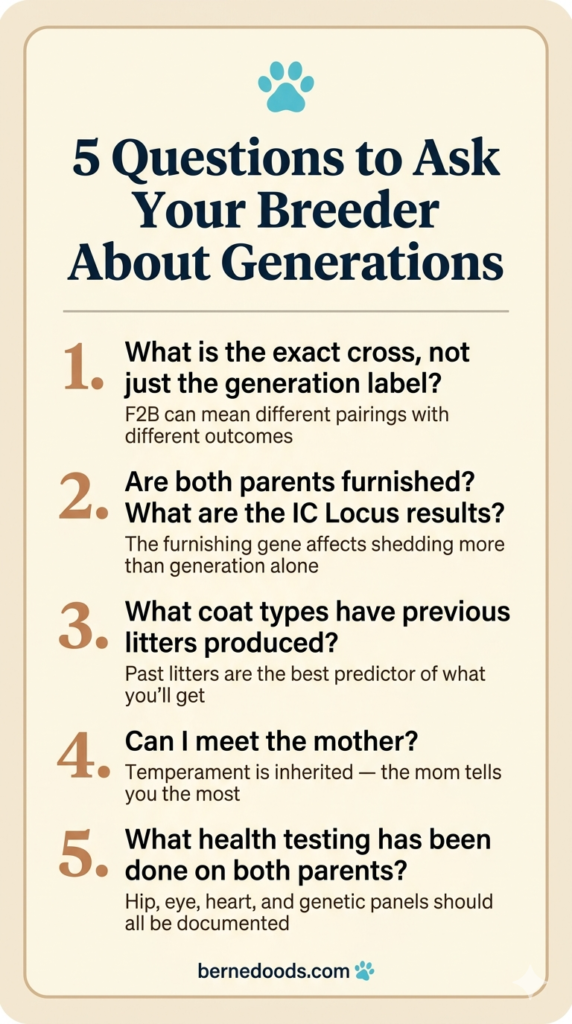
If you’re considering an F2B, the most important thing you can do is ask your breeder exactly which dogs were crossed.
Don’t just accept the generation label. Get the specifics. A good breeder will be happy to explain the pairing and why they chose it.
Generally, F2Bs work well for families with moderate allergies. They can occasionally produce the coveted Bernese look with lower shedding, which makes them appealing if you want the classic tri-color appearance without the full F1 shedding range. Coat types can include wavy, curly, and occasionally straight, so the furnishing gene test is especially valuable for this generation.
Multi-Gen Bernedoodle — The Long Game
Cross: Various (Bernedoodle × Bernedoodle, or Bernedoodle × Poodle, from F2+ lines)
Multi-gen bernedoodles offer the most consistency, but only when they come from an experienced, reputable breeder. That qualifier matters more here than with any other generation.
“Multi-gen” is a catch-all label for any bernedoodle beyond the second generation. These are dogs whose parents, grandparents, and sometimes great-grandparents are all bernedoodles (or bernedoodle-Poodle crosses).
The goal is to build a breeding program that reliably produces specific traits (consistent coat texture, predictable size, stable temperament) with less of the genetic lottery that comes with earlier generations.
When it works, multi-gen breeding is the closest thing to a sure bet in the bernedoodle world. A breeder who’s been refining their multi-gen lines for years can tell you with confidence what a litter’s coats, sizes, and temperaments will look like.
When it doesn’t work (when the breeder lacks experience or isn’t selecting carefully) multi-gen is just multiplication of unknowns. The quality of a multi-gen bernedoodle is directly proportional to the quality of the breeder behind it.
If you’re considering a multi-gen puppy, do your homework on the breeder. Ask to see the pedigree, meet the parents if possible, and look for a track record of consistent, healthy litters.
Generation Comparison Table
Here’s every generation side by side. Bookmark this for reference, you’ll come back to.
Bernedoodle Generations Compared
Tap any generation to see the full breakdown.
How Generation Affects Coat, Shedding, and Allergies
Generation is the single biggest predictor of what your bernedoodle’s coat will look like and how much it will shed, but it’s not the only factor. The furnishing gene matters just as much, and most people have never heard of it.
Every bernedoodle coat falls into one of three textures: straight (most Bernese-like, sheds the most), wavy (the classic bernedoodle look, moderate maintenance, low shedding), and curly (most Poodle-like, sheds the least, requires the most grooming).
As you move from F1 to F1B to F1BB, the probability curve shifts toward curlier coats. An F1 litter might produce all three textures. An F1BB litter will almost exclusively produce curls.
But here’s what most generation guides leave out: an unfurnished F1B will shed more than a furnished F1.
Furnishings are the facial hair gene — the beard, the shaggy eyebrows, the teddy-bear face that gives doodles their look.
A furnished bernedoodle almost always sheds less than an unfurnished one, regardless of generation.
The furnishing gene (technically the IC Locus) is testable, and any breeder who claims their puppies are low-shedding should be able to confirm the furnishing status of both parents.
And the obligatory caveat: no dog is truly hypoallergenic. Allergens come from dander, saliva, and urine, not just fur.
A dog that doesn’t shed can still trigger allergies. But dogs with curly, furnished coats spread significantly less dander around your home, which is enough to make a meaningful difference for many allergy sufferers.
The practical takeaway: when evaluating a bernedoodle for shedding and allergies, you need two pieces of information. The generation tells you the probability of a curly coat. The furnishing gene test tells you whether the coat will actually perform the way you expect. Get both.
Does Generation Affect Temperament?
Yes, but less than most people think and far less than individual variation and upbringing.
The general pattern: F1 bernedoodles tend to show the most balanced blend of Bernese calm and Poodle smarts. As the Poodle percentage increases through F1B, F1BB, and multi-gen lines, some dogs lean slightly more Poodle in personality.
Breeders and owners sometimes describe higher-Poodle-percentage dogs as “sharp” or “bouncy” compared to the more laid-back F1.
But here’s what matters more than generation: the temperament of the individual parents. A calm F1B from mellow parents will be calmer than an anxious F1 from reactive parents.
The parents are the best predictor. Generation sets broad tendencies. The parents set the specific range. Socialization and training determine where within that range your individual dog lands.
If temperament is a priority for you (and it should be) the best thing you can do is meet the parents, especially the mother.
A breeder who prioritizes temperament in their selection process will produce consistently good temperaments regardless of generation.
What About Australian and Ultra Bernedoodles?
Australian and ultra bernedoodles are not different generations. They’re different breed mixes entirely.
They show up on this page because they often get lumped into generation conversations, and it’s important to understand the distinction.
An Australian bernedoodle introduces Australian Labradoodle genetics into the cross. The Australian Labradoodle itself is a multi-generational mix that includes Cocker Spaniel and Labrador Retriever alongside Poodle. The goal is usually to refine coat quality and add certain temperament traits.
An ultra bernedoodle typically adds Australian Shepherd to the mix. The goal is often to introduce specific coloring patterns (like merle) or herding-breed drive.
Both are worth understanding if you encounter them in your research, but they operate outside the standard generation chart above. They carry different genetic profiles, different health considerations, and different trait expectations. If a breeder is advertising either, make sure you understand exactly what breeds are in the cross and why.
Which Generation Is Right for You?
The right generation depends on what you’re optimizing for. Here’s the practical decision framework.
If Allergies Are Your Primary Concern
Go with an F1B or F1BB with a curly, furnished coat. Ask the breeder for furnishing gene test results on both parents. And most importantly, spend time with the specific puppy or dog before committing. Allergy reactions are individual. A coat type that works for one person may still trigger symptoms in another. No breeder can guarantee a completely allergy-free experience, and any breeder who does is overpromising.
If You Want the Classic Bernedoodle Look and Temperament
Start with an F1 and accept some shedding. Or look for an F1B with a loose wavy coat — they exist in every litter, they look just like F1s, and they shed less. This is the combination that gives you the teddy-bear appearance, the Bernese personality, and a manageable (though not zero) shedding level.
If You Want Maximum Predictability
Choose a multi-gen from a breeder with a proven track record and years of experience refining their lines. Ask to see the lineage, meet the parents, and look for consistency across previous litters. A skilled multi-gen breeder can tell you with confidence what you’re going to get.
If Budget Is a Factor
F1s and F2s tend to sit at lower price points than F1Bs and F1BBs. Tri-color F1Bs from established lines typically command the highest premiums. The price differences reflect the breeder’s ability to predict and control outcomes, not necessarily the quality of the individual dog.
Just Keep In Mind…
Generation is one variable among many. A well-bred F1 from health-tested parents will be a better dog than a poorly bred F1BB from an irresponsible breeder every single time.
The generation label tells you about coat probability and genetic ratios. The breeder tells you about health, temperament, and the care that went into producing the litter.
Choose the breeder first. Then choose the generation.
Related Posts
-
When Do Bernedoodles Calm Down? (Asking For A Friend)
If you’re reading this at 10pm after your bernedoodle ricocheted off the couch, stole something important, and is currently staring…
-
What Is An Australian Bernedoodle? (Including What It Is Not)
If you’ve been researching bernedoodles, you’ve probably run into the term “Australian bernedoodle” and wondered if it’s a different breed,…
-
Micro & Toy Bernedoodles: The Smallest Sizes Explained
You’re looking at two breeder websites. One says micro bernedoodles weigh 10 pounds. The other says 30. Both are using…
-
How Big Do Mini Bernedoodles Get?
If you’re here, you probably fall into one of two camps. You’re either shopping for a mini bernedoodle and trying…
-
How Big Do Bernedoodles Get? That Is The Million Dollar Question.
If you’ve spent any time on breeder websites trying to figure out how big a bernedoodle actually gets, you’ve probably…
-
Do Bernedoodles Bark a Lot? An Honest Look at Noise Levels
You’re researching bernedoodles and you want to know what your neighbors are in for. Fair question. Barking is one of…