What Is a Bernedoodle? The Complete Breed Guide
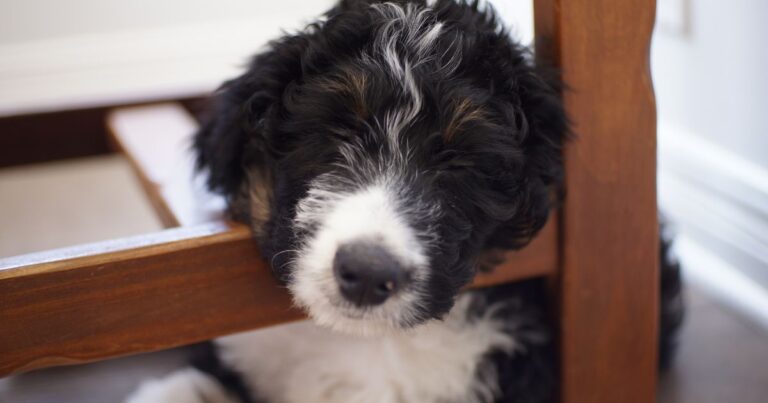
A bernedoodle is a cross between a Bernese Mountain Dog and a Poodle, a combination that pairs one of the most affectionate, gentle large breeds with one of the smartest, lowest-shedding breeds in the dog world.
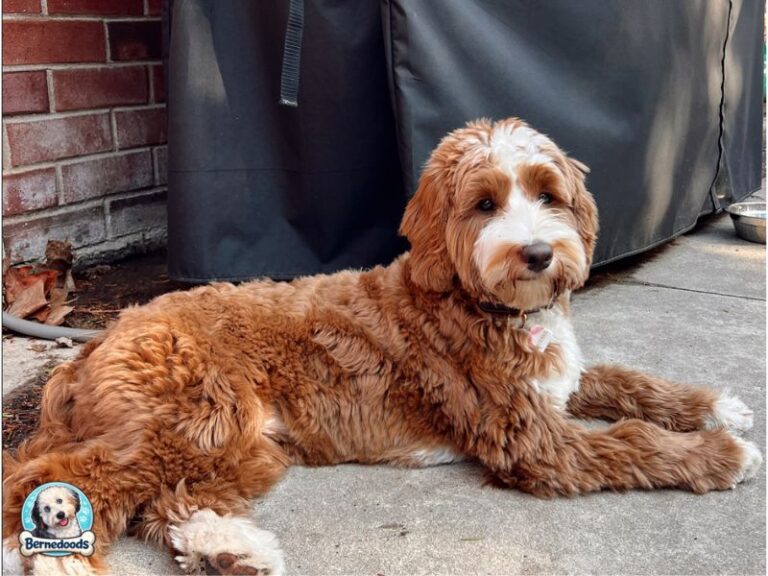
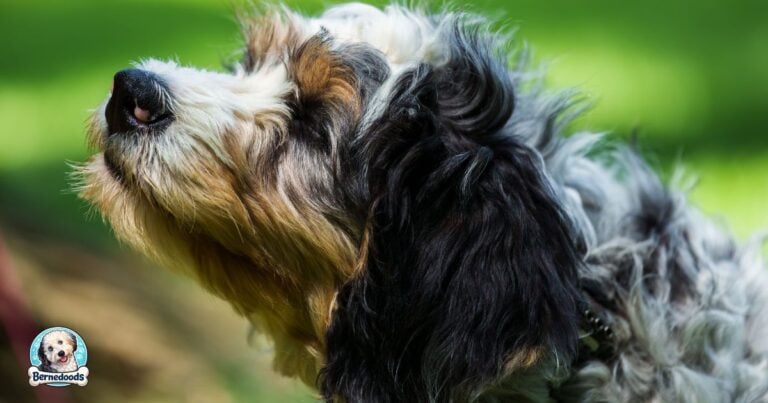
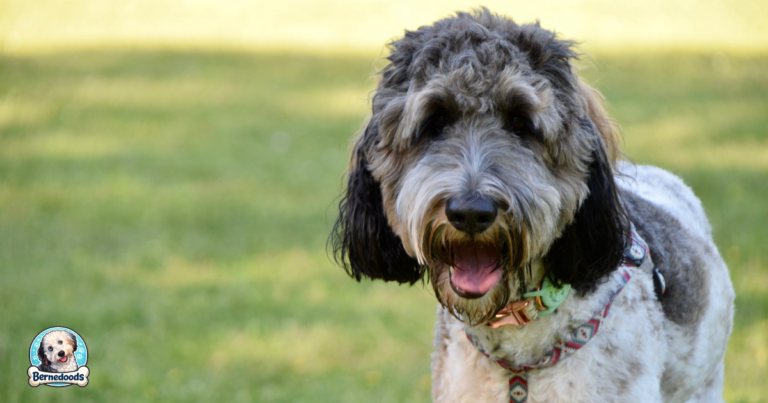
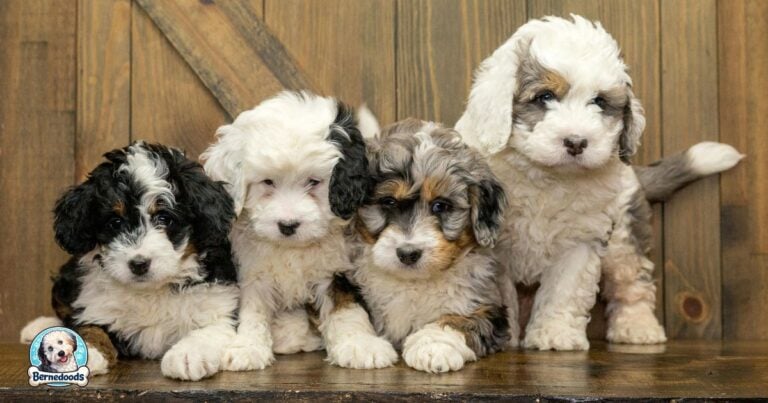
The result is a dog that’s loyal, playful, and strikingly good-looking, with a teddy-bear coat that ranges from loose waves to tight curls depending on the generation.
In this guide, we’ll cover everything you need to know from size varieties and generation types to temperament, shedding, lifespan, and whether a bernedoodle is the right dog for you.
Understanding Bernedoodles & Designer Dogs
The term “designer dog” simply means the cross is intentional.
A breeder is deliberately pairing two purebred parents, in this case a Bernese Mountain Dog and a Poodle, to combine specific traits.
Despite what some may say, it’s not a negative label, and it doesn’t mean the dogs are less healthy or less legitimate than purebreds. In many cases, the opposite is true.
What Each Parent Breed Brings
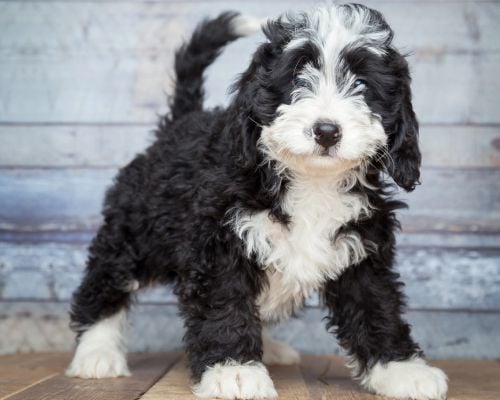
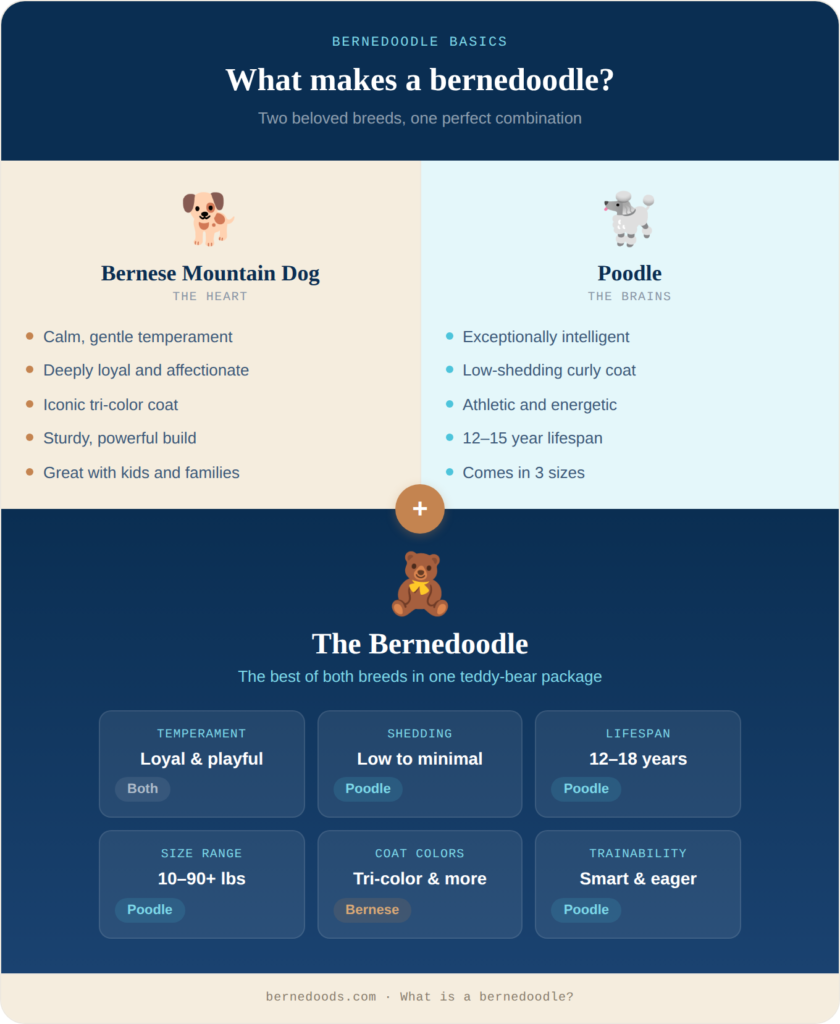
The Bernese Mountain Dog brings a calm, affectionate disposition, a sturdy and powerful build, and that iconic tri-color coat (black, white, and rust). They’re known for being gentle giants who bond deeply with their families.
The downside? They shed heavily, and their average lifespan is a heartbreakingly short 6 to 8 years.
The Poodle brings high intelligence, natural athleticism, a low-shedding curly coat, and a significantly longer lifespan.
Poodles are consistently ranked among the smartest dog breeds in the world, and they pass that trainability directly to their bernedoodle offspring.
When you combine the two, you get a dog that looks like a living teddy bear, loves people more than almost anything, and, depending on the generation, sheds far less than a purebred Bernese.
Not a One-Size-Fits-All Breed
One thing to know upfront: bernedoodles are not recognized by the American Kennel Club, since the AKC only registers purebred breeds.
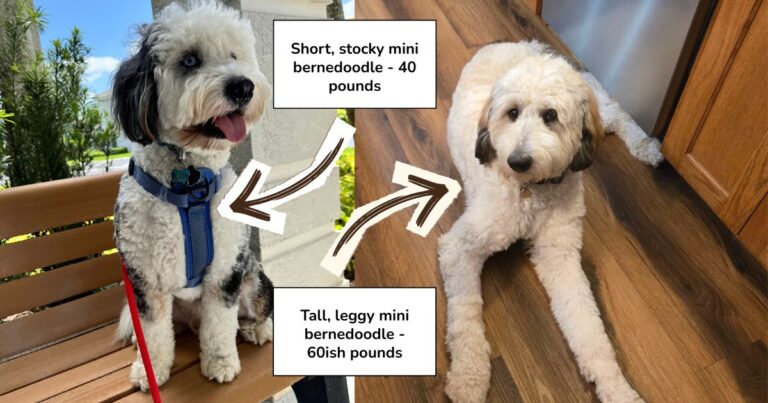
The other thing to know is that bernedoodles aren’t one-size-fits-all. They come in multiple sizes, generation types, coat textures, and color patterns, and it’s not always easy to predict what you’re going to get.
A 15-pound micro bernedoodle with a tight curly coat is a very different dog from a 90-pound standard with a loose wave.
Whether a bernedoodle is furnished or unfurnished changes the look and shedding level dramatically.
Breed Origin & History
Sherry Rupke of SwissRidge Kennels in Ontario, Canada is widely credited as the first breeder to intentionally cross a Bernese Mountain Dog with a Poodle. She began the program in the early 2000s with a specific goal in mind: capture everything people love about the Bernese while addressing the breed’s two biggest drawbacks.
Those drawbacks are hard to ignore.
Bernese Mountain Dogs are one of the shortest-lived large breeds, averaging just 6 to 8 years.
They’re also prone to cancer at alarming rates. Some estimates suggest nearly half of all Bernese die from cancer-related illness.
On top of that, they shed constantly.
Why the Poodle Cross Works
Crossing with a Poodle offered a potential solution on every front. Poodles live 12 to 15 years, carry far fewer breed-specific cancer risks, and their curly coat sheds minimally.
The theory was that the offspring would inherit the best of both: the Bernese heart in a healthier, lower-shedding body.
That theory largely played out.
Temperament & Personality Overview
If you want a dog that will follow you from room to room, rest its head on your lap while you work, and then do something completely ridiculous to make you laugh, you’re looking at the right breed.
Bernedoodles are known for being affectionate, playful, and deeply loyal. They bond hard with their people, and that bond is the defining feature of the breed’s personality.
The Velcro Dog Reputation
Bernedoodles have earned a well-deserved reputation as velcro dogs (our main ‘dood, Max, included). They want to be near you. Not in the same house, mind you. In the same room, ideally on the same piece of furniture.
For people who work from home or spend a lot of time with their dog, this is one of the breed’s best qualities.
For people who are away for long stretches every day, it’s a potential problem. That deep attachment can tip into separation anxiety if a bernedoodle is left alone too often or for too long without proper training.

Smart (Sometimes Too Smart)
Bernedoodles inherit the Poodle’s intelligence, and it shows. They pick up commands quickly, read social cues well, and are highly trainable when motivated.
The catch?
They also inherited a stubborn streak, usually from the Bernese side. A bernedoodle that doesn’t feel like doing something will find creative ways to avoid it. They’re not defiant so much as selectively cooperative.
Playful, Goofy, and Occasionally Absurd
Bernedoodle owners will tell you the breed has a sense of humor.
Puppies and adolescents, especially, are known for clownish behavior. Think: zoomies, dramatic flops, stealing socks for attention, and whatever else they come up with.
This playfulness tends to mellow with age, but most bernedoodles retain a goofy streak well into adulthood. They’re not a serious, stoic breed. If you want dignified, look elsewhere.
Energy Levels Vary
Not all bernedoodles run at the same speed.
Standards tend to be calmer and more laid-back, content with a couple of good walks and some yard time. Minis often carry more energy and need more active engagement such as longer walks, fetch sessions, or mental stimulation games.
Age plays a role too.
A bernedoodle puppy is a tornado. By age two or three, most settle into a more moderate rhythm. But they’re never fully couch potatoes.
They will always need daily exercise and interaction to stay happy.
Generally Friendly, Not Aggressive
Bernedoodles are not an aggressive breed by nature. They’re typically friendly with strangers, gentle with children, and social with other dogs.
That said, they’re not pushovers.
Some bernedoodles develop a mild protective instinct. They’ll alert-bark when someone’s at the door or position themselves between their family and an unfamiliar person. But they’re not guard dogs, and they shouldn’t be expected to act like one.
Barking levels vary by individual. Some are quiet. Some have opinions about everything. Training and socialization make the biggest difference.
The Caveat That Applies to Every Dog
Temperament isn’t guaranteed. Generation, breeding, socialization, and individual personality all play a role.
An F1 bernedoodle from well-tempered parents raised in an active household will behave differently than an undersocialized puppy from an inexperienced breeder. The traits described here are tendencies, not promises.
The best predictor of a bernedoodle’s personality? Meeting the parents (especially the mother) and choosing a breeder who prioritizes temperament alongside health.
Size Varieties at a Glance
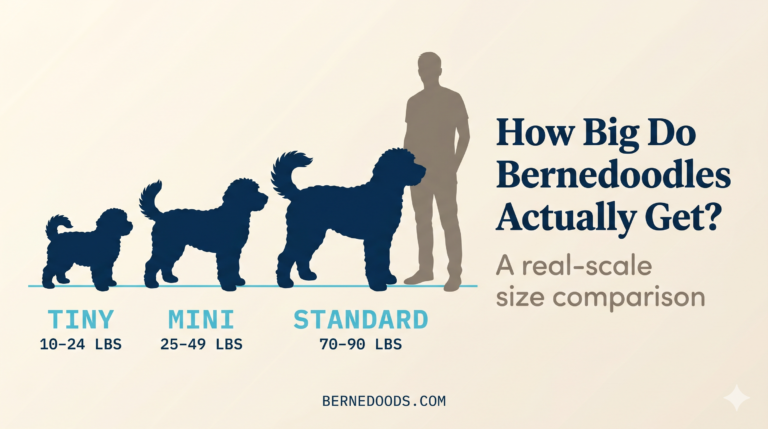
One of the biggest decisions you’ll make when choosing a bernedoodle is size. And unlike most breeds, you actually get to choose. Bernedoodles come in three distinct size categories, each with its own personality tendencies, space requirements, and lifestyle fit.
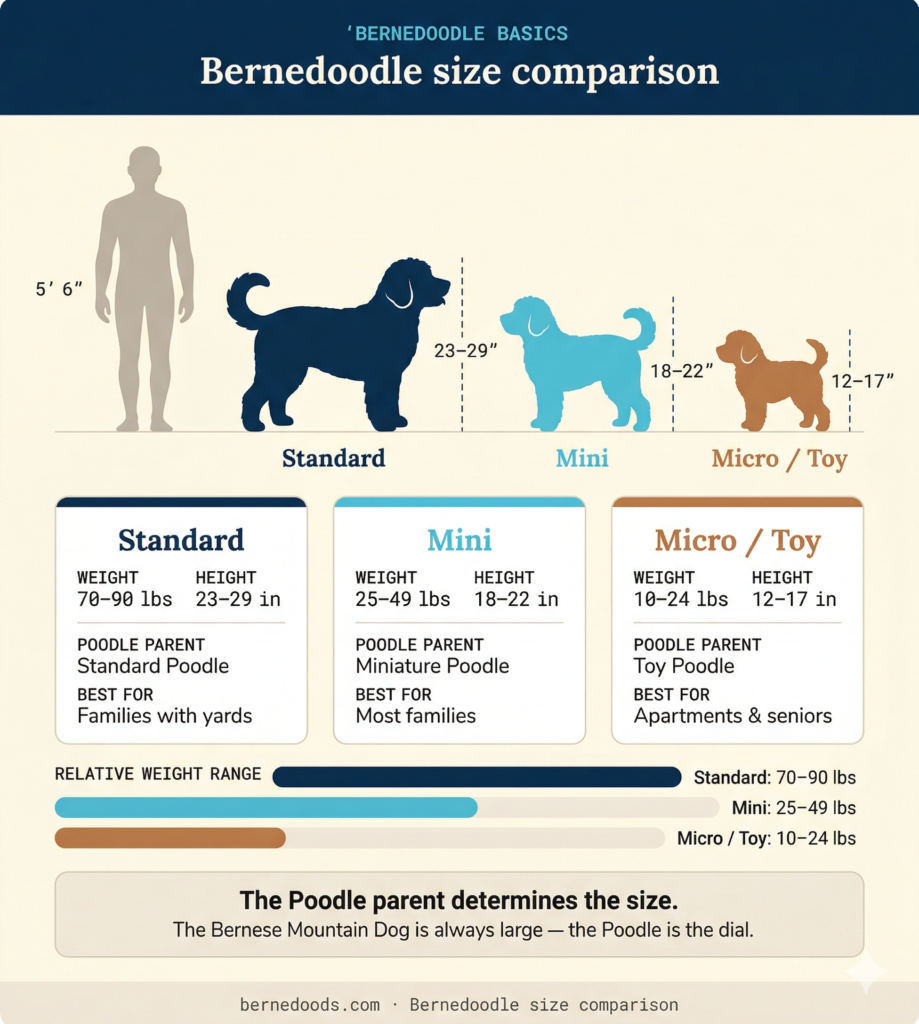
The variable? The Poodle parent. The Bernese Mountain Dog is always a large breed. The Poodle is the dial that gets turned up or down.
Standard Bernedoodle
The biggest of the bunch.
Standard bernedoodles typically weigh 70 to 90 pounds, though some males push past 100. They stand 23 to 29 inches at the shoulder and take up roughly the same amount of couch space as a human adult.
The Poodle parent in this cross is a Standard Poodle. The result is a big, sturdy dog with a calm demeanor. Standards tend to be the most laid-back of the three sizes.
They’re excellent family dogs for households with space, a yard, and an appreciation for a dog that leans against your legs hard enough to move you.

Mini Bernedoodle
The most popular size, and for good reason.
Mini bernedoodles typically weigh 25 to 49 pounds and stand 18 to 22 inches at the shoulder. The Poodle parent is a Miniature Poodle, which brings the overall size down significantly while keeping the bernedoodle personality intact.
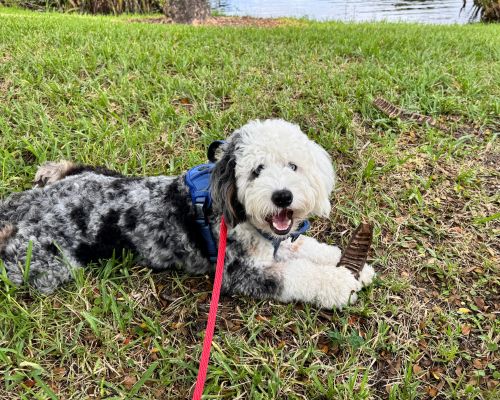
Minis hit a sweet spot for a lot of families: big enough to feel like a real dog, small enough to manage in a smaller home or apartment. They tend to carry a bit more energy than standards and often have a slightly more playful, spirited personality.
Micro and Toy Bernedoodle
The smallest option and the hardest to predict.
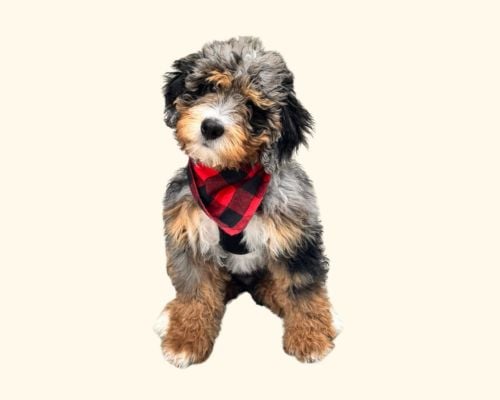
Micro bernedoodles typically weigh 10 to 24 pounds and stand 12 to 17 inches tall. The Poodle parent is a Toy Poodle, and sometimes the cross involves multiple generations of downsizing to achieve the smallest possible dog.
These are bernedoodles for people who love the breed’s personality but want it in a compact, apartment-friendly package.
The tradeoff is predictability.
Micro and toy sizes can vary more widely than standards or minis, and some breeders use the “micro” label loosely. Ask your breeder about the specific parents’ sizes and previous litter outcomes.
Size Comparison at a Glance
| Size | Weight | Height | Poodle Parent | Best For |
|---|---|---|---|---|
| Standard | 70 to 90 lbs | 23 to 29 in | Standard Poodle | Families with space and yards |
| Mini | 25 to 49 lbs | 18 to 22 in | Miniature Poodle | Most families; smaller homes |
| Micro/Toy | 10 to 24 lbs | 12 to 17 in | Toy Poodle | Apartments, seniors, compact living |
How Do You Know Which Size Is Right?
It comes down to your living situation, activity level, and personal preference. There’s no wrong answer, just different fits.
Generation Types at a Glance
If you’ve spent any time researching bernedoodles, you’ve run into the alphabet soup: F1, F1B, F1BB, F2, F2B, multi-gen.
It looks confusing. It’s actually not, once you understand what the letters and numbers mean.
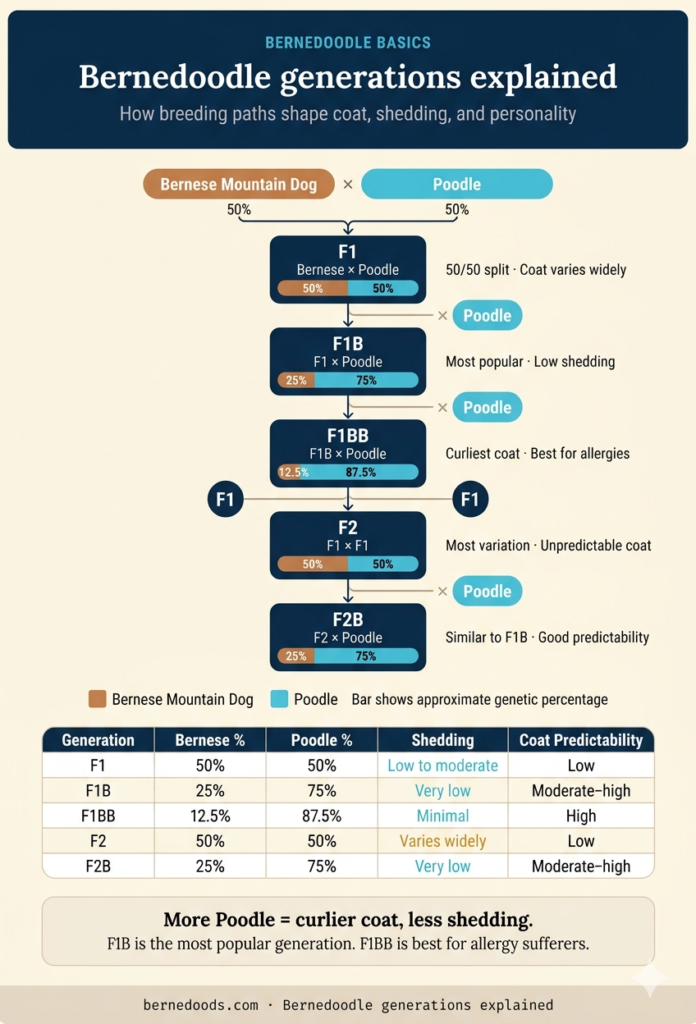
Generation describes how far removed a bernedoodle is from its purebred parents. It tells you the percentage of Bernese Mountain Dog versus Poodle in the mix, which directly affects coat type, shedding, and to some extent, temperament.
Breaking Down the Code
The “F” stands for “filial,” which just means “offspring.” The number tells you which generation of the cross you’re looking at. The “B” means “backcross”: the dog was bred back to a Poodle to increase the Poodle percentage.
Here’s what each generation actually means:
Generation Comparison Table
| Generation | Cross | Bernese % | Poodle % | Coat Predictability | Shedding |
|---|---|---|---|---|---|
| F1 | Bernese x Poodle | 50% | 50% | Low | Low to moderate |
| F1B | F1 x Poodle | 25% | 75% | Moderate to high | Very low |
| F1BB | F1B x Poodle | 12.5% | 87.5% | High | Minimal |
| F2 | F1 x F1 | 50% | 50% | Low | Varies widely |
| F2B | F2 x Poodle | 25% | 75% | Moderate to high | Very low |
| Multi-gen | Various | Varies | Varies | Highest | Breeder-dependent |
Why Generation Matters
Generation is the single biggest predictor of two things people care most about: how much the dog will shed and how allergy-friendly the coat will be.
More Poodle genetics means a curlier coat, less shedding, and less dander. That’s the simple version.
The more nuanced version: F1 bernedoodles often have the most balanced temperament, that classic blend of Bernese calm and Poodle smarts.
As you move toward higher Poodle percentages, some dogs lean more Poodle in personality too, which means they’re slightly more energetic, more alert, sometimes more independent.
Neither is better. It depends on what you’re looking for.
What About Australian and Ultra Bernedoodles?
You might also see breeders advertising Australian bernedoodles and ultra bernedoodles. These aren’t different generations. They’re different breed mixes.
An Australian bernedoodle introduces Australian Labradoodle into the cross, which adds Cocker Spaniel and Labrador genetics. An ultra bernedoodle typically adds Australian Shepherd. Both are aimed at refining specific traits like coat quality, temperament, or coloring.
They’re worth understanding if you encounter them, but they’re a different conversation from the standard generation chart above.
Coat Types & Colors Overview
The coat is a big part of why people fall in love with bernedoodles. That teddy-bear look, the color patterns, the fluffy factor. It’s a lot.
But bernedoodle coats aren’t just about aesthetics.
The type of coat your dog has determines how much they shed, how much grooming they need, and how allergy-friendly they’ll be.
Choosing a bernedoodle without understanding coat types is like buying a house without asking about the roof.
The Three Coat Textures
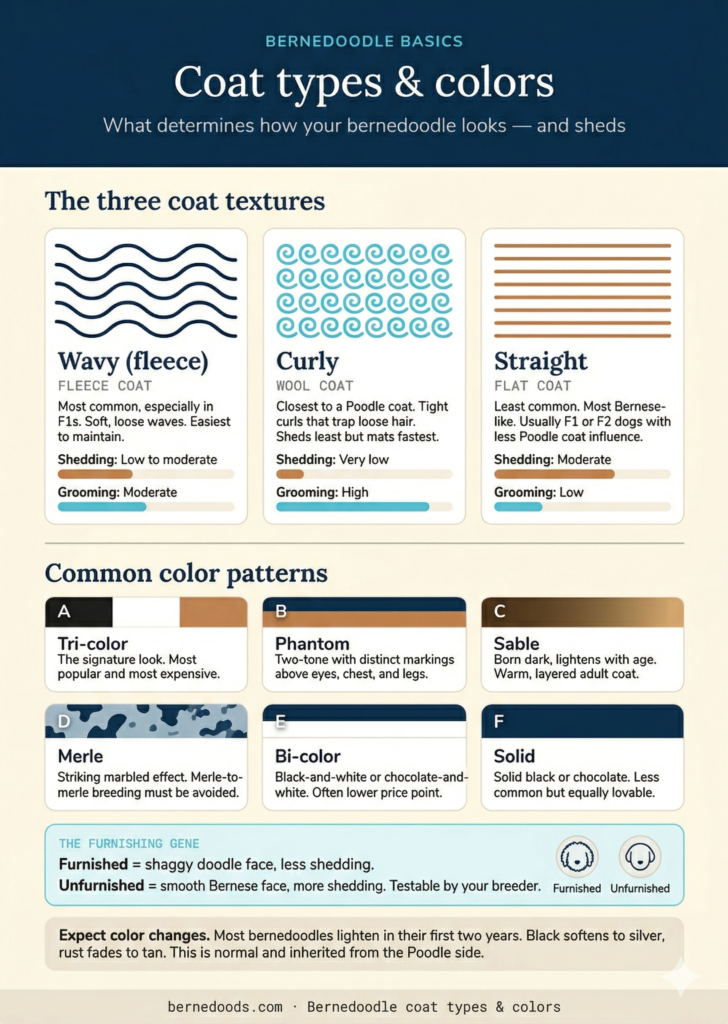
Every bernedoodle coat falls into one of three categories.
The Furnishing Gene
There’s one more coat variable that matters as much as texture: furnishings.
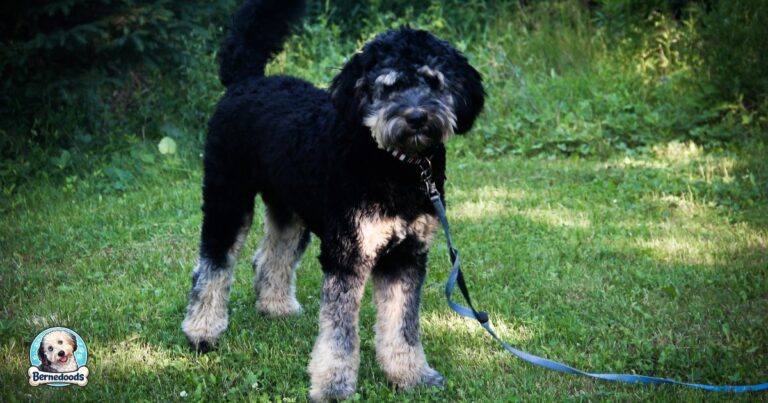
A furnished bernedoodle has the bearded, shaggy face that gives doodles their signature look. An unfurnished bernedoodle has a smoother, flatter face: more Bernese, less teddy bear.
Furnishings aren’t just cosmetic. Furnished dogs almost always shed less than unfurnished dogs, regardless of coat texture. The furnishing gene (IC Locus) can be tested for, and reputable breeders will know whether their puppies carry it.
Colors and Patterns
Bernedoodles come in a wide range of colors, and this is where the breed really shows off.
Color Fading Is Normal
Here’s something that surprises a lot of new owners: bernedoodle coats often change color as the dog matures.
Many bernedoodles lighten over their first two years, especially sable and phantom patterns. Black can soften to silver or gray. Rich rust can fade to a lighter tan. This is inherited from the Poodle side and is completely normal, but it’s worth knowing before you fall in love with a puppy’s coloring and expect it to stay exactly the same.
Do Bernedoodles Shed?
This is the question. It’s the most-searched bernedoodle topic on the internet, and the answer is more nuanced than most breeders’ websites will tell you.
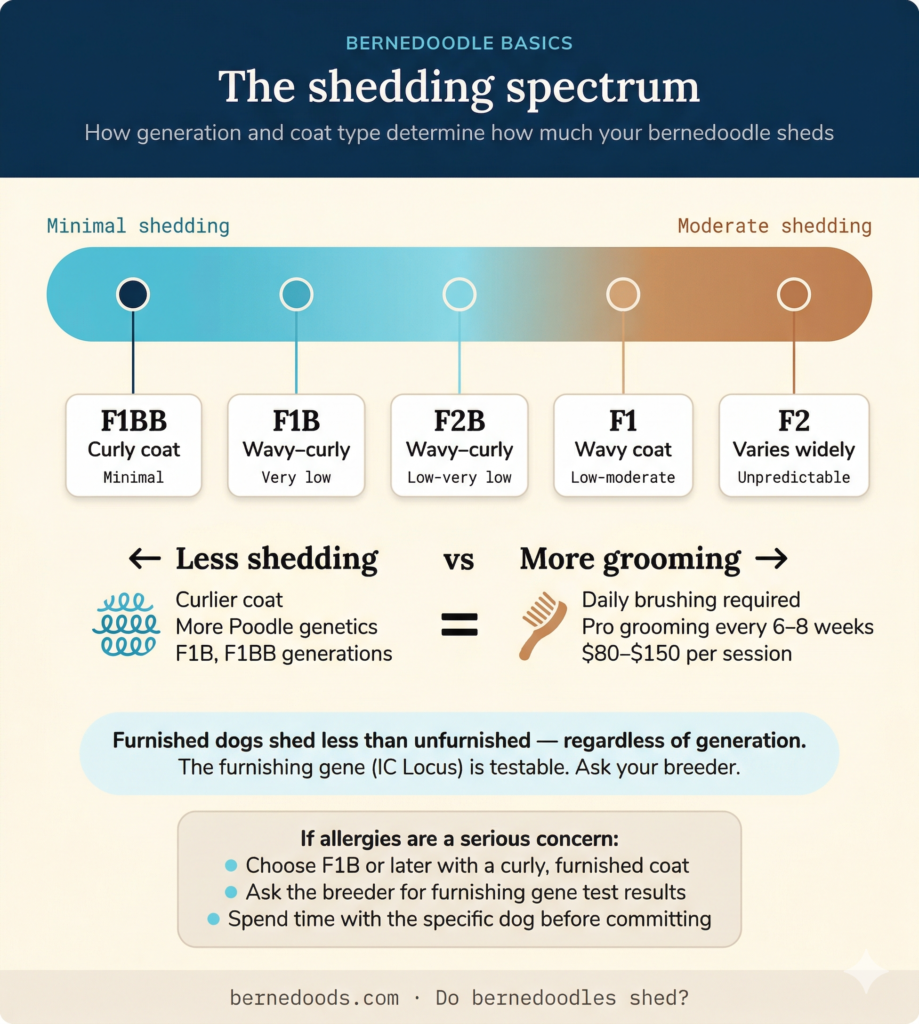
The short version: most bernedoodles shed less than most dogs. But “less” is not “none,” and the range is wide.
No Dog Is Truly Hypoallergenic
Let’s get this out of the way first.
The word “hypoallergenic” gets thrown around a lot in the doodle world, and it’s misleading. No dog breed is 100% hypoallergenic. Allergens come from dander, saliva, and urine, not just fur.
A dog that doesn’t shed can still trigger allergies.
That said, dogs that shed less spread less dander around your home. And bernedoodles with curly, Poodle-type coats produce and distribute significantly less dander than most breeds. For many allergy sufferers, that’s enough to make a meaningful difference.
Shedding Varies by Generation and Coat Type
This is where the generation chart from earlier becomes very practical.
The Furnishing Gene Matters Here Too
We covered furnishings in the coat section, but it’s worth repeating in the context of shedding: furnished bernedoodles shed significantly less than unfurnished ones.
An unfurnished bernedoodle (the ones with the smoother, more Bernese-like face) will shed more regardless of generation.
The furnishing gene is testable, and any breeder who claims their puppies are low-shedding should be able to confirm furnishing status.
The Grooming Tradeoff
Here’s the part that doesn’t make it into the Instagram captions.
Lower shedding means higher grooming demands. The same curly coat that keeps hair off your couch also mats and tangles if it’s not maintained. A curly-coated bernedoodle needs brushing every day or every other day. Not once a week, not “when you get around to it.”
On top of that, professional grooming every 6 to 8 weeks is standard. That’s a haircut, bath, nail trim, ear cleaning, and sanitary trim. Depending on your area and the dog’s size, expect to pay $80 to $150 per session.
It’s a real commitment, and it’s the number one thing new bernedoodle owners say they underestimated. If you want the low-shedding coat, you’re signing up for the grooming schedule that comes with it.
How Long Do Bernedoodles Live? Lifespan Overview
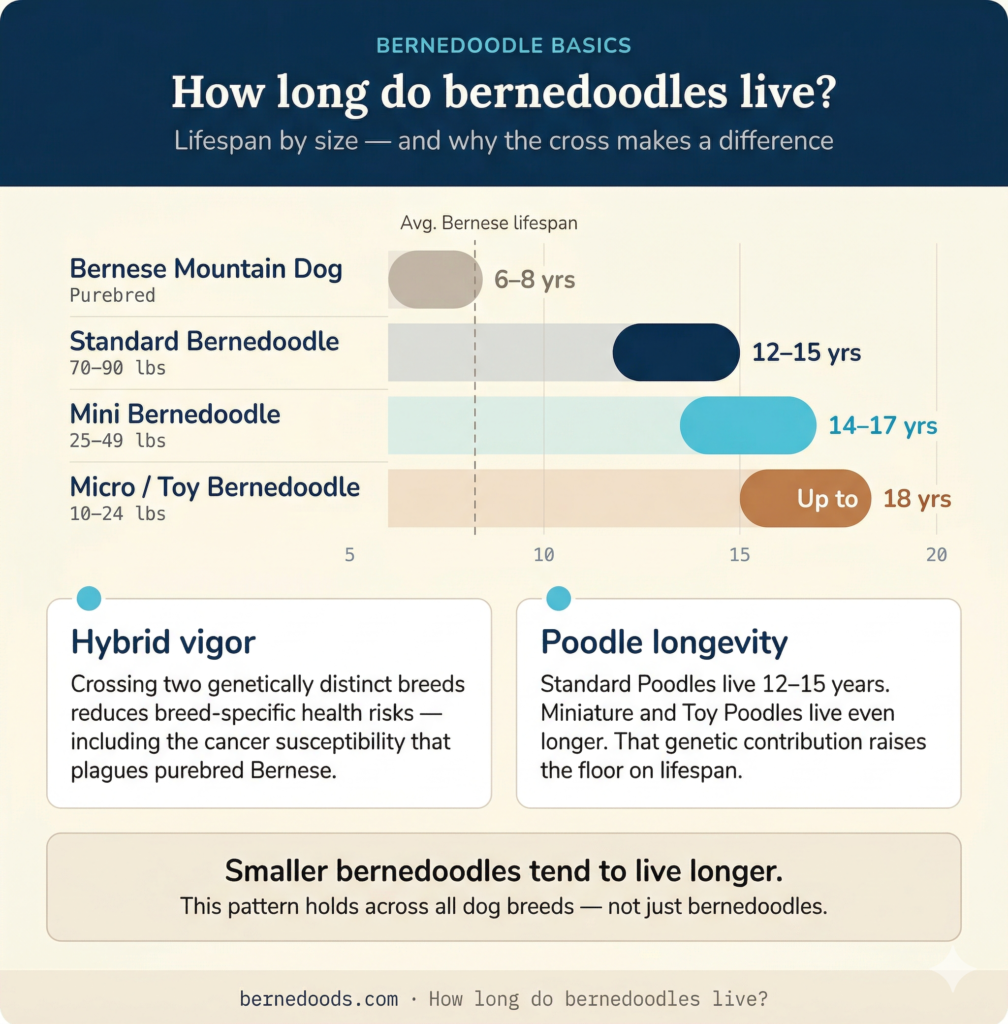
If you’ve ever loved a Bernese Mountain Dog, you know the heartbreak. Six to eight years is not enough time with any dog, and the Bernese’s short lifespan is the single biggest reason people look for alternatives.
This is where the bernedoodle offers genuine hope.
Lifespan by Size
Bernedoodle lifespans follow the same pattern seen across all dog breeds: smaller dogs tend to live longer.
What Affects an Individual Dog’s Lifespan?
Genetics set the range. Everything else determines where your dog lands within it.
An Honest Note on the Data
Bernedoodles are still a relatively young breed. The bernedoodle is only in its early twenties as a breed, meaning we don’t yet have decades of population-level lifespan data the way we do for established purebreds.
The ranges above are based on parent breed lifespans, early breeder data, and the general principles of hybrid vigor. They’re well-informed estimates, not guarantees.
As the breed matures and more longitudinal data becomes available, we’ll have a clearer picture.
For now, the evidence strongly suggests that bernedoodles outlive their Bernese parent breed by a significant margin, and that’s the number most prospective owners care about.
Are Bernedoodles Good Dogs?
Bernedoodles are wonderful dogs. They’re also not the right dog for everyone.
That’s not a knock on the breed: it’s true of every breed.
The difference is that bernedoodles are so photogenic and so heavily marketed on social media that people sometimes fall in love with the look before understanding what ownership actually requires.
This section is about helping you figure out if the reality matches what you’re hoping for.
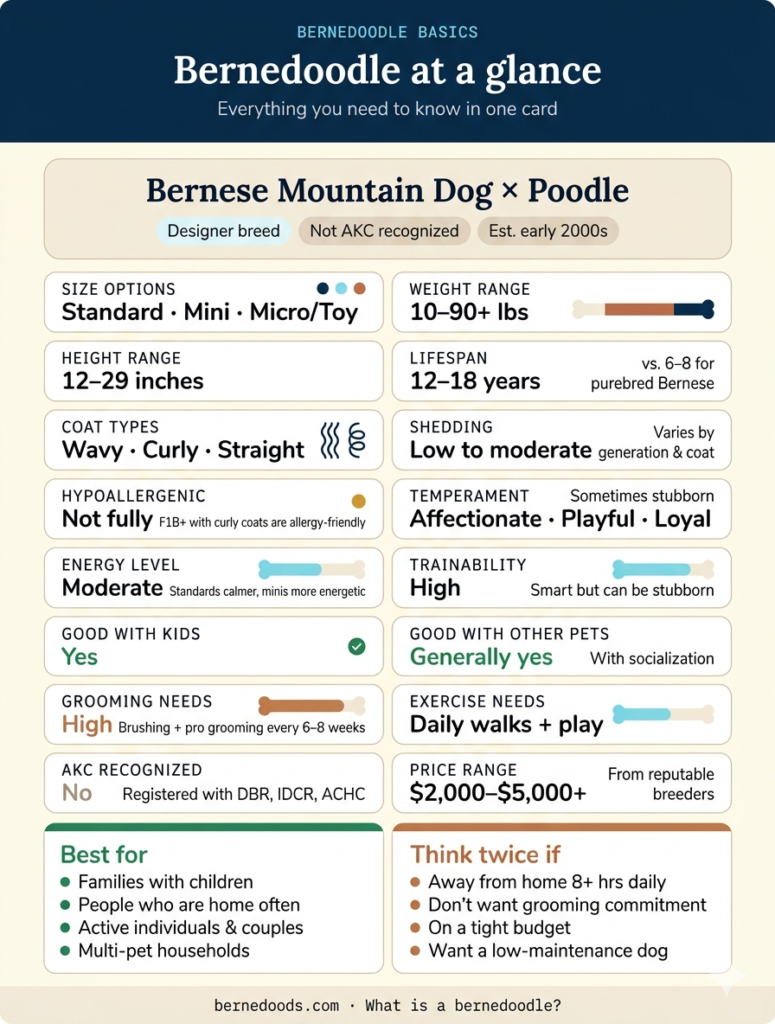
Bernedoodles Are a Great Fit For…
A Bernedoodle Might Not Be Right If…
Specific Lifestyle Questions
A few situations come up often enough to address directly.
The Bottom Line
If you have the time, the budget, and the willingness to stay on top of grooming, a bernedoodle will reward you with a level of loyalty and affection that’s hard to find in any breed.
If any of those pieces are missing, it’s worth having an honest conversation with yourself before bringing one home. The right dog in the wrong situation isn’t fair to either of you.
AKC Recognition Status
Bernedoodles are not recognized by the American Kennel Club. The AKC only registers purebred breeds, and as a hybrid cross, the bernedoodle doesn’t qualify.
This is not a reflection of the breed’s quality, health, or legitimacy. It simply means bernedoodles can’t compete in AKC conformation shows. For the vast majority of owners, that’s completely irrelevant.
Several other registries do recognize and track bernedoodles, including the Designer Breed Registry (DBR), the International Designer Canine Registry (IDCR), and the American Canine Hybrid Club (ACHC).
What matters more than registry papers is what a reputable breeder provides: health testing documentation for both parents, a puppy contract, a health guarantee, and transparency about the puppy’s generation, coat type, and expected size. Those documents tell you far more about your dog’s quality than any registration certificate.
Some breeders register the individual parent dogs with the AKC, which provides lineage documentation even though the bernedoodle offspring aren’t AKC-registered themselves. If pedigree tracking matters to you, ask your breeder whether the parents are AKC-registered.
Bernedoodle Breed Overview: Quick-Reference Table
| Trait | Details |
|---|---|
| Breed Type | Designer / hybrid (Bernese Mountain Dog x Poodle) |
| Size Options | Standard (70 to 90 lbs), Mini (25 to 49 lbs), Micro/Toy (10 to 24 lbs) |
| Height Range | 12 to 29 inches depending on size |
| Lifespan | 12 to 18 years depending on size |
| Coat Types | Wavy, curly, or straight |
| Shedding | Low to moderate (varies by generation and coat) |
| Hypoallergenic | Not fully, but F1B+ with curly coats are allergy-friendly |
| Temperament | Affectionate, playful, loyal, sometimes stubborn |
| Energy Level | Moderate (standards calmer; minis more energetic) |
| Good With Kids | Yes: gentle and patient |
| Good With Other Pets | Generally yes, with socialization |
| Trainability | High: smart but can be stubborn |
| Grooming Needs | High: regular brushing + professional grooming every 6 to 8 weeks |
| AKC Recognized | No |
| Price Range | $2,000 to $5,000+ from reputable breeders |
And that is the bernedoodle in all its floofy glory! Got more bernedoodle questions? We’ve got answers. Check out these related posts.
-
When Do Bernedoodles Calm Down? (Asking For A Friend)
If you’re reading this at 10pm after your bernedoodle ricocheted off the couch, stole something important, and is currently staring at you from across…
-
What Is An Australian Bernedoodle? (Including What It Is Not)
If you’ve been researching bernedoodles, you’ve probably run into the term “Australian bernedoodle” and wondered if it’s a different breed, a marketing upgrade, or…
-
Micro & Toy Bernedoodles: The Smallest Sizes Explained
You’re looking at two breeder websites. One says micro bernedoodles weigh 10 pounds. The other says 30. Both are using the same word. This…
-
How Big Do Mini Bernedoodles Get?
If you’re here, you probably fall into one of two camps. You’re either shopping for a mini bernedoodle and trying to figure out what…
-
How Big Do Bernedoodles Get? That Is The Million Dollar Question.
If you’ve spent any time on breeder websites trying to figure out how big a bernedoodle actually gets, you’ve probably noticed that the numbers…
-
Do Bernedoodles Bark a Lot? An Honest Look at Noise Levels
You’re researching bernedoodles and you want to know what your neighbors are in for. Fair question. Barking is one of those breed traits that…