What Is An Australian Bernedoodle? (Including What It Is Not)
If you’ve been researching bernedoodles, you’ve probably run into the term “Australian bernedoodle” and wondered if it’s a different breed, a marketing upgrade, or something with Australian Shepherd in it.
It’s a real cross with a real genetic difference, but the “Australian” part has nothing to do with Australian Shepherds. An Australian bernedoodle is a bernedoodle (Bernese Mountain Dog × Poodle) crossed with a multi-generational Australian Labradoodle. That second parent is what makes the difference, and understanding what an Australian Labradoodle actually is unlocks everything else about this breed.
Here’s the full breakdown.
Australian Bernedoodle Quick Facts
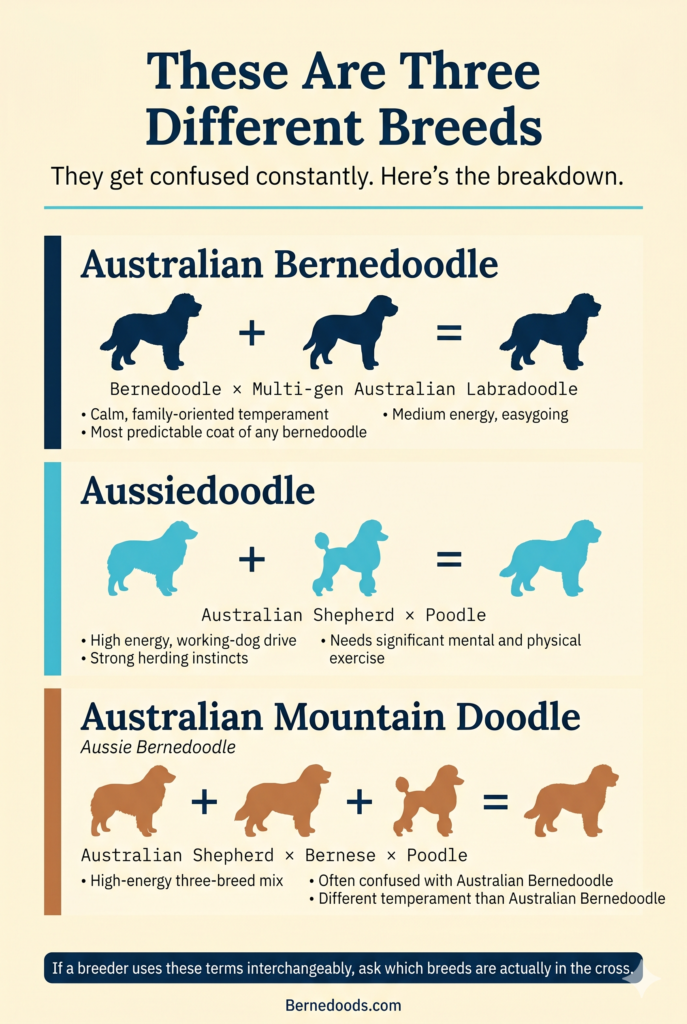
It’s Not an Aussiedoodle
This is the single most common confusion with the breed. Even within bernedoodle owner communities, people regularly buy dogs without knowing exactly which cross they have, and the terminology gets used loosely across breeders and websites.
There is no Australian Shepherd in an Australian bernedoodle.
The “Australian” refers to the Australian Labradoodle parent, which was developed in Australia in the late 1980s. Three different breeds get tangled up under similar names:
If you’re cross-shopping and the breeder uses any of these terms interchangeably, ask exactly which breeds are in the cross. Getting this wrong can mean ending up with a much higher-energy working-breed mix than you expected.
What Makes It “Australian”? The Australian Labradoodle Explained
To understand the Australian bernedoodle, you need to understand the Australian Labradoodle. It’s not what most people assume.
It’s Not a Lab × Poodle
The standard American Labradoodle is a Labrador Retriever crossed with a Poodle. The Australian Labradoodle is something different.
Originally developed in 1989 by Wally Conron at the Royal Guide Dog Association of Australia, the breed started as a Lab × Poodle cross designed to create an allergy-friendly service dog.
Over the following decades, breeders at Tegan Park and Rutland Manor in Australia infused additional breeds into the line to refine coat, size, and temperament. Today’s multi-generational Australian Labradoodle is a careful mix of Poodle,
Labrador Retriever, and Cocker Spaniel, often with Irish Water Spaniel and other infusions in older lines.
That’s a lot of breeds. Which is exactly the point.
Why “Multi-Gen” Matters
A multi-generational Australian Labradoodle is one whose parents are both Australian Labradoodles, and whose lineage traces back several generations of Australian Labradoodle to Australian Labradoodle breeding.
This matters because of a concept called genetic stability.
When you breed two F1 doodles together, you get unpredictable coat outcomes. When you breed two well-established multi-gen Australian Labradoodles together, the coat genetics are stable enough that the puppies look like the parents.
A 2020 peer-reviewed genetic analysis using over 150,000 DNA markers confirmed that modern Australian Labradoodles are largely fixed for the furnishing gene that produces the classic doodle face and low-shedding coat.
In plain terms: when an Australian Labradoodle parent is crossed with a bernedoodle, you can predict what the puppies will look like. With a standard Poodle parent, you can’t always.
What Each Breed Contributes
| Breed | What It Brings |
|---|---|
| Bernese Mountain Dog | Calm temperament, tri-color genetics, sturdy build |
| Poodle | Intelligence, low-shedding coat, longevity |
| Labrador Retriever | Friendliness, trainability, athleticism |
| Cocker Spaniel | Smaller size, soft expression, gentleness |
Australian Bernedoodle vs. F1 Bernedoodle
The biggest practical difference is coat predictability. An F1 bernedoodle is a coat lottery, especially within a single litter. An Australian bernedoodle, when bred from a true multi-gen Australian Labradoodle, isn’t.
Here’s the full comparison.
| Feature | F1 Bernedoodle | Australian Bernedoodle |
|---|---|---|
| Cross | Bernese × Poodle | F1 Bernedoodle × Multi-gen Australian Labradoodle |
| Breeds in mix | 2 | 4–6 |
| Coat predictability | Low (varies within litter) | High (mostly furnished) |
| Shedding | Low to moderate | Low (most consistent) |
| Build | More Bernese-like, sturdier | Lighter, often wispier |
| Size variety | Standard, mini, micro | Standard, mini, micro |
| Temperament | Bernese calm + Poodle smart | Similar, with added Lab/Spaniel softness |
| Availability | Widely available | Less common, fewer breeders |
| Typical price range | $2,500–$5,000 | $2,500–$5,000 (similar) |
The main takeaway is coat. If you’re allergy-sensitive or want minimal shedding, an Australian bernedoodle from a furnishing-tested breeder gives you better odds than an F1.
The temperament differences are smaller than breeders sometimes claim. Both breeds are intelligent, family-oriented, and affectionate.
The Australian Labradoodle parent may add a small bump in confidence and trainability thanks to its service-dog heritage, but the difference between a well-bred F1 and a well-bred Australian bernedoodle from the same breeder is rarely dramatic.
The build is genuinely different.
Australian bernedoodles often look lighter and wispier than F1s, which tend toward the stockier Bernese frame. If you’ve seen one in person and thought “that doesn’t look like a typical bernedoodle,” that’s why.
How Big Do Australian Bernedoodles Get?
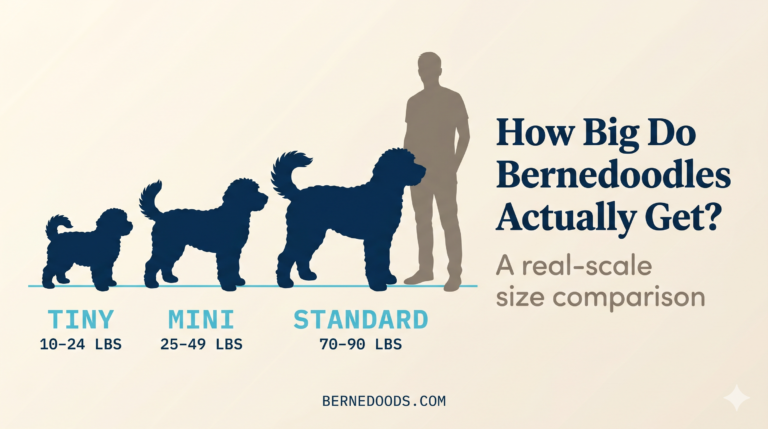
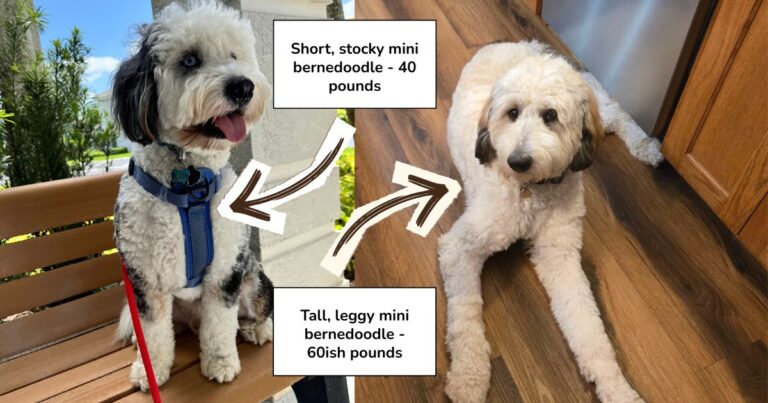
Australian bernedoodles come in three size categories, ranging from about 10 pounds at the smallest to 70+ pounds at the largest. They tend to land slightly smaller than standard bernedoodles because the Australian Labradoodle parent is itself a medium-sized breed rather than a giant one.
| Size | Weight | Height | Best For |
|---|---|---|---|
| Micro/Petite | 10–24 lbs | 12–17 in | Apartments, lap companions |
| Mini/Medium | 25–49 lbs | 17–22 in | Most families, balanced choice |
| Standard | 50–70+ lbs | 22–27 in | Active families, more space |
You’ll rarely see Australian bernedoodles cross 80 pounds, which is fairly common in standard bernedoodles bred from a Bernese and a Standard Poodle. The Australian Labradoodle parent caps the upper size range.
For a complete breakdown of bernedoodle sizing, see our full size guide. For mini-specific size data, our mini bernedoodle article covers what to expect.
Coat, Color & The Furnishing Gene
This is where Australian bernedoodles genuinely earn their reputation. The coat outcomes are more predictable than F1 bernedoodles, and the reason has to do with one specific gene.
Why the Coats Are More Predictable
The furnishing gene controls whether a dog has the classic doodle face: the beard, mustache, and eyebrows. It also strongly correlates with low shedding. Furnished dogs shed significantly less than unfurnished ones, regardless of whether the coat texture is curly, wavy, or straight.
In F1 bernedoodles, furnishing inheritance is a coin flip. In multi-gen Australian Labradoodles, it’s nearly fixed. That means when you cross a bernedoodle with a multi-gen Australian Labradoodle, the puppies are far more likely to inherit furnishings than they would be in a standard bernedoodle litter.
This is the legitimate scientific case for choosing an Australian bernedoodle. It’s not marketing. The genetics back it up.
The Three Coat Types
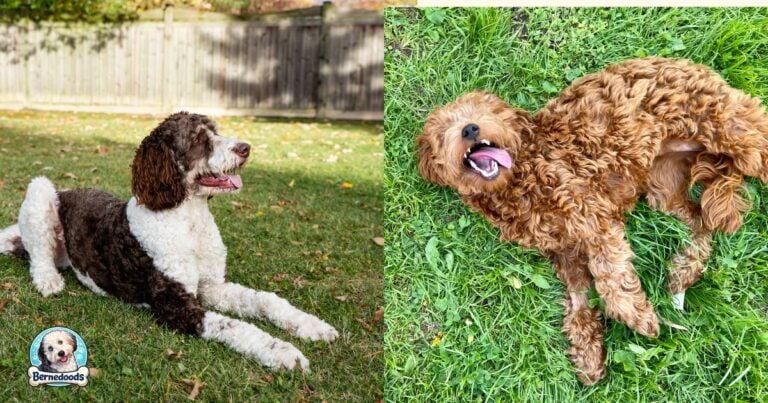
Australian bernedoodles can have any of three coat textures. With proper furnishing, all three shed minimally.
The straight-and-furnished combination is the one that surprises people. A straight-coated Australian bernedoodle can still be a low-shedding dog, which isn’t usually the case with a straight-coated F1.
Colors
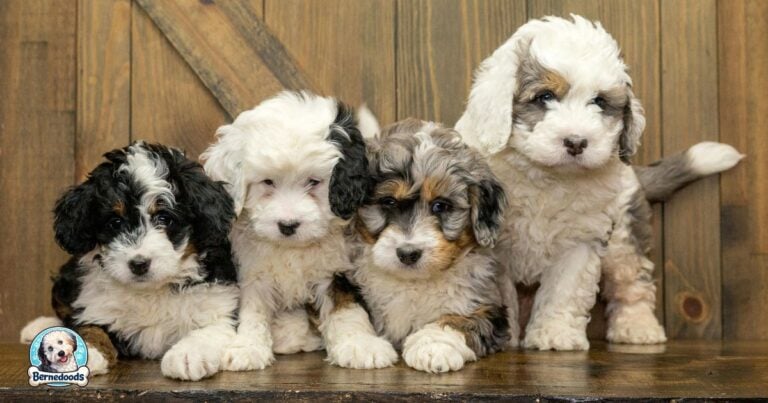
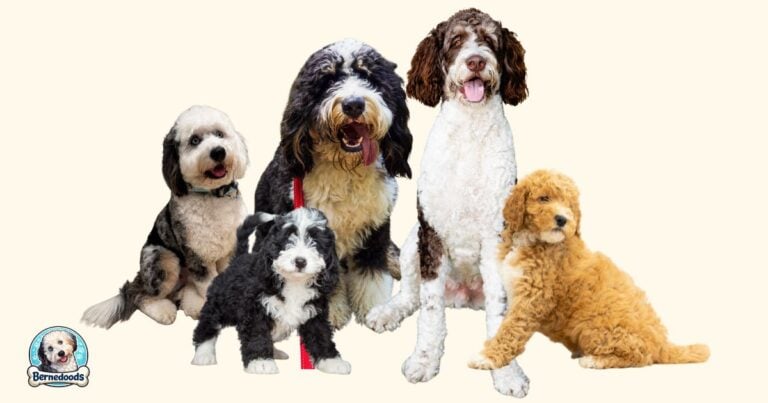
Australian bernedoodles come in the same colors as standard bernedoodles: tri-color, phantom, merle, sable, bi-color, and solid variants. The Australian Labradoodle parent sometimes introduces “splashy” or tuxedo-style markings that are less common in F1s.
Temperament & Energy
Australian bernedoodles share most temperament traits with standard bernedoodles. They’re affectionate, loyal, intelligent, and family-oriented. The Australian Labradoodle parent adds a bit more confidence and social adaptability, traits selected for during the breed’s service-dog development.
If you’ve read accounts of doodles with strong herding instincts, intense barking, or high working-dog energy, you’re probably reading about Aussiedoodles or Australian Mountain Doodles.
The Australian Labradoodle parent in an Australian bernedoodle was bred from service-dog stock, not herding stock. The behavioral profile is calmer, not more intense.
What experienced owners say: “It really depends on the temperament. I have some that are gentle and sweet and some that are anxious and more stubborn. Finding a breeder that does temperament testing and genetic testing is so important.” — Bernedoodle owner, Bernedoodle Owners Group
Spend time in bernedoodle owner communities asking about Australian vs. F1 differences and a pattern emerges.
Experienced owners and breeders consistently point back to breeder quality, temperament testing, and individual puppy personality as the real predictors of how a dog turns out. The Australian vs. F1 question matters less than people expect.
Energy level is generally moderate. Less mellow than a pure Bernese, less drive-focused than a working Lab line. Most are happy with a daily walk plus some play.
How Much Do Australian Bernedoodles Cost?
Australian bernedoodles from reputable U.S. breeders typically cost $2,500–$5,000, which is roughly the same range as standard bernedoodles. The “Australian” designation by itself isn’t a price premium tier.
What actually drives Australian bernedoodle pricing:
If a breeder is charging significantly more for an Australian bernedoodle than they’d charge for an F1 of equivalent size and color, ask them what specifically justifies the difference. The “Australian” label alone isn’t an answer.
Worth Asking a Breeder
Is “Australian” a Meaningful Distinction or a Marketing Label?
It’s both, depending on what’s being claimed.
What’s real: Coat predictability. The genetic case is solid. Multi-gen Australian Labradoodles are reliably furnished, which means Australian bernedoodle puppies inherit low-shedding coats far more consistently than F1 bernedoodles do. The build differences are also genuine. Australian bernedoodles look lighter and wispier than F1s.
What’s oversold: Claims that Australian bernedoodles are categorically smarter, calmer, healthier, or longer-lived than standard bernedoodles. Both breeds are too young to have meaningful population-level data on lifespan or health outcomes. Temperament differences exist but are dwarfed by individual variation, breeder quality, and how the puppy is raised.
What it means for buyers: If coat predictability is your top priority, especially if anyone in your household has allergies, an Australian bernedoodle from a furnishing-tested breeder is a reasonable choice. The smaller breeder pool is a real tradeoff, but the coat advantage is genuine. If you’re paying significantly more for “Australian” without the breeder being able to explain exactly what that buys you, you’re paying for the label.
The Bottom Line
The Australian bernedoodle isn’t a fundamentally different breed from a standard bernedoodle. It’s a different cross with one strong advantage and several overstated ones. The strong advantage is coat predictability. The overstated ones are temperament, intelligence, and lifespan, where individual variation and breeder quality matter far more than the cross type.
For some families, especially those navigating allergies, the coat advantage is worth the smaller pool of breeders to choose from. For others, an F1 bernedoodle from a thoughtful breeder will be functionally identical with more options to choose from.
The most important question isn’t Australian vs. F1. It’s whether you’ve found a breeder you trust.