Bernedoodles Are Great Dogs. They’re Also Not for Everyone.
You’ve seen the Instagram photos. You’ve read the glowing breeder sites. You’ve also seen the rescue posts, the “what have I done” threads, and the friend-of-a-friend whose bernedoodle chewed through a baseboard.
You’re trying to figure out whether a bernedoodle will actually be a good dog for your life, and the internet keeps giving you two versions of the answer. Both oversimplified.
Here’s the honest one. Bernedoodles are genuinely wonderful dogs. They’re also not right for a meaningful percentage of the people who want one.
Our goal is to help you figure out which group you’re in, not to talk you into a bernedoodle or talk you out of one.
What “Good Dog” Actually Means
“Good dog” is doing too much work in most articles about this breed. When someone asks whether bernedoodles are good dogs, they’re usually asking some combination of four different questions without knowing it.
The answer to “are bernedoodles good dogs” depends on which of those four you’re asking. The rest of this article takes them one at a time.

The Temperament Baseline: A Clean Yes
On the question of whether bernedoodles are safe, stable, gentle, and trainable, the answer is a clean yes for almost every household.
Both parent breeds contribute temperament traits that stack well.
The Bernese Mountain Dog is famously gentle, patient, and people-focused, one of the calmest of the large working breeds. The Poodle brings high intelligence and emotional stability. Together, you get a dog that reads social cues well, settles around children, and handles new environments without falling apart.
Bernedoodles are not an aggressive breed and they’re not guard dogs. Most bernedoodles would greet a burglar with a wagging tail and a toy.
They alert-bark at the door and might position themselves protectively when something feels off, but the instinct to protect rarely escalates beyond that. For most families, this is a feature, not a bug.
There’s one temperament nuance worth flagging: the stubborn streak. Bernedoodles pick up commands quickly, but owners consistently describe them as selectively cooperative.
They know the command. They just don’t always feel like doing it. This isn’t a safety concern. It’s a training-style concern, and it’s inherited from the Bernese side. Positive reinforcement works. Harsh correction backfires. Consistency matters more than volume.
The caveat that applies to every temperament claim: it assumes the dog is well-bred and properly socialized. Poor breeding produces fearful, anxious, or reactive bernedoodles (the kind that need medication or specialized training). This is preventable, and we’ll cover how to avoid it later in this article.
The Lifestyle Fit Question (Where It Gets Complicated)
This is where most “is a bernedoodle a good dog” questions actually live. And this is where the answer turns into “it depends.”
A few specific factors determine whether a bernedoodle will fit your life. Some matter more than others, but all of them matter.
Are You Home A Lot?
This is the single biggest factor. More than size, more than generation, more than grooming commitment.
Eight or more hours alone, five days a week, is a genuine dealbreaker for this breed. Bernedoodles were bred to be near their people, and separation anxiety is the most commonly reported behavioral issue across owner communities.
It’s not that some bernedoodles struggle with alone time. It’s that the breed as a whole does, and a meaningful number develop anxiety severe enough to require management or medication.
If you work from home, have a flexible schedule, are retired, or have a partner home during the day, this factor works strongly in your favor. If you’re a commuter with a full in-office schedule, this is the question that should give you pause. Doggy daycare, walkers, and training can help, but you’re working against the grain of the breed.

Can You Afford A Heavy Grooming Commitment?
Daily or every-other-day brushing is the reality for curly and wavy coats. Not once a week. Not “when you get around to it.” Some owners report spending up to 30 minutes a day keeping their dog mat-free. That’s probably on the high end, but it’s a real possibility, especially if you want to keep the coat long.
On top of the brushing, professional grooming every 6–8 weeks runs $80–150 per session depending on your area and the dog’s size. That covers a haircut, bath, nail trim, ear cleaning, and sanitary trim. For the life of the dog.
This is the single thing new bernedoodle owners say they underestimated. If daily brushing and a recurring grooming appointment sounds like too much, a bernedoodle will be a source of frustration rather than joy.
Do You Have Enough Space?
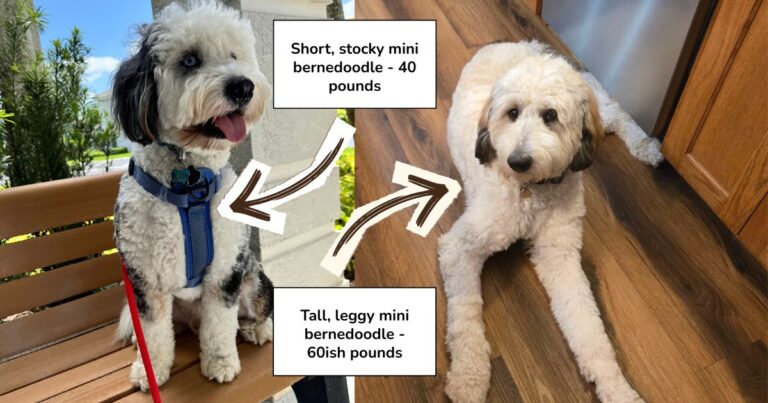
Size matters here, but less than you’d think. Standards need more room than minis, though not necessarily a fenced yard. Minis can do well in smaller living spaces like apartments with enough daily exercise.
Activity level sits in a specific middle range. Bernedoodles need daily exercise: a solid walk, some play, ideally a chance to explore off-leash somewhere safe.
But they’re not marathon dogs. They’re not the breed to take on an ultra. If you’re looking for a high-energy running partner, you’ll be disappointed. If you’re looking for a dog to take on weekend hikes and sprawl on the couch the rest of the time, you’ve found the right breed.
What Is Your Household Like?
Bernedoodles are gentle with children and generally do well with other pets when properly socialized. Standards are sturdy enough for toddler chaos. Minis are a better size match for older kids who want to help walk and care for the dog.
One thing worth knowing: bernedoodles sometimes form an especially strong bond with one household member, even in a family that spreads attention evenly.
If you have a kid who has been begging for a dog for two years and wants this dog to be their dog, there’s no guarantee it’ll play out that way.
The dog may pick the parent who feeds it, or the grandparent who visits on weekends, or no one in particular. Worth preparing kids for that possibility.
For allergy sufferers, an F1B generation with a curly coat is typically the safest starting point, though no dog is fully hypoallergenic. Spend time with the specific puppy before committing.
Can You Afford A Bernedoodle?
Bernedoodles are not an inexpensive breed to own.
Purchase price from a reputable breeder runs $2,000–$5,000+, with tri-color and mini or micro sizes at the higher end. Grooming adds up, often $500–$1,500 a year depending on size and whether you maintain the coat yourself between appointments.
Food costs scale with size; a 90-pound standard eats a lot more than a 30-pound mini. Routine vet care is standard.
The part most articles skip: bernedoodles are among the breeds vets specifically recommend pet insurance for. They eat things they shouldn’t (socks, remotes, underwear, wood) and foreign-body surgeries happen often enough that it’s worth planning for.
Food sensitivities like chicken, which shows up repeatedly in owner reports, and skin allergies are also common enough to budget around.
Our mini bernedoodle, Max, has had nearly all of the above. He has food sensitivities and caught pneumonia (we did not know dogs could even get that) at five months and had to be hospitalized. Without insurance, we would’ve been out about $4,000.
One cost-adjacent note that works in the breed’s favor: bernedoodles live meaningfully longer than Bernese Mountain Dogs, which is often the reason people look at the breed in the first place. Standards typically live 12–15 years. Minis push that to 14–17.
Are You Prepared For A Long Puppy Stage?
This deserves its own beat because it’s the thing owners most wish they’d understood going in.
Bernedoodles have a long puppyhood. Owners consistently report a rough two-year arc: things settle meaningfully around age 2 and really settle around age 3. This has been our experience. Our 20-month-old mini bernedoodle is still very much in puppy mode, though he’s getting a little calmer.
For the first 6–9 months, expect the “shark phase,” the universal teething mouthiness that owners variously call sharkadoodle, land shark, or little dinosaur. It passes. Every owner will tell you it passes.
Going in expecting an adult dog from month one is how people end up miserable. Going in expecting a toddler for two years (complete with chaos, energy, and the occasional chewed-up baseboard) is how people end up better prepared.
Bernedoodles Make Excellent Companions
Once you get past the puppy stage, a well-matched bernedoodle is one of the most rewarding dogs to live with. This is the part that’s hard to convey in a pros-and-cons list, because the real payoff is specific.
One honest note: not every bernedoodle is cuddly. A meaningful minority prefer to be near you rather than on you. If the specific image you have in your head (head on your lap, stays there for an hour, doesn’t move) is a non-negotiable, that’s not guaranteed with this breed.
Some owners get exactly that dog. Others get a dog who’s affectionate but independent, who wants to be in the same room but not on the same cushion. Both are normal.

When a Different Dog Would Serve You Better
Sometimes the honest answer is “get something else.” Here’s when.
How to Maximize Your Chances of Getting a Good One
You can materially increase your odds of ending up with a bernedoodle who fits your life. Here’s what matters.
Choose a breeder who does temperament testing. Not coat color. Not gender. Temperament. Good breeders evaluate individual puppy behavior in the first 8 weeks and match puppies to households based on what they see. Ask specifically whether the breeder does this, and ask what they observed about the specific puppy they’re placing with you.
We cannot stress this enough. In full transparency, we did not do our fullest due diligence before getting Max, and we think it may be why he is so anxiety-riddled.
Meet the parents, or at minimum the mother. Temperament is heritable. A nervous or reactive mother often produces nervous or reactive puppies. If you can’t visit in person, ask for video of the parents interacting with people and other dogs.
Ask which puppy is calmest. Don’t pick the cutest. Don’t pick based on color. Ask the breeder which puppy they’d match with a family looking for a mellow companion, and ask for video of that specific puppy’s behavior.
Budget for real training. Bernedoodles are smart enough to train themselves into bad habits if you’re not intentional. A first-year investment in a trainer or group classes pays compounding returns across the entire life of the dog.
The Bottom Line
Yes, bernedoodles are good dogs. The more useful question is whether a bernedoodle is a good dog for your life.
For the right household (home most of the day, willing to commit to daily grooming, patient through a two-year puppyhood, ready to pour real effort into training) a bernedoodle is as rewarding a dog as exists. They’re affectionate, goofy, smart, gentle with kids, and bonded to their people in a way that’s genuinely special. For the wrong household, they’re a source of frustration, and the rescue networks are full of dogs whose owners underestimated what they were signing up for.
If the quiz returned a strong-fit result, the next step is learning how to choose a breeder before you put down a deposit.
A workable-with-adjustments result means thinking honestly about whether you can solve the specific friction point before committing.
And if the answer was probably-not-the-right-breed, take that seriously. There are better-fitting breeds for almost every situation where a bernedoodle doesn’t work, and that’s totally okay!