Micro & Toy Bernedoodles: The Smallest Sizes Explained
You’re looking at two breeder websites. One says micro bernedoodles weigh 10 pounds. The other says 30. Both are using the same word.
This is the problem with micro and toy bernedoodles. The dogs are real. The size labels are not.
There’s no kennel club standard, no breed registry enforcing terminology, and no agreement among breeders about what “micro,” “toy,” “teacup,” or “petite” actually mean.
Everyone’s making it up as they go. We’ll sort through the chaos, tell you what these dogs actually weigh, and give you the questions to ask a breeder so you end up with the size you were expecting. For the full picture on the breed, see our complete bernedoodle guide.
How Big Do Micro & Toy Bernedoodles Get?
Micro/Toy Bernedoodle Quick Size Breakdown
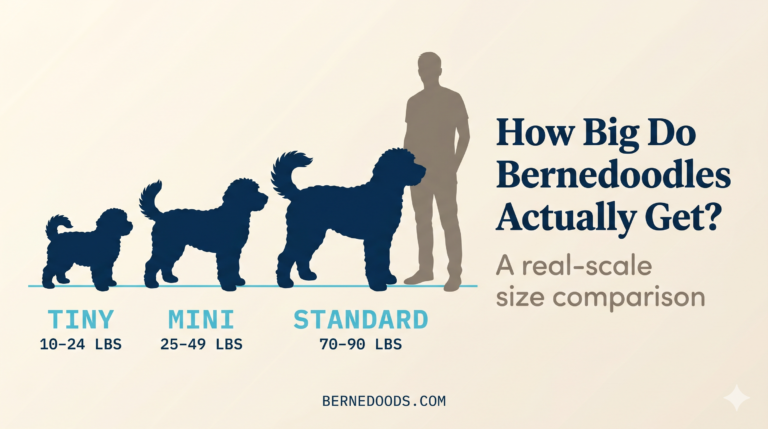
Micro and toy bernedoodles are the smallest size category in the breed. Most mature between 10 and 25 pounds and stand 12 to 17 inches tall at the shoulder. They’re typically produced by crossing a smaller F1B mini bernedoodle with a Toy Poodle, rather than breeding a Bernese Mountain Dog directly to a small Poodle.
The range is wide because these dogs are less predictable than minis or standards. A 12-pound adult and a 24-pound adult can come from the same category, and sometimes from the same litter.

Micro, Toy, Teacup, Petite: Why the Labels Don’t Agree
Generally speaking, these terms are marketing, not breed standards.
No kennel club recognizes micro or toy bernedoodles as official categories. The American Kennel Club doesn’t register any bernedoodle, regardless of size. That means every breeder gets to define their own sizing labels, and they do.
Browse five breeder websites and you’ll see five different definitions:
- One breeder’s “micro” is 10–15 pounds
- Another breeder’s “micro mini” is 15–30 pounds
- A third breeder uses “petite” to describe a 20–30 pound dog
- A fourth breeder calls their smallest option a “teddy bear” bernedoodle
- And nearly all of them use “micro” and “toy” interchangeably
This isn’t necessarily dishonest. It’s just unregulated. But it means the category name on a breeder’s website tells you very little about what the dog will actually weigh.

What the Common Labels Usually Mean
What to Ask Instead
Labels won’t give you the full picture. When you’re talking to a breeder, ask:
Questions to Ask the Breeder
A reputable breeder will answer all four questions without hesitation. Any answer that starts with “usually” or “around” without specific numbers is a sign you’re shopping at the wrong place.
Micro & Toy Bernedoodle Growth Chart by Age
Micros follow a faster growth curve than minis or standards. They do most of their growing in the first four months and finish filling out by around eight to ten months.
| Age | Expected Weight |
|---|---|
| 8 weeks | 2–4 lbs |
| 12 weeks | 4–8 lbs |
| 16 weeks | 6–12 lbs |
| 6 months | 8–18 lbs |
| 8 months | 9–22 lbs |
| 10 months | 10–24 lbs |
| Adult | 10–25 lbs |
These are averages. Individual dogs will land above or below these ranges, and the multi-gen breeding that produces micros makes variation especially common.
Why Micro Sizes Are Harder to Predict
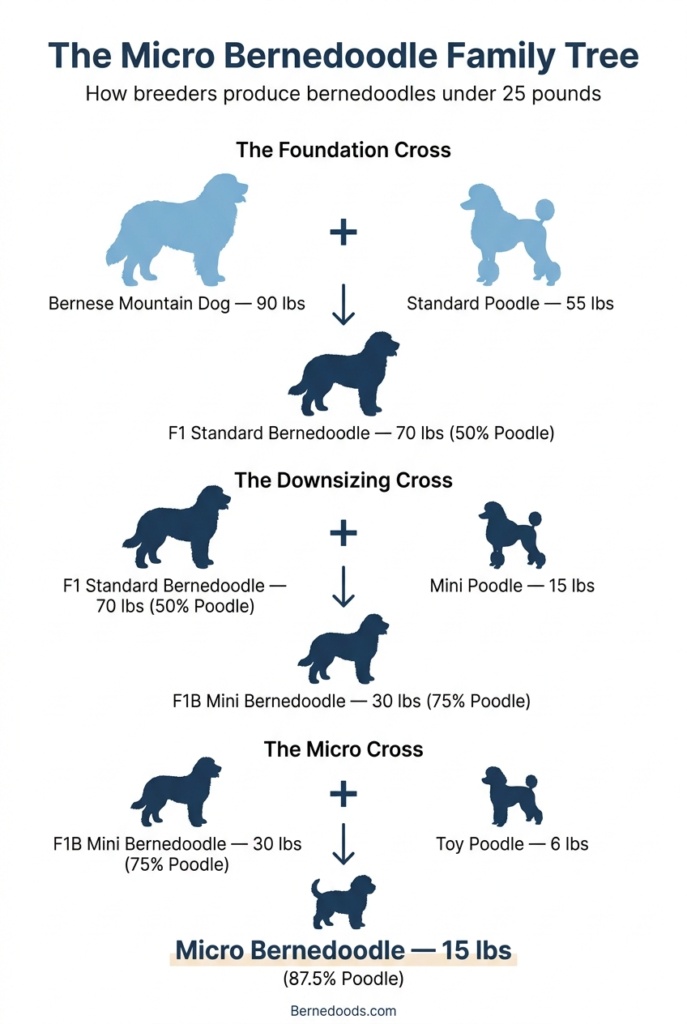
A direct cross between a Bernese Mountain Dog and a Toy Poodle isn’t realistic. A 90-pound Bernese bred to a 6-pound Toy Poodle is a size mismatch that doesn’t work physically or genetically.
So how do breeders produce a 15-pound bernedoodle? Through generations of downsizing.
A typical micro bernedoodle is an F1B or multi-gen cross: a Mini Poodle bred to a bernedoodle, then that offspring bred to another small poodle, and so on. Each generation adds more Poodle genetics and shrinks the average size.
The tradeoff is predictability.
The more generations you stack, the more room there is for genetic variation. A litter of F2B micro bernedoodles can produce puppies ranging from 12 pounds to 28 pounds, all from the same parents.
(Be mindful, though, that those Bernese genetics are still in there.)
How to Estimate Your Micro’s Adult Size
The standard rule for predicting adult weight in smaller bernedoodles is the 16-week double: weigh your puppy at 16 weeks, double that number, and you’ll have a rough estimate of their adult weight.
Quick math: Micro at 16 weeks is 8 lbs → expect 16 lbs as an adult (minus about 1 lb for final fill-out).
For micros specifically, the 16-week rule works slightly better than it does for minis because micros finish growing earlier. A micro bernedoodle has usually done 70–80% of their growing by 16 weeks. By contrast, a mini still has noticeable filling out to do until around 12 months.
The rule isn’t perfect. It gives you a range, not a guarantee. But it’s more reliable than trusting a breeder’s category label.
The Health Tradeoff
Smaller bernedoodles come with a different set of health considerations than their larger cousins.
The good news: smaller dogs generally live longer. Micro and toy bernedoodles can live 15 to 18 years, compared to 12 to 15 for standards. That’s meaningful extra time.
The tradeoff: small dogs inherit small-dog health issues. Micro bernedoodles can be more prone to patellar luxation (kneecap problems), dental crowding in their small jaws, and hypoglycemia in young puppies. These risks are manageable with good breeding and veterinary care, but they’re real and worth knowing about.
Who a Micro or Toy Bernedoodle Is Actually Right For
Micros and toys aren’t a smaller version of a standard. They’re a different kind of dog for a different kind of home.
They may be less ideal for families with small children.
Frequently Asked Questions
1. Are micro and toy bernedoodles the same thing?
Usually yes, though the terms aren’t officially defined. Most breeders use “micro” and “toy” interchangeably to describe bernedoodles in the 10–25 pound range. Some reserve “toy” for the smallest end (under 15 pounds) and “micro” for slightly larger. Ask the breeder what they mean by the term.
2. What’s the smallest bernedoodle?
The smallest bernedoodles are typically 10–12 pounds as adults. Anything advertised as smaller than that is either the runt of a litter or a “teacup” dog bred for extreme smallness, which carries real health risks.
3. How long do micro bernedoodles live?
Micro bernedoodles typically live 15 to 18 years, noticeably longer than standards (12–15) or minis (14–17). Smaller dogs generally have longer lifespans across breeds, and bernedoodles follow the same pattern.
4. Can a micro bernedoodle fly in an airline cabin?
Usually yes, if they’re under 20 pounds including their carrier. Most major airlines allow small dogs in-cabin for a fee. Check the specific airline’s pet policy and dimensions before booking, as carrier size matters as much as weight.
5. Do micro bernedoodles bark more than larger bernedoodles?
Not inherently, but small dogs are sometimes more prone to alert-barking because they’re more reactive to their environment. Training and socialization matter more than size.
6. Are micro bernedoodles hypoallergenic?
No dog is truly hypoallergenic. Allergens come from dander, saliva, and urine, not just fur. That said, micro bernedoodles often have more Poodle genetics than minis or standards, which can mean a lower-shedding coat and fewer allergens.
The Bottom Line
Micro and toy bernedoodles typically weigh 10–25 pounds and stand 12–17 inches tall. The numbers are real. The labels breeders use to describe them are not standardized, and reading “micro” on a website tells you almost nothing about what the dog will weigh.
Focus on the specifics: parent weights, generation, and past litter data. A good breeder will give you all three. A category name alone is not enough information to buy a dog.
If you’re not sure, check out our bernedoodle size comparison guide.
Related Posts
-
How Big Do Bernedoodles Get? That Is The Million Dollar Question.
If you’ve spent any time on breeder websites trying to figure out how big a bernedoodle actually gets, you’ve probably…
-
Are Bernedoodles Clingy? Let’s Talk Separation Anxiety & Neediness
If you’re searching this, your bernedoodle is probably sitting on your foot right now. Or staring at you from across…
-
Are Bernedoodles Smart? Intellect & Trainability
Bernedoodles are smart, but probably not in the way you’re picturing. When most people ask whether a dog is intelligent,…
-
Bernedoodle vs. Goldendoodle: Which Doodle Is Right for You?
So, you’ve decided on a doodle! Now you’re stuck between two, staring at impossibly adorable photos of bernedoodle and goldendoodle…
-
What Is a Bernedoodle? The Complete Breed Guide
A bernedoodle is a cross between a Bernese Mountain Dog and a Poodle, a combination that pairs one of the…
-
Bernedoodles Are Great Dogs. They’re Also Not for Everyone.
You’ve seen the Instagram photos. You’ve read the glowing breeder sites. You’ve also seen the rescue posts, the “what have…