Are Bernedoodles Clingy? Let’s Talk Separation Anxiety & Neediness
If you’re searching this, your bernedoodle is probably sitting on your foot right now. Or staring at you from across the room because you had the audacity to stand up without announcing your destination.
Yes, bernedoodles are clingy. It’s one of the breed’s most consistent personality traits, and it’s not a defect. The Bernese Mountain Dog was bred to work alongside people all day. The Poodle is one of the most handler-focused breeds in the world.
Cross them and you get a dog that genuinely does not understand why you would ever be in a different room.
Our complete bernedoodle breed guide covers temperament at a high level, but clinginess deserves its own conversation because it affects daily life more than almost any other trait.
Our mini bernedoodle Max is eighteen months old and has never voluntarily let me go to the bathroom alone. He is, by every measure, a velcro dog.
This article draws on that lived experience alongside everything we know about the breed’s attachment tendencies, separation anxiety risks, and what actually helps.
Are Bernedoodles Clingy?
Yes, 100%. Most bernedoodles are clingy by any reasonable definition of the word.
The breed has earned the “velcro dog” label honestly, and if you spend five minutes in any bernedoodle owner group online, you’ll find hundreds of people describing the exact same behaviors.
What does clingy actually look like day to day? It looks like a dog that follows you from room to room, including the bathroom, including at 2 a.m. when you get up for water.
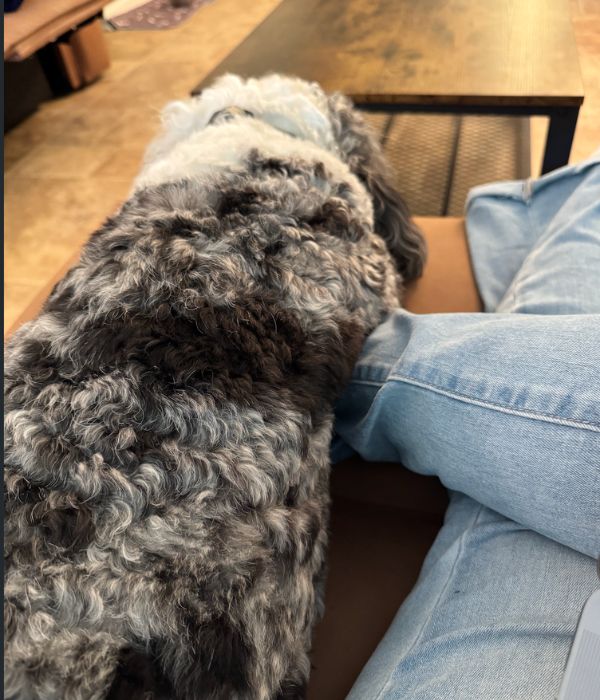
It looks like a dog that positions itself wherever it can maintain a line of sight to you. It looks like physical contact seeking: leaning against your legs while you cook, lying on your feet under the desk, pressing its body against the couch cushion next to you so firmly that you slowly lose territory over the course of an evening.
Most bernedoodles bond with the whole family but choose one primary person.
That person gets the full shadow treatment. Max is attached to everyone in our house, but I’m clearly his person. When I work from home, he’s under my desk. When I move to the kitchen, he moves to the kitchen. When I go upstairs, he parks himself at the bottom of the stairs and waits, watching.
Why Are Bernedoodles So Clingy?
In a word: genetics.
The Bernese Mountain Dog was a working farm dog in the Swiss Alps, bred to stay close to its handler throughout the day. Not a herding dog sent out to work fields independently. Not a terrier bred to think for itself underground.
A stay-close, work-alongside, be-present dog. That proximity drive is deep in the breed’s DNA.
The Poodle is one of the most human-oriented breeds in existence. High social intelligence, high sensitivity to their owner’s moods, high need for interaction. Poodles don’t just tolerate human company. They seek it actively and continuously.
Combine those two drives and you get the bernedoodle’s signature attachment style.

Do Bernedoodles Have Separation Anxiety?
Many do, and the breed is predisposed to it. But there’s an important distinction between a dog that’s clingy and a dog that has separation anxiety.
All bernedoodles are clingy. Not all of them have separation anxiety. The difference matters because the management strategies are different.
Clingy vs. Separation Anxiety: What’s the Difference?
A clingy dog wants to be near you. It follows you around, parks itself in whatever room you’re in, and looks a little sad when you leave. But it settles. It might sigh dramatically, but it doesn’t spiral.
A dog with separation anxiety cannot self-regulate when left alone. The distress escalates: sustained barking or whining, pacing, destructive behavior, refusal to eat, attempts to escape confinement. The dog is in genuine emotional distress.
Many bernedoodle owners live in a gray zone between the two. Their dog isn’t destroying the house or injuring itself, but the behavior at homecoming tells a different story than “my dog was totally fine while I was gone.”
Max is a good example of that gray zone. He can technically be left alone for six to seven hours. He stays gated in the main living area (crates never clicked for him), and he doesn’t destroy things.
(One notable exception: he once ate my husband’s new glasses off a shelf because I’d been upstairs washing my daughter’s hair for what he apparently deemed an unreasonable amount of time.)
But when we come home, even from a short errand, he launches into a high-pitched barking fit and physically struggles to calm down. That’s not a dog that was relaxed while we were gone.
Signs Your Bernedoodle May Have Separation Anxiety
The behaviors to watch for are distinct from normal clinginess. High-pitched barking or whining that starts within minutes of your departure.
Pacing or inability to settle (a pet camera is useful here). Destructive behavior focused on exits, like scratching at doors or gates. Refusal to eat treats or food left out for them. Excessive drooling or panting with no physical explanation.
And the one that catches most owners off guard: the meltdown greeting.
Not the happy-to-see-you wiggle that all dogs do. It’s the cannot stop barking, cannot calm down for several minutes, seems genuinely overwhelmed reaction that suggests the dog experienced your absence as a crisis, not an inconvenience.
Age matters here. A six-month-old bernedoodle that whines when you leave is a puppy being a puppy. A two-year-old bernedoodle that still can’t handle thirty minutes alone may need targeted intervention.
How Long Can a Bernedoodle Be Left Alone?
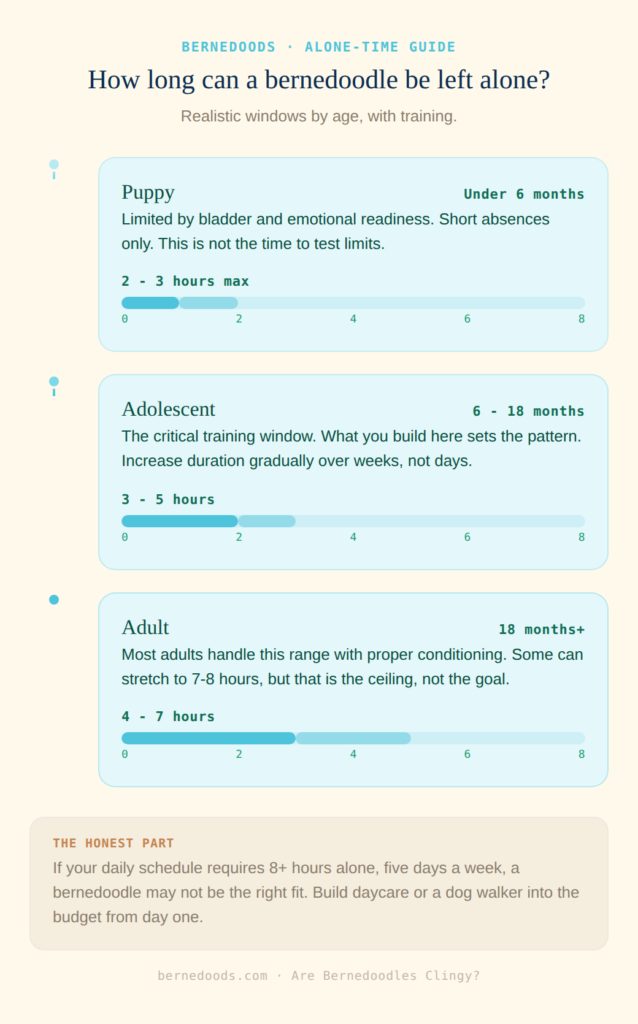
Most adult bernedoodles can handle four to six hours alone with proper training and setup. Some manage seven to eight, but that’s the upper limit for a breed this people-oriented.
Planning your life around the assumption that your bernedoodle will happily do a full workday solo is not realistic for most dogs in this breed.
At eighteen months, Max can handle six to seven hours gated in the living room. But we don’t treat that as the everyday plan.
For longer days, he goes to doggy daycare. The investment is worth it for his well-being and our peace of mind. He loves daycare, for the record. He’s not clingy with other dogs. Just with me.
If your daily schedule requires leaving a bernedoodle alone for eight or more hours, five days a week, this may not be the right breed. Or you need a daycare, dog walker, or midday visit built into the budget from the start.
What Actually Helps with Bernedoodle Clinginess
You will not train the clinginess out of a bernedoodle. That’s not the goal. The goal is to teach them that your absence is temporary, boring, and survivable.
The attachment stays. The panic goes.
Graduated Departures
This is the single most effective technique for building alone-time tolerance. The concept is simple. You practice leaving for very short periods and return before the dog has time to escalate. Thirty seconds. Then one minute. Then five. Then fifteen. You build duration over weeks, not days.
The key is returning while the dog is still calm. If you come back and the dog is already barking, you’ve pushed too far too fast. Back up to a shorter duration and build again. The dog learns that departures predict a calm return, not an emergency.
This works. It also takes real commitment and consistency over several weeks. It’s not a weekend project.
Stop Making Departures and Arrivals a Big Deal
This is counterintuitive and genuinely hard to do.
When you leave, leave calmly. No drawn-out goodbyes, no guilt voice, no “Mommy will be right back, I promise.” When you come home, don’t immediately engage. Set your things down. Wait until the dog is calm. Then say hello.
The more dramatic the departure and arrival rituals, the more the dog learns that your absence is a significant, emotionally charged event. You want it to be boring. Boring is the goal.
This has been the hardest thing for us.
When Max hits us with the high-pitched bark tornado at the front door, every instinct says to comfort him immediately. But we’ve learned to walk in, set our stuff down, and wait. He calms down faster now than he did six months ago, but it honestly still takes longer than is comfortable.
Create a Positive Alone-Time Association
Give the dog something genuinely engaging that only appears when you leave. A frozen Kong, a puzzle feeder, a lick mat spread with peanut butter. The departure becomes the trigger for something good, not something scary.
The “only when you leave” part matters. If the dog gets the Kong every day regardless, it loses its association with departure. Save the high-value enrichment for alone time specifically.
Doggy Daycare or a Dog Walker
For days when alone time would exceed the dog’s comfortable threshold, daycare is not a luxury. It’s a practical management tool.
Many bernedoodle owners build it into the weekly budget the same way they budget for grooming. Two or three days a week of daycare can make the difference between a dog that copes and a dog that doesn’t.
Professional Help for Serious Cases
For moderate to severe separation anxiety, a certified trainer or veterinary behaviorist is worth the investment. If the dog is injuring itself trying to escape, destroying property, or showing signs of extreme distress on camera, this is not a DIY situation.
Professional guidance can include behavior modification protocols, environmental changes, and in some cases, anti-anxiety medication prescribed by a vet. Medication for separation anxiety isn’t giving up. It’s treating a medical condition, and for some dogs, it’s the thing that makes behavioral training possible.
Does Size or Generation Affect Clinginess?
Not as much as individual personality and upbringing. The velcro tendency runs across all sizes and all generations. An F1 standard and an F1B mini are equally capable of following you to the bathroom at 3 a.m.
That said, some general patterns are worth noting.
Minis and micros sometimes present as more anxious (not just more clingy) than standards. One possible explanation: smaller dogs tend to be carried more, held more, and physically closer to their owners from puppyhood, which can reinforce dependence.
But this is a tendency, not a rule, and it’s hard to separate breed tendencies from owner behavior.
Generation doesn’t meaningfully predict clinginess. An F1 and an F1B from the same breeder can have very different attachment styles.
What matters more than size or generation is the temperament of the parents (especially the mother) and early socialization.
A good breeder will know whether previous litters have shown separation anxiety tendencies. Ask the question directly. Ask whether you can meet the mother.
A breeder who prioritizes temperament testing and early socialization protocols is giving you a meaningful head start on a dog that handles alone time well.
Knowing what I know now, I would have asked more questions about the parents’ temperament before choosing Max’s breeder.
He is the most loving, sweet dog I’ve ever had. He’s also the most attached. I don’t think you can fully separate those two things in this breed, but the degree varies, and breeder selection matters more than I realized going in.
Is Clinginess a Dealbreaker?
For some people, it’s the best thing about the breed. For others, it’s a genuine lifestyle mismatch. Neither reaction is wrong.
The clinginess is inseparable from the affection. The same dog that follows you to the bathroom is the one that rests its head on your lap during a hard day, greets your kids at the door like they’re returning from war, and makes you feel more loved than any animal has a right to.
You don’t get one without the other.
If you work from home, enjoy having a constant companion, and don’t mind sharing your personal space with a dog that doesn’t understand the concept of personal space, the clinginess is a feature.
If you travel frequently, work long hours away from home, or value a more independent pet, it’s a genuine problem.
I’ve questioned my life choices at various points during the puppy stage. The high-pitched arrival bark. The constant shadowing. The potty training and reactivity to certain dogs and people while on walks.
But on net, Max has been an absolute blessing to our home.
Would I choose a bernedoodle again? Yes. But I’d go in more informed about what “velcro dog” actually means in practice, and I’d ask harder questions about the parents’ temperament before choosing a breeder.
Bernedoodles are beautiful dogs, but where you get them from matters.
Related Posts
-
Are Bernedoodles Hypoallergenic?
No dog is 100% hypoallergenic, and bernedoodles are no exception. But most bernedoodles are a strong option for allergy sufferers,…
-
What Is an Ultra Bernedoodle? What to Know Before You Start Breeder Shopping
If you’ve spent any time on breeder websites lately, you’ve probably seen the term “ultra bernedoodle” thrown around alongside F1s,…
-
When Do Bernedoodles Calm Down? (Asking For A Friend)
If you’re reading this at 10pm after your bernedoodle ricocheted off the couch, stole something important, and is currently staring…
-
What Is An Australian Bernedoodle? (Including What It Is Not)
If you’ve been researching bernedoodles, you’ve probably run into the term “Australian bernedoodle” and wondered if it’s a different breed,…
-
Micro & Toy Bernedoodles: The Smallest Sizes Explained
You’re looking at two breeder websites. One says micro bernedoodles weigh 10 pounds. The other says 30. Both are using…
-
How Big Do Mini Bernedoodles Get?
If you’re here, you probably fall into one of two camps. You’re either shopping for a mini bernedoodle and trying…