Bernedoodle vs. Goldendoodle: Which Doodle Is Right for You?
So, you’ve decided on a doodle! Now you’re stuck between two, staring at impossibly adorable photos of bernedoodle and goldendoodle puppies.
Bernedoodles and goldendoodles are both Poodle crosses, both marketed as hypoallergenic family dogs, and both capable of demolishing a stuffed toy in under ninety seconds.
On the surface, they look like the same dog in different color options.
They’re not.
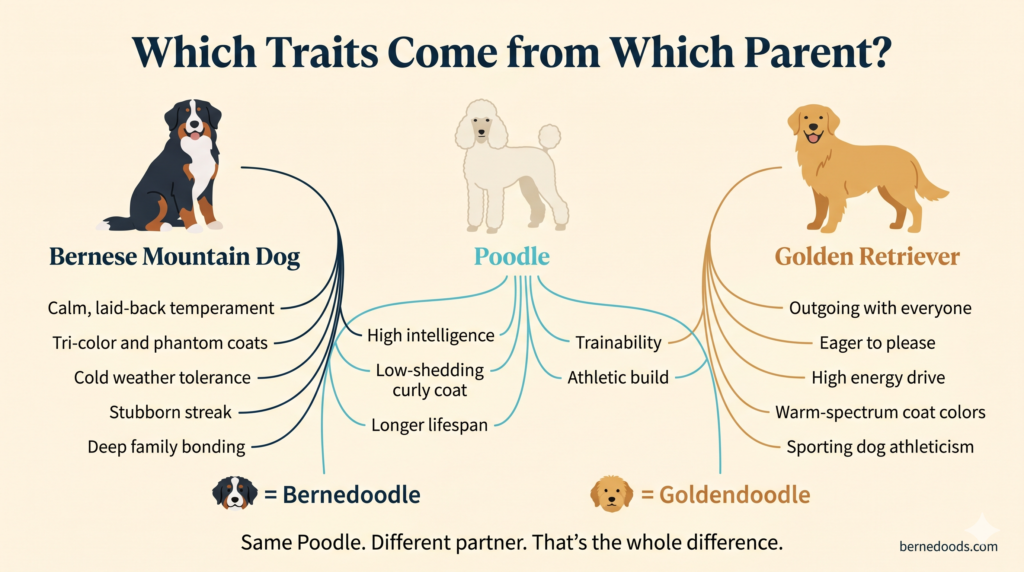
The Poodle half is identical. It’s the other parent that changes everything: the Bernese Mountain Dog in one, the Golden Retriever in the other. That split affects temperament, energy, lifespan, and how the dog handles meeting a stranger at the park.
This article is an honest comparison. By the time you finish, you should know which breed fits your life better.
Side-by-Side Comparison
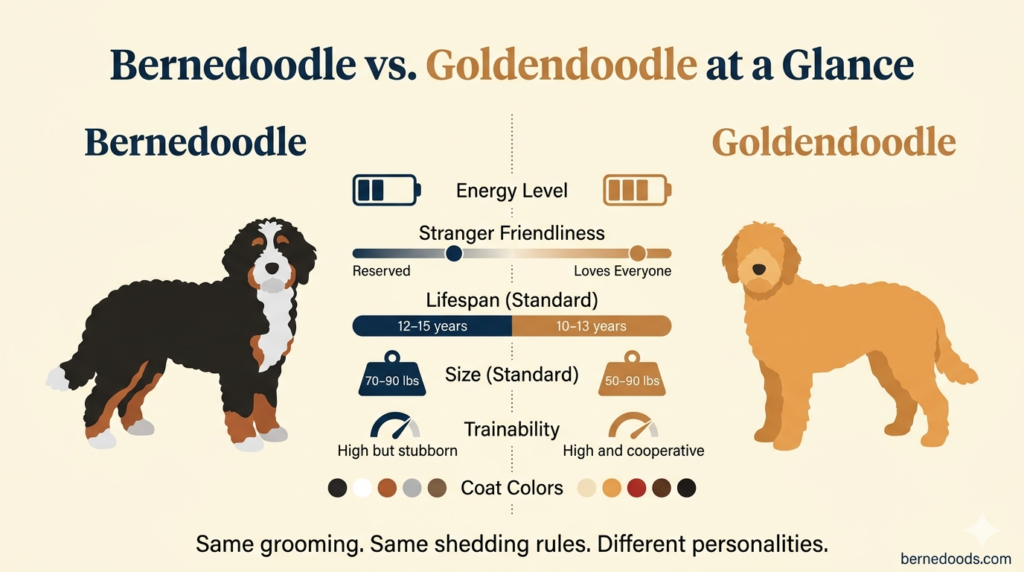
Here’s every major trait compared. The rest of this article explains the why behind these numbers.
| Trait | Bernedoodle | Goldendoodle |
| Parent breeds | Bernese Mountain Dog × Poodle | Golden Retriever × Poodle |
| Standard size | 70–90 lbs, 23–29 in | 50–90 lbs, 22–26 in |
| Mini size | 25–49 lbs, 18–22 in | 15–35 lbs, 13–20 in |
| Lifespan (standard) | 12–15 years | 10–13 years |
| Lifespan (mini) | 14–17 years | 12–16 years |
| Energy level | Moderate (standards laid-back; minis higher) | Moderate to high (consistently active) |
| Temperament | Calm, loyal, occasionally stubborn | Outgoing, eager to please, social with everyone |
| Stranger friendliness | Warms up; may be reserved at first | Instant best friends with everyone |
| Trainability | High, but stubborn streak from Bernese side | High and more consistently cooperative |
| Shedding | Low to moderate (varies by generation/coat) | Low to moderate (varies by generation/coat) |
| Coat colors | Tri-color, phantom, merle, sable, solids | Cream, apricot, red, chocolate, black |
| Cold weather tolerance | Excellent (Bernese heritage) | Good, but less cold-hardy |
| Grooming needs | High (brushing + pro grooming every 6–8 wks) | High (same schedule) |
| Separation anxiety risk | Higher (velcro dog tendency) | Moderate (social but more independent) |
| Price range | $2,000–$5,000+ | $1,500–$5,000 |
| Best for | Calmer, laid-back companion seekers | Active families wanting outgoing energy |
What You’re Actually Comparing: Bernese vs. Golden Retriever
The Poodle contributes the same things to both breeds: intelligence, a low-shedding coat, and a longer lifespan than most large dogs. The real variable is the other parent.
Those two profiles explain nearly every difference between bernedoodles and goldendoodles. Whenever you read a trait comparison below, trace it back to which non-Poodle parent is responsible. It almost always tracks.
Temperament: Calm and Loyal vs. Outgoing and Eager
Bernedoodles tend to be calmer and more reserved, although minis and micros can be pretty energetic. Goldendoodles tend to be more outgoing and universally social. That’s the headline.
A standard bernedoodle typically inherits the Bernese’s laid-back demeanor. They’re content to be near you without demanding constant action.
They warm up to new people on their own terms, which can look like aloofness to someone used to Golden Retriever energy.
Once they’re comfortable, they’re deeply affectionate.
A goldendoodle treats every human like a long-lost friend. There’s no warm-up period. They’re in your lap within minutes of meeting you, and they bring that enthusiasm to everyone, from your mail carrier to the vet.
The stubbornness factor is worth noting.
Bernedoodles inherit a streak of selective cooperation from the Bernese side. They’re not defiant. They just have strong opinions about whether they feel like doing something right now.
Goldendoodles, with their Golden Retriever eagerness to please, tend to be more consistently cooperative during training. For first-time dog owners, that difference matters.
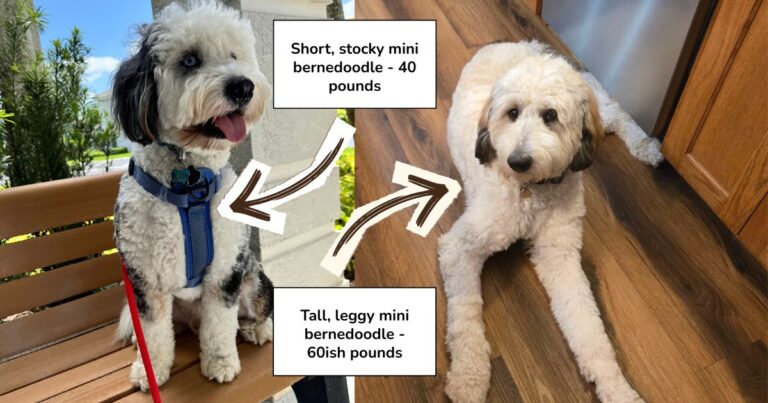
One important nuance: the “calm bernedoodle” reputation belongs mostly to standards. Mini bernedoodles carry more Poodle energy and can run just as hot as a goldendoodle. If you’re choosing a mini, the temperament gap between these breeds narrows considerably.
Energy Levels and Exercise Needs
Goldendoodles are generally higher energy across all sizes. That’s the Golden Retriever’s sporting-dog engine at work.
Standard bernedoodles are the most laid-back option in the doodle world.
They’re happy with a couple of solid walks and some yard time. They’ll hike with you enthusiastically, but they won’t pace the house if you skip a day.
Goldendoodles need more consistent output. A goldendoodle that doesn’t get enough exercise will let you know, usually by redecorating your living room with whatever was accessible. They’re a better match for runners, hikers, and families who are outside a lot.
Mini bernedoodles split the difference. They carry more energy than standards but can still settle well with proper exercise. Both breeds need daily movement (walks, fetch, swimming, mental stimulation). Neither is a couch-only dog. The question is intensity, not whether exercise is required.
Shedding and Allergies: Same Rules, Both Breeds
Shedding is governed by generation and coat type, not by whether your dog is a bernedoodle or a goldendoodle. An F1B bernedoodle with a curly coat and an F1B goldendoodle with a curly coat will shed roughly the same amount.
The mechanism is identical for both breeds. More Poodle genetics means a curlier coat, less shedding, and less dander. The furnishing gene matters equally for both. A furnished dog (the ones with the shaggy, bearded face) sheds significantly less than an unfurnished one, regardless of breed or generation.
If allergies are driving your decision, generation matters more than breed. An F1B or later generation with a curly, furnished coat is the safest bet whether you go bernedoodle or goldendoodle.
The standard caveat applies: no dog is truly hypoallergenic. Allergens come from dander, saliva, and urine, not just fur. A low-shedding coat reduces dander distribution, but it doesn’t eliminate it.
Size Options Compared
Both breeds come in standard, mini, and micro/toy sizes. Bernedoodles tend to be slightly larger at each tier because Bernese Mountain Dogs are bigger than Golden Retrievers.
At the standard level, the difference is noticeable. A standard bernedoodle typically weighs 70–90 pounds; a standard goldendoodle runs 50–90 pounds, with most landing in the 50–75 range. If you want the biggest possible doodle, a standard bernedoodle is the more reliable path to a genuinely large dog.
At the mini level, the ranges overlap more. Mini bernedoodles (25–49 lbs) and mini goldendoodles (15–35 lbs) can land in similar territory, though bernedoodle minis tend toward the heavier end.
Lifespan: Where Bernedoodles Have a Real Edge
Standard bernedoodles typically outlive standard goldendoodles by two to four years. That gap is significant enough to factor into your decision.
Here’s why. The Bernese Mountain Dog lives only 6–8 years on average. Crossing with a Poodle (12–15 years) roughly doubles that, pushing the standard bernedoodle to 12–15 years. The Golden Retriever already lives 10–12 years, so the Poodle cross adds less lift. Standard goldendoodles typically land at 10–13 years.
At the mini level, both breeds converge closer. Mini bernedoodles average 14–17 years; mini goldendoodles average 12–16 years. The gap shrinks but doesn’t disappear.
An honest caveat: bernedoodles are still a young breed without decades of population-level lifespan data. The ranges are well-informed estimates based on parent breed lifespans and hybrid vigor principles, not guarantees.
Coat Colors and Appearance
This is where bernedoodles pull ahead on variety. They come in tri-color (the signature black, white, and rust Bernese pattern), phantom, merle, sable, bi-color, and solid options. That range is hard to match.
Goldendoodles stick to the warm spectrum: cream, apricot, red, chocolate, and occasionally black. They’re beautiful dogs, but if distinctive coat patterns matter to you, the bernedoodle’s palette is wider.
One thing to know: bernedoodle coats often fade as the dog matures.
Black can soften to silver, rich rust can lighten to tan. That’s inherited from the Poodle side and is completely normal, but don’t fall in love with a puppy’s coloring expecting it to stay identical.
Grooming: Equal Commitment, No Shortcuts
Both breeds require the same grooming schedule: brushing every day or two, professional grooming every 6–8 weeks, and $80–$150 per session depending on size and location.
Neither breed wins on grooming ease.
A curly-coated goldendoodle mats just as fast as a curly-coated bernedoodle. Both need regular ear cleaning and nail trims. If you’re choosing between these two, grooming should not be a deciding factor. It’s a wash.
Price and Availability
Bernedoodles typically cost more upfront: $2,000–$5,000+ from a reputable breeder, compared to $1,500–$5,000 for goldendoodles. The premium reflects the additional genetic testing that Bernese Mountain Dog breeding requires, along with smaller average litter sizes.
Goldendoodles are more widely available. The breed has been around longer, the breeder network is larger, and waitlists tend to be shorter. If timing matters, a goldendoodle may be easier to find quickly.
Ongoing costs (food, grooming, vet care) are similar for both breeds at comparable sizes. A 70-pound bernedoodle and a 70-pound goldendoodle eat roughly the same amount and cost the same to groom.
So Which Doodle Is Right for You?
The right choice depends on your household, your activity level, and what you want the relationship with your dog to feel like. A bernedoodle will give you deep, quiet loyalty and a dog that reads your mood before you do. A goldendoodle will give you unbridled enthusiasm and a social butterfly who makes friends for both of you.
Neither answer is wrong. The wrong answer is picking based on an Instagram photo without understanding what you’re signing up for.
Quiz: Should You Get A Bernedoodle or a Goldendoodle?
Which Doodle Fits Your Life?
7 quick questions. An honest recommendation.