Furnished vs. Unfurnished Bernedoodles: What’s the Difference?
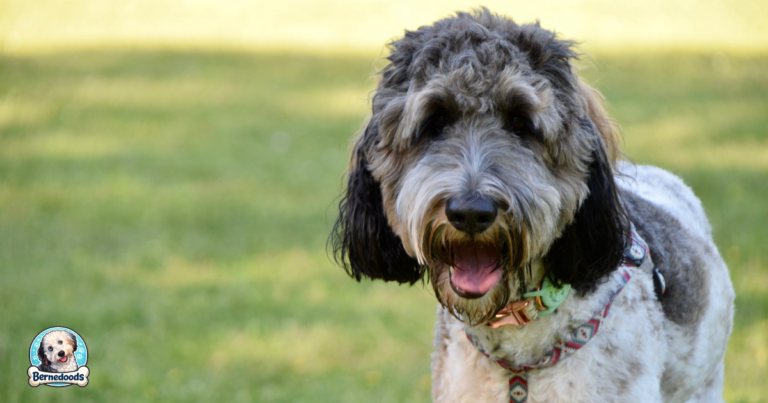
A furnished bernedoodle has the shaggy, bearded face that gives doodles their teddy-bear look. An unfurnished bernedoodle has a smoother, flatter face that looks more like a purebred Bernese Mountain Dog.
The difference comes down to a single gene, and it affects shedding, grooming demands, and allergy-friendliness far more than most people realize.
If you’ve been comparing bernedoodle puppies and wondering why some look like fluffy stuffed animals while others look like miniature Bernese, this is the reason.
Our complete bernedoodle breed guide touches on furnishings briefly. This article goes deeper: what the gene actually does, how it’s inherited, which generations are affected, and how to make sure you know what you’re getting before you put down a deposit.
What Is a Furnished Bernedoodle?
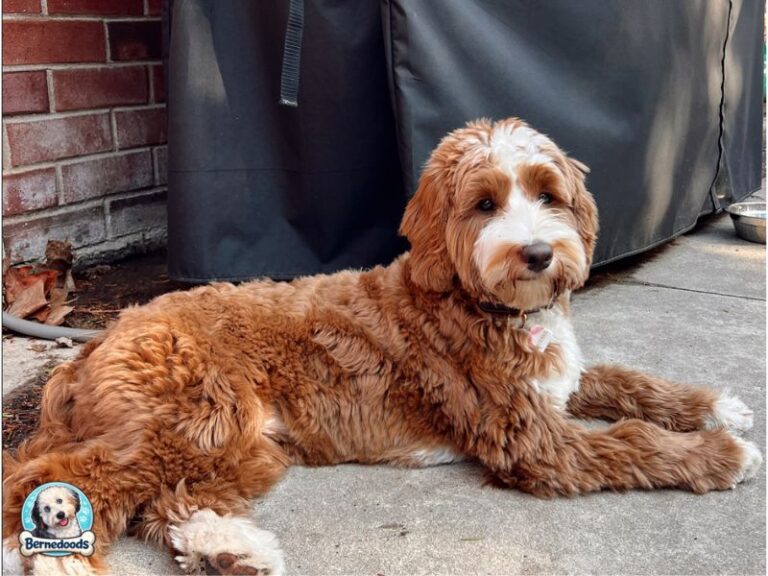
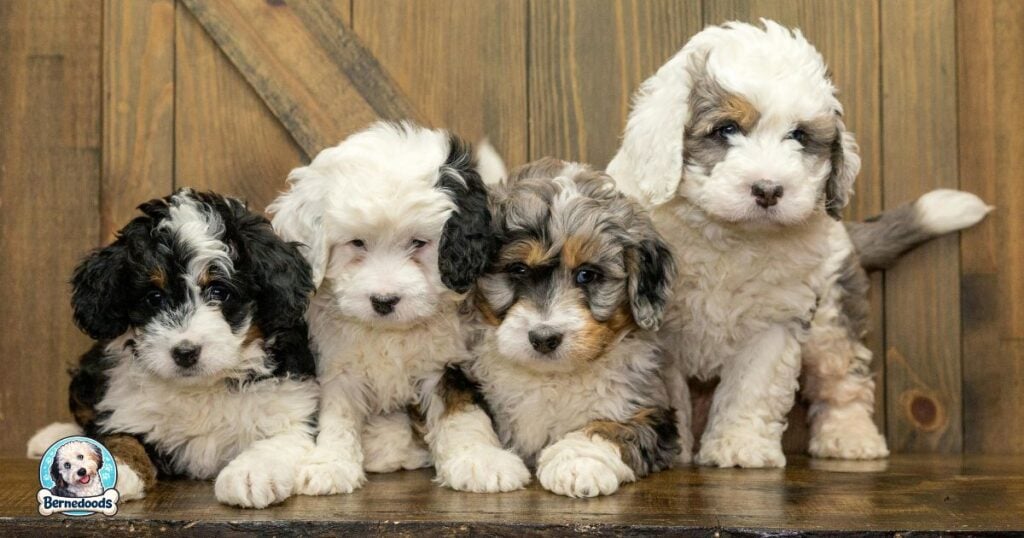
A furnished bernedoodle has longer hair on the face, including a distinct beard, eyebrows, and mustache. This is the look most people picture when they hear the word “doodle.”
The coat on the body is typically wavy or curly, though furnished dogs can also have straighter coats. The facial hair is the defining feature.
Furnishings don’t just change how a bernedoodle looks. They change how the coat behaves.
Furnished dogs shed significantly less than unfurnished dogs because the furnishing gene affects the entire coat’s growth cycle, not just the hair on the face.
The longer, continuously growing coat traps loose hair rather than dropping it onto your couch. That’s good news for your furniture. The tradeoff is that all that trapped hair mats and tangles if you don’t brush it out regularly.
What Is an Unfurnished Bernedoodle?
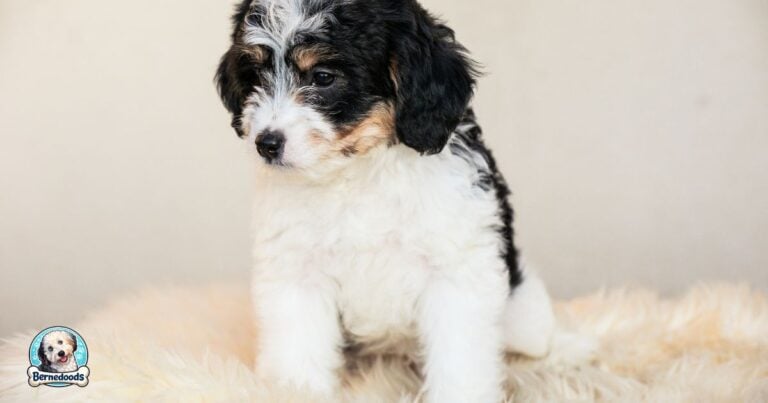
An unfurnished bernedoodle has a smooth, clean face with short hair and no beard. The overall look is closer to a Bernese Mountain Dog than a Poodle.
The body coat can still be wavy (this surprises people), but it tends to be shorter, flatter, and closer to what you’d see on a traditional sporting or working breed.
Unfurnished bernedoodles shed more than furnished ones. How much more depends on the individual dog and the coat texture, but expect something in the low-to-moderate range.
They’ll never shed as heavily as a purebred Bernese, but you will find hair on your clothes and furniture.
The upside? Grooming is dramatically easier. No daily brushing sessions, no mats behind the ears, no $120 grooming appointments every six weeks.
A bath, a weekly brush, and the occasional trim around the sanitary areas covers it.
For people who love the bernedoodle personality but don’t want the grooming commitment that comes with a furnished coat, an unfurnished bernedoodle is a legitimate option.
The Gene Behind It: RSPO2 and How Furnishings Are Inherited
Furnishings are controlled by a variant of the RSPO2 gene, sometimes called the IC Locus (IC stands for “improper coat,” a term from the purebred world where lacking furnishings is considered a fault in certain breeds). In bernedoodles, it’s not a fault. It’s just a different look.
Here’s how it works in plain terms. Every dog inherits two copies of this gene, one from each parent. Each copy is either the furnishing variant (F) or the non-furnishing variant (IC). Furnishings are dominant, which means a dog only needs one copy of the F variant to have a furnished coat. That gives you three possible combinations.
The genetics here follow a simple pattern. If both parents carry at least one F variant, most or all of the puppies will be furnished. But if both parents are F/IC carriers, roughly 25% of the litter will be IC/IC (unfurnished). If one parent is IC/IC and the other is F/IC, about half the litter will be unfurnished.
What About Weak Furnishings?
Genetic testing labs have identified a third variant at the RSPO2 locus called weak furnishings (Fw). Dogs with weak furnishings develop facial hair, but it’s sparse, slow to come in, and much less pronounced than full furnishings. Think of it as a middle ground: some beard, but not the full teddy-bear effect.
Weak furnishings are dominant over IC but recessive to full furnishings. So the dominance hierarchy goes: F (full furnishings) > Fw (weak furnishings) > IC (unfurnished). Most breeders don’t specifically test for this variant yet, but the major labs (Paw Print Genetics, Embark, UC Davis Veterinary Genetics Laboratory) do offer it.
If coat appearance matters to you, asking for the full IC Locus panel rather than a simple furnished/unfurnished result gives the most complete picture.
Which Generations Produce Furnished vs. Unfurnished Puppies?
The likelihood of getting a furnished or unfurnished puppy depends heavily on the generation, because the generation determines how the furnishing gene gets passed down.
F1 (Bernese Mountain Dog × Poodle)
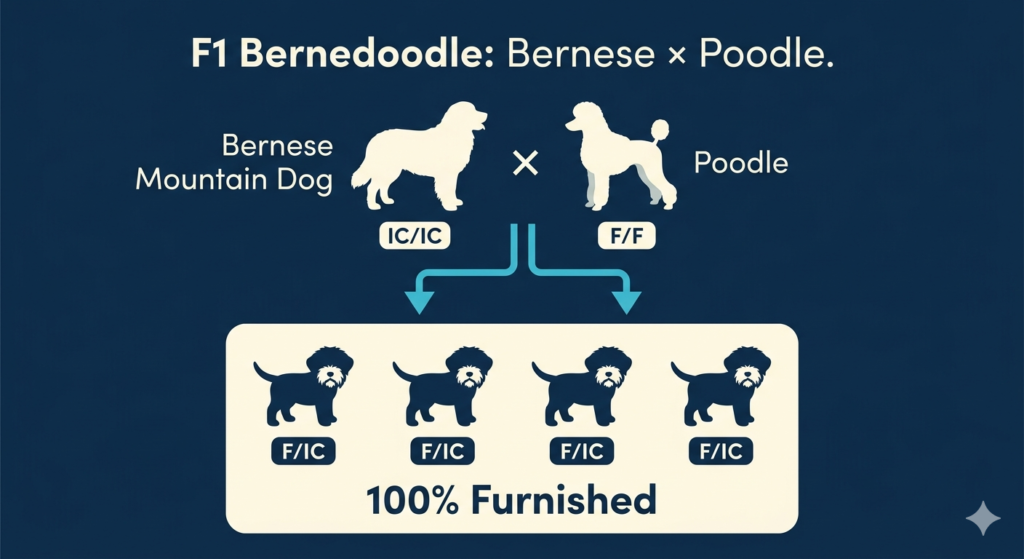
Every F1 bernedoodle is furnished. The Bernese parent is IC/IC (no furnishing gene). The Poodle parent is F/F (two copies of the furnishing gene, since Poodles are a furnished breed). Every puppy inherits one F from the Poodle and one IC from the Bernese, making them all F/IC. Furnished, every time, no exceptions.
But here’s the detail that matters later: every F1 is a carrier of the non-furnishing variant. They look furnished, but they’re carrying IC in their back pocket. This only becomes relevant when an F1 is bred to another dog that also carries IC.
F1B (F1 Bernedoodle × Poodle)
Almost always furnished. The F1 parent is F/IC. The Poodle parent is F/F. That means every puppy gets at least one F from the Poodle, so the entire litter will be furnished. About half will be F/F (fully furnished) and half will be F/IC (furnished carriers). No unfurnished puppies in this cross.
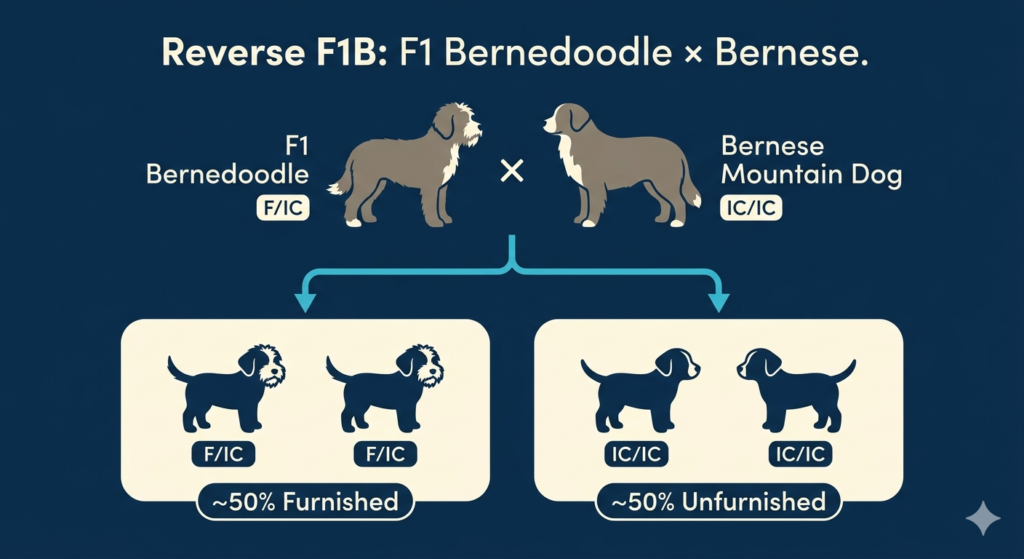
Reverse F1B (F1 Bernedoodle × Bernese Mountain Dog)
This is where unfurnished puppies show up. The F1 parent is F/IC. The Bernese parent is IC/IC. That gives you roughly a 50/50 split: half the litter will be F/IC (furnished) and half will be IC/IC (unfurnished). If you’re buying from a reverse F1B litter and coat type matters to you, genetic testing of the puppies is essential.
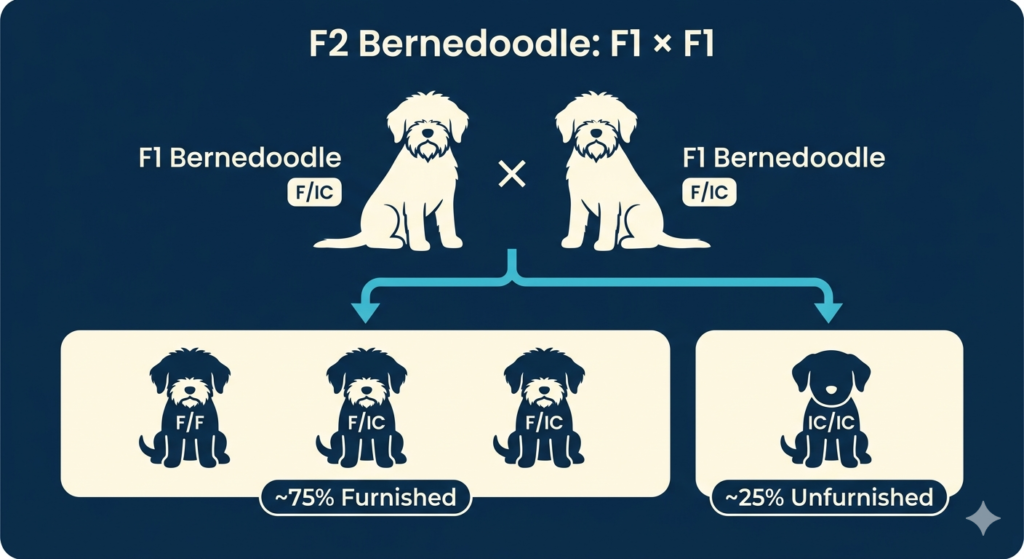
F2 (F1 × F1)
Both parents are F/IC. Standard dominant-recessive math applies: about 75% of the litter will be furnished (roughly half F/IC and a quarter F/F), and about 25% will be IC/IC (unfurnished). F2 litters [LINK: /bernedoodle-generations-explained] are already the most unpredictable generation for coat type and texture. Furnishing variation adds another layer of uncertainty.
F1BB and Multi-gen
F1BB bernedoodles (F1B × Poodle) are almost always F/F, since there’s so much Poodle in the mix. Unfurnished puppies in an F1BB litter would be unusual. Multi-gen litters vary depending on the specific parents, but experienced breeders using multi-gen pairings are typically selecting for consistent furnishings and can predict outcomes based on the parents’ test results.
Here’s the generation-by-generation breakdown.
| Generation | Cross | Parent Genotypes | Furnished % | Unfurnished % |
| F1 | Bernese × Poodle | IC/IC × F/F | 100% | 0% |
| F1B | F1 × Poodle | F/IC × F/F | 100% | 0% |
| Reverse F1B | F1 × Bernese | F/IC × IC/IC | ~50% | ~50% |
| F2 | F1 × F1 | F/IC × F/IC | ~75% | ~25% |
| F1BB | F1B × Poodle | F/F or F/IC × F/F | ~100% | ~0% |
| Multi-gen | Varies | Varies | Breeder-dependent | Breeder-dependent |
How Do Furnishings Affect Shedding?
Furnished bernedoodles shed significantly less than unfurnished bernedoodles. That’s the headline. But the reason why is worth understanding, because it explains a lot about how bernedoodle coats work in general.
The RSPO2 gene doesn’t just control facial hair. It influences the growth pattern of the entire coat, including how hair cycles through its growth phases and whether the dog develops a dense undercoat. Dogs with the furnishing variant grow hair more continuously (similar to human hair) rather than in the shed-and-replace cycles typical of most dogs. Loose hairs get caught in the surrounding coat instead of falling out. That’s why furnished doodles seem to “not shed” when in reality they’re retaining the dead hair in their coat.
This is also why furnished coats mat so easily. The hair that would normally fall to the floor is instead tangling into the coat around it. Regular brushing removes that trapped hair before it becomes a matted mess.
Unfurnished bernedoodles have a more traditional shedding pattern. Hair grows, reaches its full length, dies, and falls out. They typically shed less than a purebred Bernese Mountain Dog (the cross with Poodle genetics helps), but noticeably more than a furnished bernedoodle. For a full breakdown of shedding by generation and coat type, see our complete shedding guide [LINK: /do-bernedoodles-shed].
What About Allergies?
No dog is truly hypoallergenic. Allergens come from dander, saliva, and urine, not just fur. That said, furnished bernedoodles distribute less dander around the home because they shed less hair, and the dander that does flake off tends to get trapped in the coat rather than becoming airborne. For many people with mild to moderate dog allergies, a furnished bernedoodle with a curly or wavy coat is tolerable. An unfurnished bernedoodle is a riskier choice for allergy sufferers. For more on this, see our allergy guide [LINK: /are-bernedoodles-hypoallergenic].
The Grooming Tradeoff: What Each Coat Type Actually Requires
This is the part that doesn’t make it into the cute Instagram photos. The same coat genetics that reduce shedding create a grooming commitment that catches a lot of new owners off guard.
Furnished Bernedoodle Grooming
A furnished bernedoodle needs brushing every day or every other day. Not once a week, not when you notice tangles.
The beard, the area behind the ears, the armpits, and anywhere the coat rubs against a collar or harness are mat-prone zones that require consistent attention.
Professional grooming is necessary every 6 to 8 weeks.
That means a full haircut, bath, nail trim, ear cleaning, and sanitary trim. Depending on your area and the dog’s size, expect to pay $80 to $150 per session.
For a standard bernedoodle, some groomers charge more. Over a year, that’s roughly $600 to $1,300 in grooming costs alone.
Unfurnished Bernedoodle Grooming
An unfurnished bernedoodle’s coat is closer to a Bernese Mountain Dog’s in maintenance terms. Weekly brushing keeps things tidy.
Baths as needed, typically monthly or when the dog gets into something. No regular haircuts required, since the coat reaches a natural length and stops growing rather than growing continuously.
You’ll still want occasional professional grooming for nail trims and sanitary areas, but the frequency drops to every few months rather than every six weeks.
Annual grooming costs for an unfurnished bernedoodle are a fraction of what you’d spend on a furnished one.
Side-by-Side Comparison
| Furnished | Unfurnished | |
| Facial Hair | Beard, eyebrows, mustache | Smooth, clean face |
| Shedding | Low | Low to moderate |
| Brushing | Daily or every other day | Weekly |
| Pro Grooming | Every 6–8 weeks | Every few months |
| Annual Grooming Cost | $600–$1,300+ | $150–$400 |
| Allergy-Friendliness | Higher (less dander spread) | Lower |
| Overall Look | Teddy-bear / doodle | Bernese Mountain Dog |
Who Is an Unfurnished Bernedoodle Best For?
Unfurnished bernedoodles get treated like the lesser option on most breeder websites. That’s a disservice. For certain owners, an unfurnished bernedoodle is the better choice.
If you love the Bernese Mountain Dog’s appearance but can’t accept the breed’s short 6- to 8-year lifespan, an unfurnished bernedoodle gives you that classic look in a dog that’s expected to live 12 to 17 years depending on size. You still get the bernedoodle temperament: loyal, affectionate, goofy, and people-focused.
Furnishings don’t affect personality at all.
Unfurnished bernedoodles also make sense for people who want a lower-maintenance coat. Not everyone wants to brush a dog every day or budget over a thousand dollars a year on grooming.
If you’re comfortable with some shedding and want a dog you can bathe at home and brush once a week, unfurnished is the practical choice.
They’re also worth considering if you want a bernedoodle in a smaller size. A micro or mini unfurnished bernedoodle gives you the compact size with the Bernese look and a fraction of the grooming work.
How to Confirm Furnishing Status Before You Buy
Don’t guess. Don’t rely on how a five-week-old puppy looks in a photo. If furnishing status matters to you, here’s how to confirm it.
Ask for Genetic Test Results
The definitive answer comes from a DNA test of the IC Locus (RSPO2 gene). The result will read as one of three genotypes: F/F, F/IC, or IC/IC. Any reputable breeder should be testing parent dogs at minimum. Many also test individual puppies, especially in litters where both furnished and unfurnished outcomes are possible (reverse F1B and F2 litters in particular).
If a breeder tells you a puppy is “furnished” but can’t show you test results, that’s worth questioning. The test is inexpensive, widely available through labs like Embark, Paw Print Genetics, and the UC Davis Veterinary Genetics Laboratory, and it gives a definitive answer.
There’s no reason to skip it.
Visual Clues (With Caveats)
By around five to six weeks of age, furnished puppies typically start developing fluffier, longer hair on the face. Unfurnished puppies maintain a sleek, smooth face. The hair between the paw pads is another early indicator: furnished puppies tend to have noticeably more hair growing between the pads.
These visual clues are helpful but not foolproof, especially for puppies with weak furnishings that may develop slowly.
If it matters, get the genetic test. It’s the only way to know for certain, and it also tells you whether a furnished puppy is F/F or F/IC, which matters if you ever plan to breed.
Do Furnishings Affect Personality or Health?
No. The RSPO2 gene controls coat growth. That’s it. A furnished bernedoodle and an unfurnished bernedoodle from the same litter will have the same range of temperaments, the same energy levels, and the same health profile. The gene has no known connection to behavior, intelligence, or disease risk.
This is worth emphasizing because some breeder websites imply that furnished dogs are somehow “better” bernedoodles. They’re not. They’re different-looking bernedoodles with different grooming needs. The personality you fall in love with comes from the dog, not its facial hair.
The Short Version
Furnished bernedoodles have the classic doodle look, shed less, and need daily grooming. Unfurnished bernedoodles look more like a Bernese, shed more, and are dramatically easier to maintain.
Both are the same dog on the inside. Neither is objectively better. The right choice depends entirely on whether you’d rather deal with shedding or deal with grooming.
Related Posts
-
When Do Bernedoodles Calm Down? (Asking For A Friend)
If you’re reading this at 10pm after your bernedoodle ricocheted off the couch, stole something important, and is currently staring…
-
What Is An Australian Bernedoodle? (Including What It Is Not)
If you’ve been researching bernedoodles, you’ve probably run into the term “Australian bernedoodle” and wondered if it’s a different breed,…
-
Micro & Toy Bernedoodles: The Smallest Sizes Explained
You’re looking at two breeder websites. One says micro bernedoodles weigh 10 pounds. The other says 30. Both are using…
-
How Big Do Mini Bernedoodles Get?
If you’re here, you probably fall into one of two camps. You’re either shopping for a mini bernedoodle and trying…
-
How Big Do Bernedoodles Get? That Is The Million Dollar Question.
If you’ve spent any time on breeder websites trying to figure out how big a bernedoodle actually gets, you’ve probably…
-
Do Bernedoodles Bark a Lot? An Honest Look at Noise Levels
You’re researching bernedoodles and you want to know what your neighbors are in for. Fair question. Barking is one of…