
When Do Bernedoodles Calm Down? (Asking For A Friend)
If you’re reading this at 10pm after your bernedoodle ricocheted off the couch, stole something important, and is currently staring at you from across the room — hi. You’re in the right place.
Max, my mini bernedoodle, had me questioning everything around the one-year mark. The puppy phase was hard to be sure. The kind of hard that makes you understand why sleep deprivation is a negotiation tactic.
But we got through it. (Or so I thought.)
He learned not to pee in the house. He slept in his crate. He became a friendly, mostly-reasonable floofball, and I exhaled.
Then, right around his first birthday, the floor dropped out. He got reactive on walks, started barking at dogs and people he’d been completely fine with before, and snapped three retractable leashes chasing bunnies.
Three.
I genuinely did not like having a dog for a while. I loved him, but I was not prepared for what was coming, and nobody had warned me. This article is that warning and the explanation I wish I’d had.
You can read more about the bernedoodle breed overall in our complete bernedoodle guide, but here we are going to focus on what actually happens inside this specific developmental window, and when things get better.
The short answer
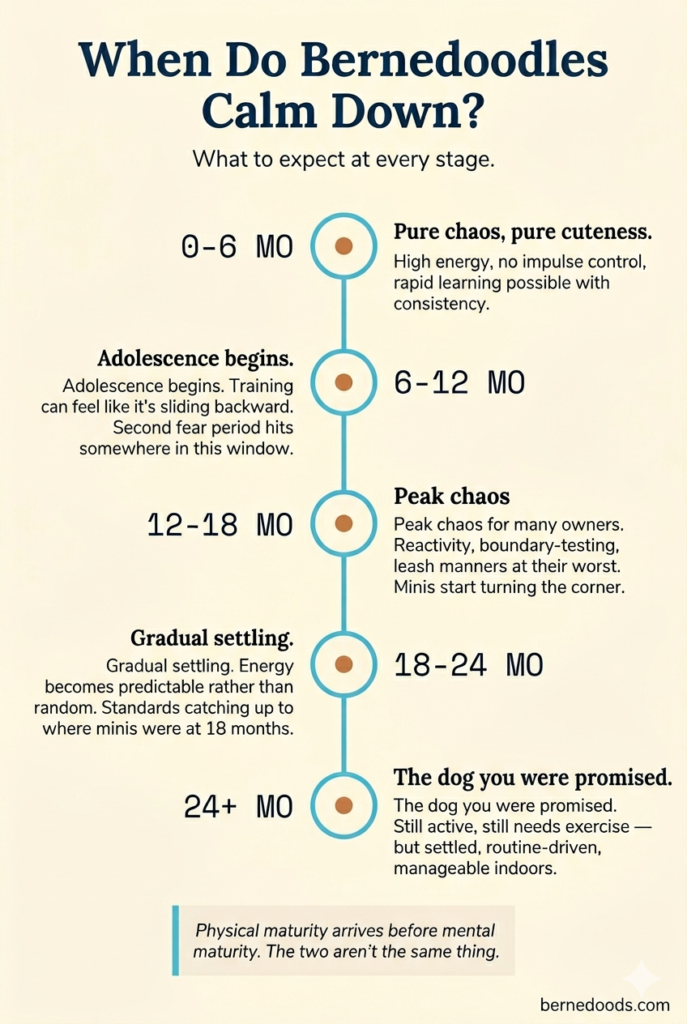
Most bernedoodles start to meaningfully calm down around two years old. But that number alone isn’t very useful, because size affects the timeline, and physical maturity arrives well before mental maturity. A bernedoodle who looks like an adult at fourteen months is still working through a lot internally.
Minis tend to get there faster — closer to 18 months for the first real signs of settled adult behavior. Standards often take the full two years, and some males continue filling out emotionally (and physically) past that.
Size timelines are covered in more detail in our bernedoodle size guide, but the short version is: smaller dogs mature faster, across the board.
The other thing worth knowing upfront: calming down is not a switch. It’s a slow shift toward more predictable, manageable behavior. The dog doesn’t change. The chaos just becomes less random.
Why does it take so long?
Both parent breeds are slow maturers. Bernese Mountain Dogs aren’t fully grown until two to three years old. Standard Poodles often take a year and a half to two years. When you cross them, that extended developmental timeline compounds. Bernedoodles are working from both sides of the equation.
There’s also the energy equation that surprises a lot of people. The Bernese Mountain Dog side has a reputation for being calm and steady — and that’s real, eventually.
But the Poodle side was bred to work all day. It’s athletic, driven, and mentally restless in a way that doesn’t just sit quietly in the background. Many owners expect a mellow teddy bear and get a highly intelligent dog with real physical and mental needs, and those needs don’t negotiate.
The calm bernedoodles are known for is genuine, but it’s conditional. A well-exercised, mentally stimulated bernedoodle will settle on the couch like a weighted blanket.
An under-stimulated one will find its own agenda — and as more than a few owners have discovered, that agenda is rarely one you’d have chosen. We cover the energy piece in more depth in our article on bernedoodle energy levels, but know that it matters here too: the wait for calm goes faster when the dog’s actual needs are being met.
The phase that catches everyone off guard
Somewhere between six and eighteen months, something shifts. The puppy who was reliably improving, learning commands, sleeping through the night, building good habits — that dog starts acting like a different animal.
Training that stuck at five months seems to have evaporated. Recall gets selective. Leash manners deteriorate. Behaviors you thought were behind you reappear.
This is canine adolescence, and it is the most misunderstood stretch of bernedoodle ownership.
It’s also where a lot of people quietly reach the conclusion that something is wrong with their dog. Nothing is wrong. This is biology.
During adolescence, dogs experience significant hormonal changes and a genuine neurological reorganization. What looks like stubbornness or regression is usually a dog struggling with impulse control in a way they weren’t a few months earlier.
The outside world has become dramatically more interesting and stimulating. Their own body is producing hormones they’ve never experienced. They’re probably not ignoring you. It’s more likely they’re overwhelmed, and the circuits that governed their earlier behavior are being rewired.

There’s also a second fear period that hits during this window, typically between six and fourteen months. It can appear without warning. A dog who was perfectly comfortable on a busy street suddenly startles at things it’s encountered dozens of times. For bernedoodles, whose Bernese side already trends toward cautious observation with strangers, this can intensify reactivity on walks or in new environments in ways that feel like they came out of nowhere.
Our mini bernedoodle, Max, became reactive on walks. He started barking at people and dogs he’d previously been relaxed around, all around this window.
It felt alarming precisely because it was new. He had been fine. And then, very suddenly, he wasn’t. We did one-on-one training and group classes. I genuinely thought something was wrong with my specific dog. What I didn’t know is that I was right on schedule for this breed.
He’s still reactive. We’re still working on it, closer to two years in than I’d like. But we’ve learned to move with his anxiety instead of fighting it — to let him work through things at his pace, which is far slower than ours, and to find that patience somewhere. If your bernedoodle’s barking has ramped up during this phase, that article has more on what drives it and what actually helps.
One more thing worth knowing about the adolescent phase: socialization can quietly regress even in dogs who were well-socialized as young puppies. Teenage dogs get taken out less, kept home more, and the consistent exposure that built confidence in puppyhood starts to slip. Keeping socialization active through this period — not forcing it, but maintaining it — makes a real difference on the other side.
What calming down actually looks like
It’s not one day to the next. What most owners describe is a gradual shift toward predictability: the dog starts developing routines and settling into them. The indoor chaos becomes less frequent and less random. There are still zoomies (that 4:30pm tax will probably never fully disappear), but they happen on a schedule you can set a clock by rather than at 2 am for no reason.
The energy doesn’t go away.
A two-year-old bernedoodle is still an active dog with real exercise needs. What changes is that the energy becomes manageable.
You know what will settle them. You know what the day looks like. The dog stops finding its own agenda because its needs are being met consistently, and the consistency has finally taken hold after two years of building it.
Spend any time in bernedoodle owner communities and the same observation surfaces over and over: owners who are mid-chaos don’t believe the two-year mark is real, and owners who are past it can’t quite remember how bad it was. Both things are true.
What actually helps during the wait
The advice to ‘be consistent’ is correct and also almost completely unhelpful without more context. Here’s what consistency actually means in practice for this breed.
Max will be two in three months. The dog I have now is genuinely different from the dog I had at fourteen months. He’s calmer indoors, more settled in routine, easier to read. The reactivity is still there, and we’re still working through it at his pace.
But I know what I’m dealing with now, which makes it manageable in a way it wasn’t when I was standing on a sidewalk holding two-thirds of a retractable leash, wondering where it all went wrong.
If you’re in the thick of it right now, the two-year mark is real. So is the work between here and there. For more on the breed overall, our complete bernedoodle guide covers the full picture — temperament, size, generations, and what to actually expect.
Related Posts
-
Are Bernedoodles High Energy or Calm? Activity Levels Explained
If you’ve spent any time researching bernedoodles, you’ve seen them described as “laid-back couch dogs” and “high-energy bundles of chaos”…
-
Do Bernedoodles Bark a Lot? An Honest Look at Noise Levels
You’re researching bernedoodles and you want to know what your neighbors are in for. Fair question. Barking is one of…
-
Micro & Toy Bernedoodles: The Smallest Sizes Explained
You’re looking at two breeder websites. One says micro bernedoodles weigh 10 pounds. The other says 30. Both are using…
-
How Big Do Mini Bernedoodles Get?
If you’re here, you probably fall into one of two camps. You’re either shopping for a mini bernedoodle and trying…
-
Bernedoodle vs. Goldendoodle: Which Doodle Is Right for You?
So, you’ve decided on a doodle! Now you’re stuck between two, staring at impossibly adorable photos of bernedoodle and goldendoodle…
-
Furnished vs. Unfurnished Bernedoodles: What’s the Difference?
A furnished bernedoodle has the shaggy, bearded face that gives doodles their teddy-bear look. An unfurnished bernedoodle has a smoother,…