Are Bernedoodles Smart? Intellect & Trainability
Bernedoodles are smart, but probably not in the way you’re picturing.
When most people ask whether a dog is intelligent, they’re imagining something like a border collie running an agility course, executing commands on the first try, never putting a paw wrong.
That’s one kind of smart.
Bernedoodles have a different kind, and understanding the distinction will tell you more about what life with this breed actually looks like than any ranking or test result.
The short version: bernedoodles learn quickly, read people exceptionally well, and are genuinely interested in working with you.
They also inherited enough Bernese Mountain Dog personality to be selectively cooperative. There will be moments where they understand exactly what you’re asking and simply decide the answer is no.

Where Bernedoodle Intelligence Actually Comes From
Bernedoodles inherit two distinct types of intelligence from their parent breeds, and the combination produces something more nuanced than either one alone.
The Poodle contribution: working intelligence
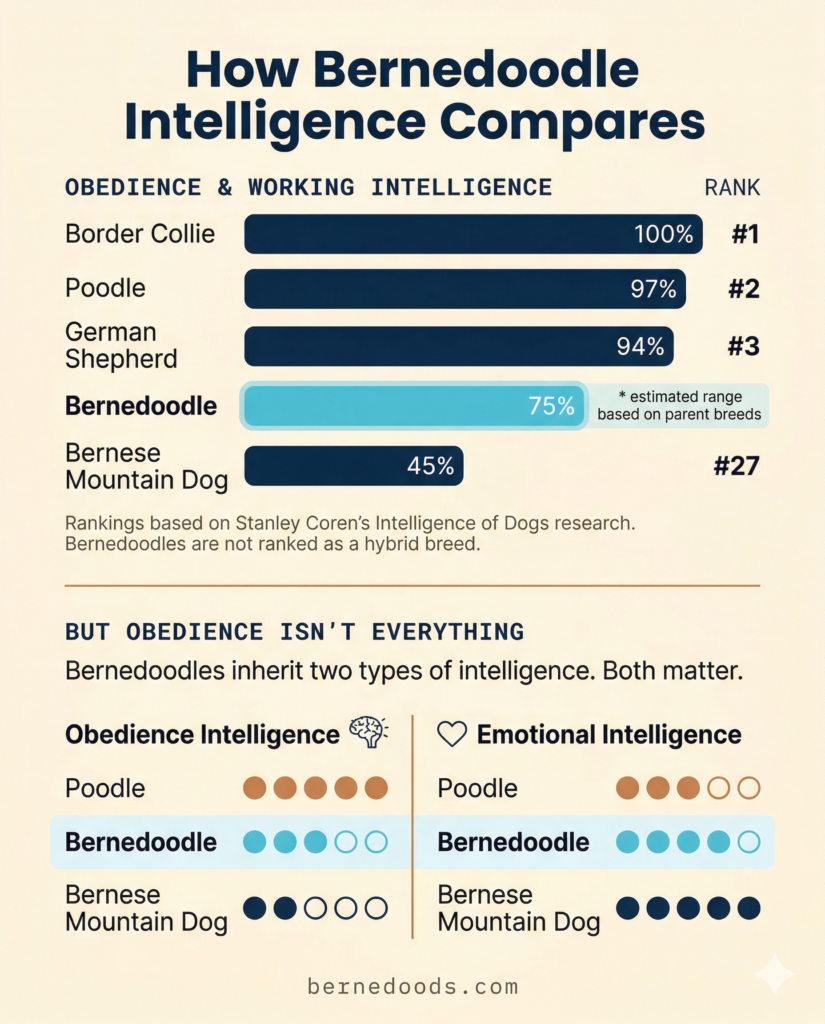
Poodles rank #2 in Stanley Coren’s research on dog intelligence, which evaluated breeds on obedience and working ability.
The metric is specific: how many repetitions it takes a dog to learn a new command, and how reliably they obey on the first try.
Poodles learn new commands in five repetitions or fewer and obey on the first command more than 95% of the time. That’s elite-level performance by any measure.
That contribution carries into bernedoodles in a meaningful way. The Poodle side is responsible for quick uptake, the problem-solving instinct, and eagerness to engage when properly motivated.
Owners with higher Poodle-percentage dogs often describe early training as almost effortless. The dog figures out what you want before you’ve finished asking.
The Bernese contribution: social and emotional intelligence
Bernese Mountain Dogs don’t rank in the top tier for obedience intelligence, and that’s fine, because breeders never selected them for it.
They bred Bernese to work alongside people in the Swiss Alps: not executing rapid commands, but reading situations, staying calm under pressure, and bonding deeply with their families.
What the Bernese contributes to the bernedoodle is a different kind of smart. Emotional attunement.
These dogs notice things.
They pick up on shifts in mood, read body language with unusual accuracy, and orient toward their people in a way that feels almost uncanny to new owners.
A bernedoodle that seems to know you’re having a hard day before you’ve said a word isn’t performing a trick. It’s doing what Bernese Mountain Dogs have been selected to do for generations.
What the mix actually produces
Put those two types together and you get a dog that understands what you want (Poodle), cares deeply about how you feel (Bernese), and retains just enough independence to make its own assessment of whether your request is worth acting on.
Bernedoodles are capable, perceptive, and fast-learning. They also have an opinion about everything.
Owners who work with both sides of that personality tend to have a much better experience than owners who expect pure Poodle compliance from a dog that is, at best, half Poodle.
How Smart Are Bernedoodles Compared to Other Breeds?
Concrete benchmarks help here, so let’s put some numbers on it.
In Coren’s rankings, Standard Poodles sit at #2. Border Collies are #1. German Shepherds are #3. Bernese Mountain Dogs rank around #27, which places them in the above-average working intelligence tier.
They learn new commands in 15 to 25 repetitions and obey on the first command roughly 70% of the time. Capable, but not exceptional on the obedience scale.
Bernedoodles don’t appear in Coren’s rankings as a hybrid. But based on parent breed data and consistent owner reports, most bernedoodles land somewhere between those two benchmarks, and in practice they tend to sit closer to the Poodle end for day-to-day learning. That’s especially true for higher Poodle-percentage generations.
One important caveat: Coren’s research measures a specific kind of intelligence, specifically obedience and working ability. It doesn’t capture social awareness, emotional sensitivity, or problem-solving in non-training contexts.
A dog that ranks #27 for formal obedience can still read a room better than most humans. The rankings are useful, but they’re not the whole story.
Does Generation Affect How Smart a Bernedoodle Is?
Yes, but not in the way most people assume.
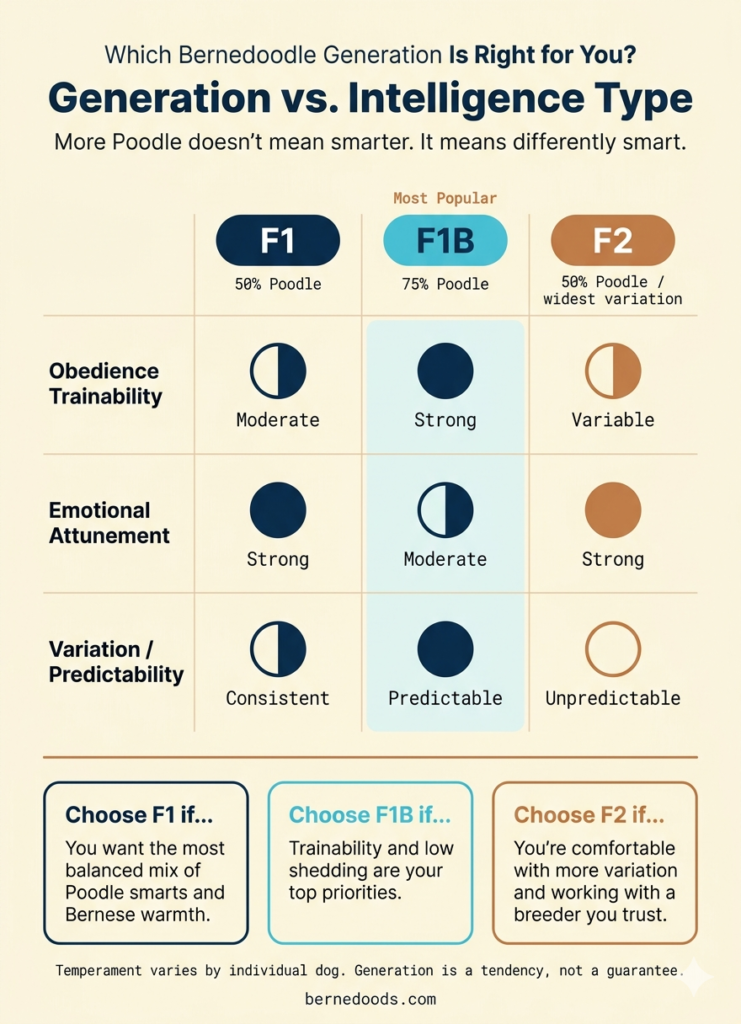
Generation affects the Poodle-to-Bernese ratio in your dog’s genetics, which has a practical influence on how training tends to go. It doesn’t make one dog smarter than another in any absolute sense. It shifts the type of intelligence that’s more dominant.
None of this makes one generation smarter. It means owners with higher Poodle-percentage dogs may find formal obedience training moves faster, while owners with more balanced generations get more of the Bernese emotional intelligence in return.
Different strengths, not a hierarchy.
Are Bernedoodles Easy to Train?
Generally yes, with one caveat worth being direct about. Bernedoodles are easy to train when they’re motivated. When they’re not, they will locate every loophole available to them and use it with great creativity.
Positive reinforcement is not just the recommended approach with this breed. It’s essentially the only approach that works consistently.
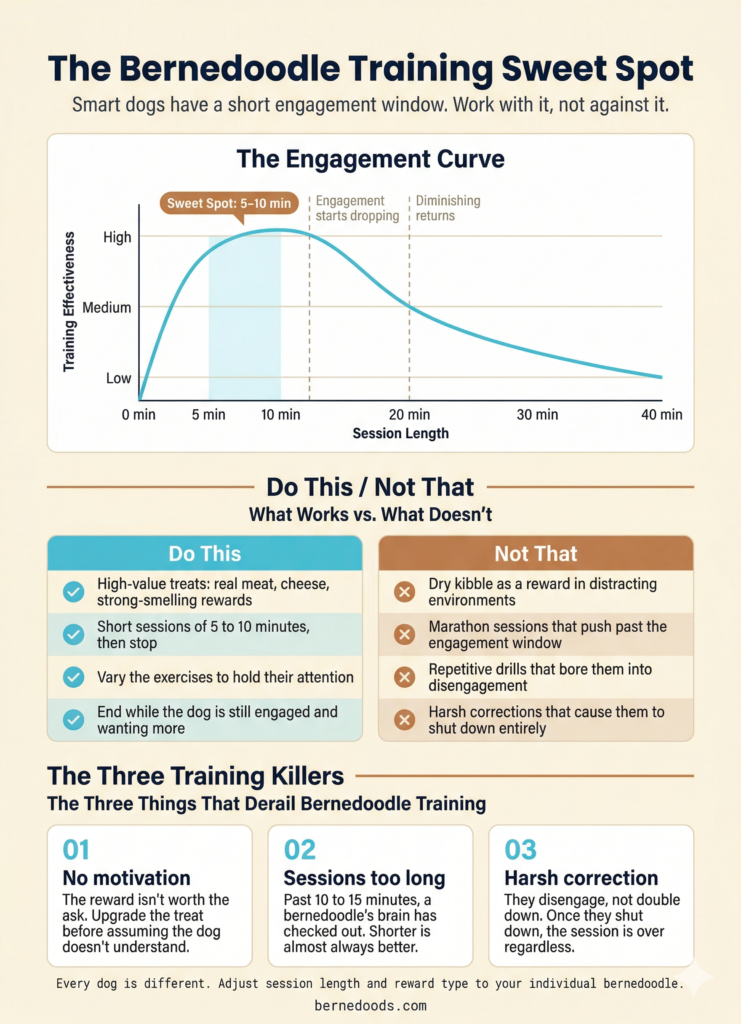
Bernedoodles respond to clear, reward-based training with food as the primary motivator and praise and play as secondary reinforcers.
Sessions should stay short enough to hold their interest. They fall apart under harsh correction, not because they’re fragile but because they shut down.
A bernedoodle that’s been corrected harshly tends to disengage rather than push through, and a disengaged bernedoodle is not a trainable one.
Starting early matters. Puppies are more receptive and haven’t yet developed the full repertoire of negotiating tactics that adult bernedoodles deploy.
Early socialization and structured training from the first weeks home builds habits that carry through adolescence much more reliably than trying to install them later.
The stubborn streak, explained
The Bernese influence on bernedoodle temperament is sometimes described as stubbornness, which is accurate but incomplete. What’s really happening is selective cooperation, and it’s worth understanding the difference.
A stubborn dog doesn’t understand what you’re asking. A selectively cooperative dog understands perfectly and is running its own cost-benefit analysis.
Bernedoodles do the latter.
If you ask for a sit and the reward on offer doesn’t seem worth the effort, a bernedoodle with enough Bernese in its personality will simply look at you with deep, affectionate eyes and not sit.
This is not a comprehension problem. It’s a motivation problem, and it’s fixable.
The solution is making compliance more rewarding than non-compliance, which is basic positive reinforcement. But it requires owners to actually follow through rather than accepting the refusal and moving on. Consistency matters more with this breed than with more naturally deferential dogs.
The stubborn phase also tends to peak in adolescence, roughly between six and eighteen months, when the dog is physically capable of doing whatever it wants and emotionally committed to testing whether it has to.
Most bernedoodles come out the other side of adolescence significantly easier to work with. The training you do during that window matters.
What motivates a bernedoodle in training
Food is the primary lever for most bernedoodles, and high-value treats (real meat, cheese, something with a strong smell) work considerably better than dry kibble in distraction-heavy environments. The reward has to be worth the ask.
Praise works as a secondary reinforcer for dogs that are already well into training, but on its own it’s rarely enough to drive new learning in the early stages. Play, especially with a favorite toy, can substitute for food in dogs that are toy-motivated. Some bernedoodles are.
What doesn’t work: long repetitive drills that exhaust their patience, harsh or confrontational corrections, and training sessions that run past their engagement window. Five to ten minutes of focused training produces more than a forty-minute session that starts well and ends in distraction. Stop while the dog is still interested.
The Double-Edged Sword of a Smart Dog
Smart dogs that don’t get enough mental stimulation become problems.
A bernedoodle with an active mind and not enough to do will find something to do. That something is rarely what you would have chosen. Destructive chewing, nuisance barking, and the specific kind of anxious clinginess that comes from a dog that’s bored and under-stimulated are all expressions of a smart breed not getting enough of what it needs cognitively.
The owners who are blindsided by this are usually the ones who assumed adequate physical exercise would cover it. It doesn’t, at least not entirely.
A bernedoodle that’s been on two walks and had zero mental engagement for the day is still a bernedoodle with energy left to spend, and it will spend it.
Owners who handle it best treat mental stimulation as a non-negotiable part of daily care rather than an optional add-on.
How to Keep a Bernedoodle’s Brain Engaged
Mental stimulation for a bernedoodle doesn’t have to be complicated, but it does have to be consistent.
Scent work is one of the best fits for the breed. The nose is one of the most cognitively demanding tools a dog has, and activities that involve sniffing and searching (whether that’s a formal nose work class or hiding treats around the house) provide significant mental exercise in a short time.
A bernedoodle that spends fifteen minutes working through a sniff search is often more settled afterward than one that spent an hour on a leash walk.
Ongoing training keeps the brain active and reinforces the relationship between dog and owner. Bernedoodles that learn new commands and tricks throughout their lives, not just during the puppy phase, are generally better regulated and easier to live with.
Learning itself is stimulating, and this is a breed that benefits from always having something to learn.
Social outings provide a different kind of engagement. Because bernedoodles are so attuned to people and other animals, new environments, new faces, and new interactions give their social intelligence something to work on.
A trip to a dog-friendly store, a visit to a new park, or a play session with an unfamiliar dog all count.
Puzzle feeders and food toys are useful supplements, but treat them as exactly that: supplements.
A dog that only gets mental stimulation through a Kong and a snuffle mat is getting less variety than one whose owner also trains, socializes, and engages with them directly.
The Bottom Line
Bernedoodles are smart in a way that rewards owners who engage with them and occasionally frustrates owners who expect automatic compliance.
The Poodle genetics give them real capacity: fast learning, strong problem-solving, and the ability to pick up complex behaviors when training is consistent and rewarding. The Bernese genetics give them something different but equally valuable: emotional attunement, social awareness, and a deep investment in the people around them. What you get is a dog that understands you well and genuinely cares about you, and that combination is worth more in daily life than a raw obedience ranking.
The stubborn streak is real but manageable. The mental stimulation requirement is real and non-negotiable.
Related Posts
-
Bernedoodles Are Great Dogs. They’re Also Not for Everyone.
You’ve seen the Instagram photos. You’ve read the glowing breeder sites. You’ve also seen the rescue posts, the “what have…
-
What Is an Ultra Bernedoodle? What to Know Before You Start Breeder Shopping
If you’ve spent any time on breeder websites lately, you’ve probably seen the term “ultra bernedoodle” thrown around alongside F1s,…
-
Micro & Toy Bernedoodles: The Smallest Sizes Explained
You’re looking at two breeder websites. One says micro bernedoodles weigh 10 pounds. The other says 30. Both are using…
-
Furnished vs. Unfurnished Bernedoodles: What’s the Difference?
A furnished bernedoodle has the shaggy, bearded face that gives doodles their teddy-bear look. An unfurnished bernedoodle has a smoother,…