Are Bernedoodles High Energy or Calm? Activity Levels Explained
If you’ve spent any time researching bernedoodles, you’ve seen them described as “laid-back couch dogs” and “high-energy bundles of chaos” in the same Google search.
Both descriptions show up because both are technically true, just for different dogs at different life stages.
The short answer: most adult bernedoodles are moderate-energy dogs.
They need daily exercise and mental engagement, but they’re generally happy to settle once those needs are met.
Where your specific dog falls on the spectrum depends on size, generation, age, and, more than most people realize, how you raise them.
Bernedoodles Have Moderate Energy With a Wide Range
Bernedoodles are not a high-energy breed. They’re also not couch potatoes. The best description is moderate energy with a calm disposition, which means they want daily exercise and interaction but don’t need to run five miles to be happy.
That said, the range within the breed is wider than most people expect.
A 90-pound standard bernedoodle who’s content with two 30-minute walks and a 15-pound micro who vibrates with pent-up energy if she misses her afternoon fetch session are both normal bernedoodles. They just operate at different RPMs.
How Size Affects Energy Levels
Size is the single biggest predictor of a bernedoodle’s baseline energy. The reason is straightforward: the Bernese Mountain Dog is always the calm half of the equation. The Poodle parent is the variable, and smaller Poodles tend to carry more energy than Standards.
Standard Bernedoodles: The Calmest of the Three
Standards inherit the most Bernese influence relative to their size, and it shows. They’re the most naturally laid-back of the group, content with moderate daily exercise and long stretches of doing absolutely nothing. If your image of a bernedoodle is a big fluffy dog draped across the couch while you work, you’re picturing a standard.
That doesn’t mean they’re lazy. A standard bernedoodle still needs daily walks and playtime. But their default state leans toward calm, and they don’t get restless as quickly as smaller sizes when activity is delayed.
Mini Bernedoodles: More Drive, More Go
Minis are the most popular size, and part of the reason is that they’re fun to be around. They carry more energy than standards, are quicker to initiate play, and tend to stay active for longer stretches.
The Miniature Poodle parent brings a level of drive and alertness that you can feel in daily life.
For active families, this is a feature. For people expecting a purely mellow companion, it can be a surprise.
Mini bernedoodle owners consistently report that their dogs need more engagement, not just more walking, but more mental stimulation, more interactive play, more variety in their routine.
Micro and Toy Bernedoodles: Small Dog, Big Energy
This catches people off guard. Micro and toy bernedoodles may be the smallest, but they’re often the most energetic per pound. Toy Poodles are active, alert dogs, and that influence concentrates in a compact package.
Micros can also be more reactive, meaning they’re quicker to bark, quicker to get excited, and sometimes quicker to develop anxious energy if they’re not properly exercised and stimulated.
They’re wonderful dogs, but “small” does not automatically mean “easy.”
Here’s how the three sizes compare on activity level and exercise needs.
| Size | Typical Energy | Daily Exercise Needs | Default Setting |
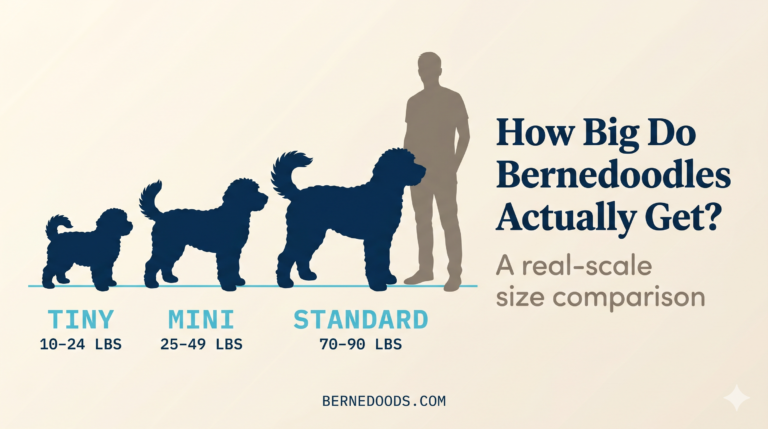
| Standard (70–90 lbs) | Moderate | 45–60 min walking + play | Calm and settled |
| Mini (25–49 lbs) | Moderate–high | 60–75 min walking + active play | Alert and engaged |
| Micro/Toy (10–24 lbs) | High | 45–60 min walking + mental work | Busy and reactive |
If you’re specifically looking for a calm bernedoodle, a standard gives you the best odds. If you want one that’s ready for anything and keeps you on your toes, a mini or micro will deliver.
Does Generation Matter for Energy?
Yes, but less than size and less than most people think.
The connection is indirect. Generation determines the percentage of Poodle genetics in the mix, and Poodles, as a breed, carry more drive and alertness than Bernese Mountain Dogs.
So a bernedoodle with a higher Poodle percentage (F1B, F1BB) may trend slightly more energetic and alert than an F1 with its even 50/50 split.
In practice, though, the difference is subtle.
An F1B isn’t going to feel like a different breed from an F1. You might notice a bit more eagerness to play, a bit more responsiveness during training, or a slightly quicker trigger on excitement. But it’s a nudge, not a gear shift.
The real takeaway is, don’t choose a generation based on energy level. Choose it based on shedding and coat type, which is where generation makes a much bigger practical difference. Energy is shaped more by size, individual temperament, and how you raise the dog.
When Do Bernedoodles Calm Down?
Most bernedoodles start noticeably settling between 18 months and 2.5 years, with full behavioral maturity arriving around age 3. That’s the direct answer. Here’s what the journey looks like.
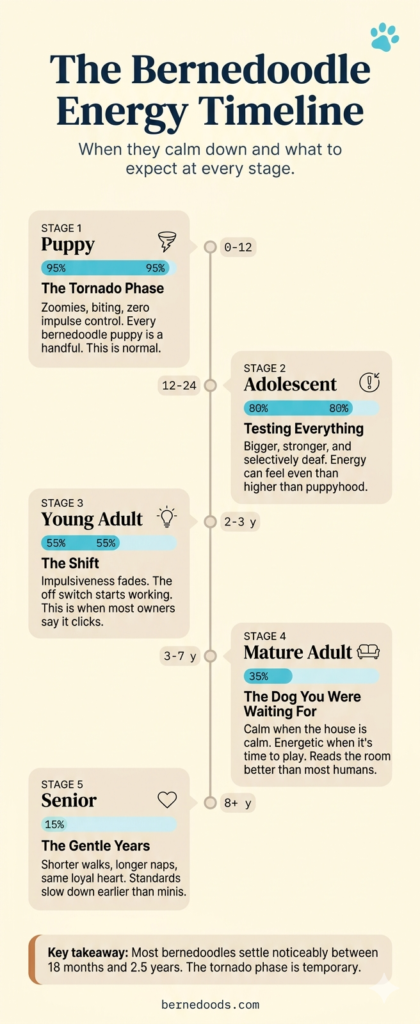
Puppyhood (0–12 Months): The Tornado Phase
Every bernedoodle puppy is a handful. This is not a breed-specific observation. It’s a puppy observation. Expect biting, zoomies, short attention spans, counter surfing, sock theft, and a general inability to sit still for more than four minutes.
Bernedoodle puppies are often described as “goofy tornadoes,” and that’s about right. The goofy part is the Bernese influence. The tornado part is just being a puppy.
Standards may be slightly calmer during this phase than minis, but the difference is marginal. All of them are a lot.
Adolescence (12–24 Months): Testing Everything
This is the phase that breaks people. Your bernedoodle knows the commands. They’re choosing to ignore them. Adolescent bernedoodles push boundaries, regress on training, and develop selective hearing at the worst possible moments.
Energy levels during adolescence can actually feel higher than puppyhood because the dog is now bigger, stronger, and more confident.
A 60-pound adolescent bernedoodle with the zoomies is a very different experience than a 15-pound puppy with the zoomies.
This is also the window where separation anxiety tends to show up most visibly. A dog that seemed fine alone at 5 months might start struggling at 14 months. It’s not exactly a regression. It’s the attachment deepening as the dog matures emotionally.
Patience and consistency matter most here. Adolescence is temporary. The training you invest during this phase pays off permanently.
Young Adult (2–3 Years): The Shift
This is when most owners say their bernedoodle “finally became the dog we expected.” Somewhere between 2 and 3, the impulsiveness fades, the settling ability clicks, and the dog starts making better decisions on its own.
You’ll still see zoomies. You’ll still see playful energy. But the baseline drops, and the dog learns to regulate between active and calm without needing you to manage every transition.
Mini bernedoodles often take slightly longer to reach this phase than standards, sometimes closer to 2.5 or 3 years rather than 2.
Mature Adult (3+ Years): The Dog You Were Waiting For
By age 3 and beyond, most bernedoodles have fully settled into their adult temperament. They’re calm when the house is calm, energetic when it’s time to play, and generally able to read the room better than most humans.
Seniors (roughly 8+ years) slow down further, preferring shorter walks and more rest. For standard bernedoodles, you may notice this shift earlier than for minis or micros, whose smaller bodies tend to stay active longer.
The Difference Between Energy and Hyperactivity
This distinction matters, and almost nobody talks about it.
A bernedoodle with healthy energy needs exercise and stimulation, gets it, and then settles. They have an on switch and an off switch, and both work. This is normal. This is what the breed is supposed to look like.
A bernedoodle that seems hyperactive can’t settle even when their physical needs are met. They pace, they demand attention constantly, they escalate instead of winding down after a walk.
This is almost always a signal that something is missing whether that be mental stimulation, settle training, routine, or, in some cases, a visit to the vet.
Many bernedoodle owners who describe their dogs as “hyper” are actually describing a dog that gets plenty of physical exercise but almost no mental engagement. A tired body with a bored brain is a recipe for a dog that can’t relax.
The part most people miss:A bernedoodle that can’t settle down after a walk isn’t “high energy.” It’s usually a dog that needs more mental stimulation, settle training, or both. If your adult bernedoodle never seems to have an off switch, the issue is almost always training or enrichment, not genetics.
Indoor Calm, Outdoor Energy: The Bernedoodle Pattern
Talk to enough bernedoodle owners and a pattern emerges: calm and quiet inside the house, bursting with energy the moment they step outside.
A dog that can distinguish between indoor and outdoor appropriate behavior is a dog that’s learned to read context, and bernedoodles are especially good at this.
The indoor calm comes from the Bernese side. Bernese Mountain Dogs were bred as farm dogs who spent long periods resting between work.
The outdoor energy comes from the Poodle side. Poodles are athletic, driven dogs who were originally bred to retrieve in water.
The combination produces a dog that lounges in the living room and lights up at the dog park. If that’s what you’re looking for, you’re looking at the right breed.
How Much Exercise Does a Bernedoodle Actually Need?
The generic advice floating around the internet is “60 minutes a day.” That’s a decent starting point for minis, but it’s not the full picture. Exercise needs vary by size, and what counts as exercise matters as much as how long you do it.
Physical Exercise
Walks are the baseline. Standards do well with 45 to 60 minutes of walking per day, split across two outings. Minis benefit from closer to 60 to 75 minutes, and they do better when some of that time includes higher-intensity activity like fetch, tug, or off-leash running.
Micros need less total time (45 to 60 minutes) but more variety. Their energy comes in bursts, and they burn out faster but recharge faster too.
Swimming is an excellent option for all sizes. It tires dogs out faster than walking, is easy on joints (especially important for standards), and most bernedoodles take to water naturally.
Mental Stimulation
This is the piece most owners underestimate, and it’s arguably more important than physical exercise for keeping a bernedoodle calm.
Bernedoodles are smart dogs. They inherited the Poodle’s intelligence, and that brain needs work. Puzzle feeders, snuffle mats, nose work, and short training sessions (10 to 15 minutes of focused obedience or trick work) are all effective. Twenty minutes of mental exercise can tire a bernedoodle as much as an hour-long walk.
A good daily routine combines both: physical exercise to meet the body’s needs, mental stimulation to meet the brain’s.
Here’s a practical breakdown by size.
| Size | Physical Exercise | Mental Stimulation | Signs They Need More |
| Standard | 45–60 min/day | 15–20 min/day | Restlessness, pacing, demand barking |
| Mini | 60–75 min/day | 20–30 min/day | Destructive chewing, inability to settle |
| Micro/Toy | 45–60 min/day | 20–30 min/day | Excessive barking, reactive behavior |
These are starting points. Every dog is an individual. If your bernedoodle is settling nicely after their daily routine, you’re in the right range. If they’re climbing the walls, they need more, and the missing piece is usually mental, not physical.
Calm Is Trained, Not Just Inherited
This is the section most bernedoodle articles skip entirely, and it’s the one that matters most for owners.
Genetics set the range. Training determines where your dog lands within it. A bernedoodle from calm parents can still become a chaotic adult if it never learns to settle. And a bernedoodle with higher natural energy can become a wonderfully calm house dog if its owner puts in the work.
Settle Training
Teaching a dog to settle on cue is one of the most valuable skills you can build, and one of the least commonly taught.
The concept is simple: reward the dog for lying down quietly in a designated spot. Start with short durations, build up gradually, and practice in different environments.
Most bernedoodles pick this up quickly because they already want to be near you. Giving them a mat or bed near your workspace and rewarding calm behavior there creates a default “off switch” that the dog can access on its own.
Enforced Naps
Puppies and adolescent bernedoodles need far more sleep than most owners realize: 16 to 20 hours a day for puppies, 14 to 16 for adolescents.
An overtired bernedoodle doesn’t get sleepy. It gets wired. Just like a human toddler. If your puppy is zooming around the house at 8 PM like it’s been plugged into a wall socket, it’s probably overtired.
Crate-based or pen-based enforced naps after play sessions teach the dog that rest is part of the routine, not something that only happens when they crash from exhaustion.
Routine and Structure
Bernedoodles thrive on predictability. A consistent daily schedule (walk, play, rest, meal, repeat) reduces anxiety and gives the dog a framework for when to be active and when to relax.
The calmest bernedoodles almost always belong to owners who have built a structured routine. It’s not that those dogs got lucky genetically (though some did). It’s that the routine taught them when and how to be calm.
What Doesn’t Work: “Running It Out”
A common mistake is thinking that more exercise will make a hyper dog calmer. It can, to a point. But past that point, you’re just building a fitter dog that needs even more exercise to tire out. It’s a losing race.
Exercise matters. But if your bernedoodle is getting adequate physical activity and still can’t settle, adding another mile to the walk won’t fix it. The solution is almost always mental stimulation, settle training, or both.
When High Energy Is a Red Flag
Normal bernedoodle energy looks like: excited before walks, playful during interactions, calm after exercise, occasional zoomies, and the ability to settle when nothing is happening.
These patterns are worth paying attention to because they might signal something beyond normal energy:
None of these are breed-specific problems. They’re dog problems that can happen in any breed. But they’re worth mentioning because “He’s just high energy” can become an excuse that delays addressing a real issue.
How Bernedoodles Compare to Other Doodles on Energy
If you’re choosing between doodle breeds and energy level is a deciding factor, bernedoodles sit at the calmer end of the spectrum.
Goldendoodles tend to carry more sustained energy. Golden Retrievers are enthusiastic, go-go-go dogs, and that influence shows up in their doodle offspring.
Labradoodles are similar, with the Labrador’s high drive pushing energy levels up. Aussiedoodles (Australian Shepherd x Poodle) are arguably the most energetic of the common doodle crosses, since both parent breeds are high-drive working dogs.
The Bernese Mountain Dog is the difference. It’s a breed that was comfortable doing nothing for hours between work sessions, and that calm, low-key baseline transmits to the bernedoodle in a way that separates it from other doodles.
This is one of the main reasons people choose bernedoodles specifically. They want the doodle coat with less doodle chaos.
The Bottom Line
Bernedoodles are moderate-energy dogs whose actual activity level depends on size, age, generation, and training. Standards tend to be the calmest. Minis are more energetic. All of them settle significantly between 18 months and 3 years, and most adults are calm, easy-going companions when their exercise and mental stimulation needs are met.
The most important factor is also the one you control directly: how you raise them. Settle training, consistent routine, and mental enrichment do more to shape a calm bernedoodle than genetics alone.
For a broader overview of the breed’s personality, start with the temperament section of our complete bernedoodle guide.
Related Posts
-
Are Bernedoodles Hypoallergenic?
No dog is 100% hypoallergenic, and bernedoodles are no exception. But most bernedoodles are a strong option for allergy sufferers,…
-
What Is an Ultra Bernedoodle? What to Know Before You Start Breeder Shopping
If you’ve spent any time on breeder websites lately, you’ve probably seen the term “ultra bernedoodle” thrown around alongside F1s,…
-
When Do Bernedoodles Calm Down? (Asking For A Friend)
If you’re reading this at 10pm after your bernedoodle ricocheted off the couch, stole something important, and is currently staring…
-
What Is An Australian Bernedoodle? (Including What It Is Not)
If you’ve been researching bernedoodles, you’ve probably run into the term “Australian bernedoodle” and wondered if it’s a different breed,…
-
Micro & Toy Bernedoodles: The Smallest Sizes Explained
You’re looking at two breeder websites. One says micro bernedoodles weigh 10 pounds. The other says 30. Both are using…
-
How Big Do Mini Bernedoodles Get?
If you’re here, you probably fall into one of two camps. You’re either shopping for a mini bernedoodle and trying…