
Do Bernedoodles Bark a Lot? An Honest Look at Noise Levels
You’re researching bernedoodles and you want to know what your neighbors are in for. Fair question. Barking is one of those breed traits that can quietly ruin daily life if you pick wrong.
The short answer: most bernedoodles aren’t heavy barkers.
But there’s more honest nuance here than most breed guides admit, and a real minority of bernedoodles are genuinely vocal dogs.
We’ll explore the whole picture (including what separates the quiet ones from the loud ones).
Do Bernedoodles Bark a Lot?
No, not usually. Bernedoodles are considered moderate-to-low barkers, and most owners report their dog only barks with clear purpose. A knock at the door, a stranger on the property, a squirrel crossing the yard. Then they stop.
But, sppend any time in bernedoodle owner communities and a pattern shows up.
Most bernedoodles rarely bark. A meaningful number bark with clear purpose but not constantly. And a real minority are genuinely vocal dogs. Those three groups aren’t evenly sized.
The quiet camp is clearly the largest. But the vocal minority is big enough that you shouldn’t assume your bernedoodle will fall into the easy category by default.
So “bernedoodles don’t bark much” is true on average. Averages hide outliers, though. If you end up with a dog on the louder end, the generic advice on most breeder blogs won’t help you much. We’ll get to that.
Where Bernedoodles Land on the Barking Spectrum
Context matters. Here’s how bernedoodles compare to other popular breeds and doodles.
| Breed | Barking Tendency | Notes |
|---|---|---|
| Beagle | High | Bred to vocalize while hunting. Bays and howls. |
| Miniature Schnauzer | High | Alert, reactive, vocal by design. |
| Goldendoodle | Moderate to high | Golden Retriever side is expressive. |
| Aussiedoodle | Moderate to high | Herding drive adds vocal reactivity. |
| Cavapoo | Moderate | Less vocal than most doodles. |
| Bernedoodle | Low to moderate | Bernese side typically wins on quietness. |
| Bernese Mountain Dog | Low | Alert bark only. Rarely reactive. |
| Bulldog | Low | One of the quieter breeds overall. |
| Basenji | Very low | Doesn’t bark traditionally at all. |
Within the doodle category, bernedoodles are on the quieter end. Goldendoodles tend to be more expressive thanks to the Golden Retriever’s vocal nature. Aussiedoodles carry the Australian Shepherd’s herding reactivity, which often comes with barking at movement. Bernedoodles inherit their calmer disposition from the Bernese Mountain Dog side, and it shows in their vocal habits.
Why Bernedoodles Tend to Be Quieter Than You’d Think
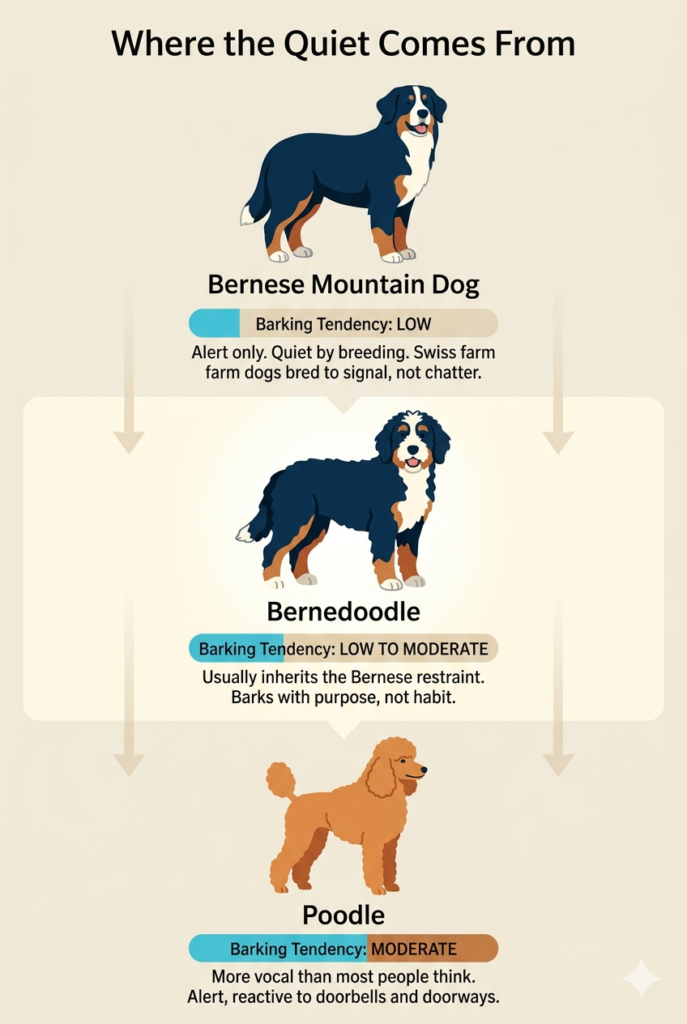
This may or may not come as a surprise, but Poodles are actually somewhat vocal.
Most people assume the Poodle contributes the quiet, elegant half of the bernedoodle equation. That’s not quite right.
Poodles are intelligent and alert, and that alertness often translates into barking at doorbells, at people walking past the window, and at unfamiliar sounds. Mini and Toy Poodles especially have a reputation among their owners for being reactive.
The Bernese Mountain Dog is where the calm comes from. Bernese were bred as Swiss farm dogs, alert enough to signal when something was off but too even-tempered to bark at every leaf that blew by. They use their voice sparingly. When they do, it’s usually an alert bark, short and deliberate.
Most bernedoodles land closer to the Bernese end of this spectrum on barking specifically. That’s why a bernedoodle is typically quieter than its Poodle parent, even though Poodles contribute so much of the breed’s other defining traits.
That said, F1B and F1BB bernedoodles, with higher Poodle percentages, sometimes lean slightly more alert and reactive than F1s. The difference is subtle and not universal, but it’s there.
When Bernedoodles Do Bark: The Real Triggers
Every dog has reasons. Bernedoodle barking usually falls into one of these categories:
Worth Noting: Demand barking is very often a trained behavior, not a breed trait. If your bernedoodle barks every time they want food, attention, or the door opened, and you respond by providing what they want, you’ve taught them that barking works. Bernedoodles are smart enough to figure out the lever in about a week.
Do Mini Bernedoodles Bark More Than Standards?
Slightly, on average. Not dramatically.
Mini bernedoodles inherit from a Miniature Poodle parent, and Miniature Poodles are somewhat more vocal and alert than Standard Poodles. Some of that carries through.
Owners of mini bernedoodles report a higher rate of alert barking at doorbells, strangers, and outside activity. The bark itself is usually less loud than a standard’s, but it can be more frequent.
Our Max is a mini, and he’s on the heavier-barking end for his size. Plenty of mini bernedoodles are quiet dogs. But the slight bias toward vocality in the mini version is real, and it’s worth factoring in if you’re choosing between sizes and live in an apartment or share walls with neighbors.
Do Bernedoodles Howl?
Some do. Most don’t.
Howling isn’t a defining bernedoodle trait. You won’t see it listed on any breed profile as a common behavior. But Poodles inherited a faint wolf-era howling tendency that occasionally shows up in doodle offspring, and a subset of bernedoodles will howl along with sirens, certain music, or loud environmental sounds.
More commonly, howling in a bernedoodle is a signal of distress. Separation anxiety, in particular, can produce howling when a dog is left alone. There have been a few times when Max has started howling in the middle of the night, and we have to go downstairs to remind him that everyone is still in the house with him.
If your bernedoodle is howling regularly when you leave the house, it’s a sign worth addressing. We don’t let Max “cry it out” when it comes to howling.
What If Your Bernedoodle Is a Heavy Barker?
If you already have a bernedoodle who barks at everything, the first thing to know is that you’re not alone and you haven’t necessarily done something wrong. Some bernedoodles are simply more vocal, and others develop anxiety or reactivity issues that drive barking in ways training didn’t cause and won’t fix overnight.
The second thing to know is that the right intervention depends entirely on which type of barking you’re dealing with. Generic “more exercise, more training” advice is what most articles give, and it’s not always the right answer.
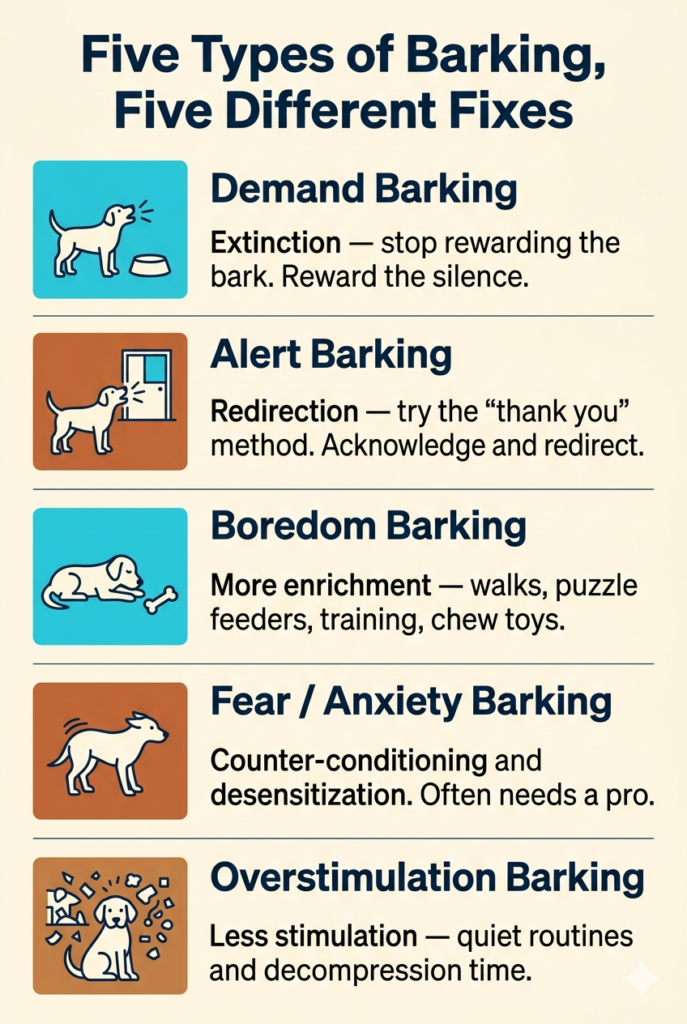
A quick map of the main types:
Max falls into the fear and anxiety category, and we’ve been working on it for a long time. His barking is largely a wiring issue that responds slowly to consistent counter-conditioning, routine, and keeping him under threshold when we can.
Some weeks are better than others. We’re not going to pretend there’s a fast fix, because there isn’t one. If you’re in the same boat, a qualified trainer or veterinary behaviorist is worth the investment. (This is what we had to do.) The generic advice isn’t going to cut it.
The Adolescent Barking Phase
One more thing worth flagging. Many bernedoodles go through a vocal phase between roughly eight and fourteen months, even if they were quiet as puppies.
This lines up with canine adolescence, the doggy equivalent of the teenage years. Dogs who were previously well-socialized can suddenly become reactive, barky, or fearful at stimuli that never bothered them before. Window reactivity shows up. Barking at the TV starts. Barking at strangers on walks ramps up.
This phase is normal and usually passes by around 14 to 18 months with consistent, patient training. It’s not a sign you’ve failed. It’s a sign your dog is going through a developmental stage. Don’t panic, and don’t give up on the socialization and training work you’ve already done.
Can You Train a Bernedoodle Not to Bark?
Yes, with realistic expectations.
Bernedoodles are intelligent and responsive to training, which is both good news and a caveat. The good news is that most of them learn cues like “quiet” quickly when trained with positive reinforcement.
The caveat is that training works best when it matches the type of barking. Training a “quiet” cue will help with demand and alert barking. It will barely move the needle on fear-based reactivity.
For most bernedoodles, basic work goes a long way. Reward quiet behavior. Ignore demand barking. Build a reliable “quiet” cue using the classic “speak” and “quiet” method. Keep daily exercise and mental stimulation consistent. Start socialization early and keep it going through adolescence.
For the minority of bernedoodles with deeper anxiety or reactivity issues, pair that foundation with professional help.
Fear-based barking in particular benefits from a certified trainer or veterinary behaviorist who can build a counter-conditioning plan around your specific dog’s triggers. Our Max has been working through his for a while now. Progress is real but not linear.
The Bottom Line on Bernedoodle Barking
Most bernedoodles are quiet dogs. They bark with purpose and move on. If you’re choosing this breed partly because you don’t want a yappy house, the odds are solidly in your favor.
A real minority of bernedoodles, though, are genuinely vocal. Sometimes that’s demand barking, which is fixable. Sometimes it’s adolescent reactivity, which passes. Sometimes it’s fear or anxiety, which takes real work.
The honest version of this answer isn’t “they don’t bark much.” It’s: most don’t, some do, and which camp your dog lands in depends on genetics, socialization, training, and luck.
If you’re already living with a barker, be patient with yourself and your dog. If you’re choosing a puppy, meet the parents, ask the breeder about their temperament, and prioritize early socialization. That’s more predictive than generation or size when it comes to whether your bernedoodle grows up quiet.
Related Posts
-
Are Bernedoodles Hypoallergenic?
No dog is 100% hypoallergenic, and bernedoodles are no exception. But most bernedoodles are a strong option for allergy sufferers,…
-
What Is an Ultra Bernedoodle? What to Know Before You Start Breeder Shopping
If you’ve spent any time on breeder websites lately, you’ve probably seen the term “ultra bernedoodle” thrown around alongside F1s,…
-
When Do Bernedoodles Calm Down? (Asking For A Friend)
If you’re reading this at 10pm after your bernedoodle ricocheted off the couch, stole something important, and is currently staring…
-
What Is An Australian Bernedoodle? (Including What It Is Not)
If you’ve been researching bernedoodles, you’ve probably run into the term “Australian bernedoodle” and wondered if it’s a different breed,…