How Big Do Bernedoodles Get? That Is The Million Dollar Question.
If you’ve spent any time on breeder websites trying to figure out how big a bernedoodle actually gets, you’ve probably noticed that the numbers vary a lot.
One site says a mini bernedoodle tops out at 35 pounds. Another says 55 pounds. A third throws in a “medium” category that doesn’t seem to exist anywhere else.
And if we’re being honest, there is a big difference between a 35-pound dog and a 55-pound dog. What do you mean that’s the range?
First, the basics. There are three official bernedoodle size categories: Tiny/Toy, Mini, and Standard. We’ll break down what each one actually means in terms of weight and height, explain why the published ranges are wide (there’s a good reason), and give you the practical information you need to figure out which size fits your life.
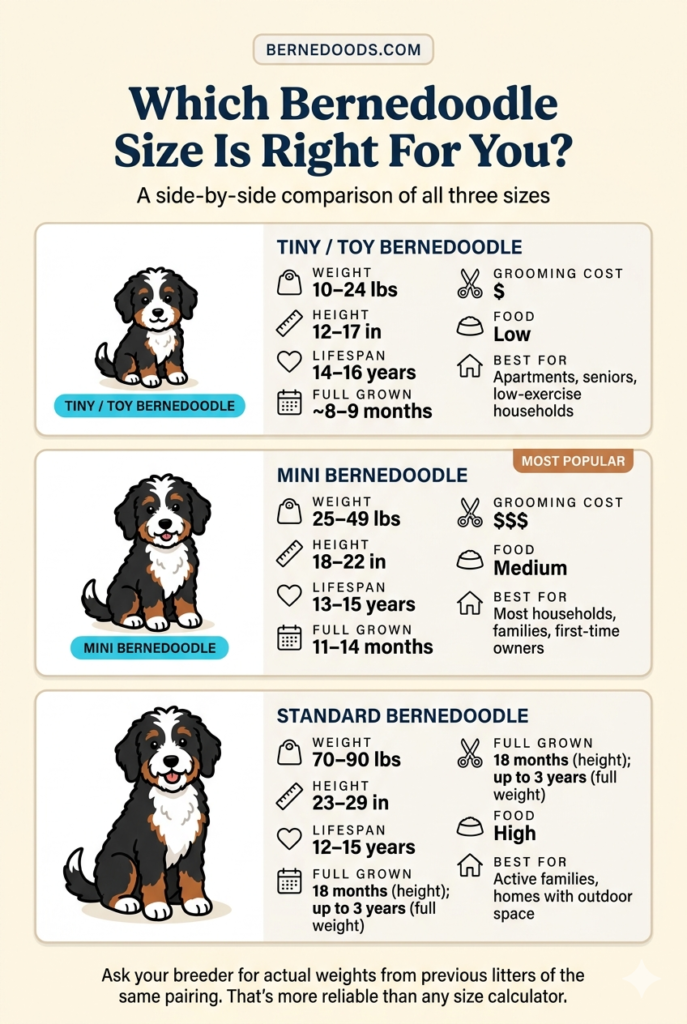
Bernedoodle Size at a Glance
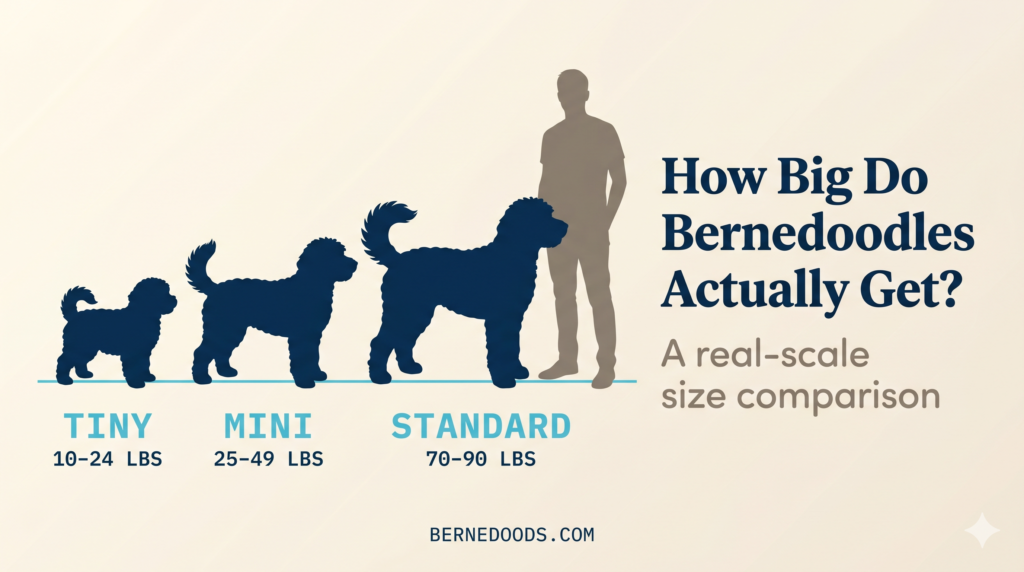
Here’s how the three size categories compare. The ranges are intentionally honest — more on why they’re wide in the next section.
| Size | Weight | Height | Full grown by | Best for |
|---|---|---|---|---|
| Micro/Toy | 10–24 lbs | 12–17 in | ~8–9 months | Apartments, seniors, low-exercise households |
| Mini | 25–49 lbs | 18–22 in | ~11–14 months | Most households, families, first-time owners |
| Standard | 70–100 lbs | 23–29 in | ~18–24 months* | Active families, homes with outdoor space |
*Standard bernedoodles reach full height around 18 months but may not reach their maximum weight until age 2–3.
Why the Size Ranges Are So Wide
There’s no official breed standard for a Bernedoodle, which means size categories like “mini,” “medium,” and “standard” aren’t consistently defined across breeders.
Unlike purebred dogs recognized by organizations like the American Kennel Club, there’s no single guideline that determines what those labels should mean, so one breeder’s “mini” may overlap with another’s “small standard.”
But labeling isn’t the main reason Bernedoodles vary so much in size. Genetics are.
Sex adds another layer. Males typically run 10 to 15 percent larger than females across all three size categories. The published ranges blend both sexes together, so a male mini near the top of the range and a female near the bottom are both technically correct.
The Three Bernedoodle Sizes, Broken Down
Micro/Toy Bernedoodles
Weight: 10–24 lbs
Height: 12–17 inches
Full grown: ~8–9 months
Best for: Small spaces, seniors, low-exercise households
Tiny and Toy are used interchangeably. They refer to the same size category. In real-world terms, a Tiny bernedoodle is roughly the size of a Cavalier King Charles Spaniel. They’re portable, apartment-friendly, and reach their adult size faster than any other category.
How they’re produced matters here.
Tiny bernedoodles are typically bred by pairing a Mini bernedoodle with a Toy Poodle, not two Standard-sized parents.
The breeding approach is more involved, and that’s part of why reputable breeders who do it well are relatively uncommon. Some less scrupulous operations produce Tinys by pairing runts of the litter together, which can introduce compounding health issues.
If you’re considering a Tiny, it’s worth asking your breeder directly how they achieve that size and whether they’ve tested parent dogs for genetic health conditions.
One label worth flagging: “Teacup” bernedoodles. This is not a recognized size category. If you see a breeder advertising Teacup bernedoodles, ask a lot of questions before proceeding.
Mini Bernedoodles
Weight: 25–49 lbs
Height: 18–22 inches
Full grown: ~11–14 months
Best for: Most households, families, first-time owners
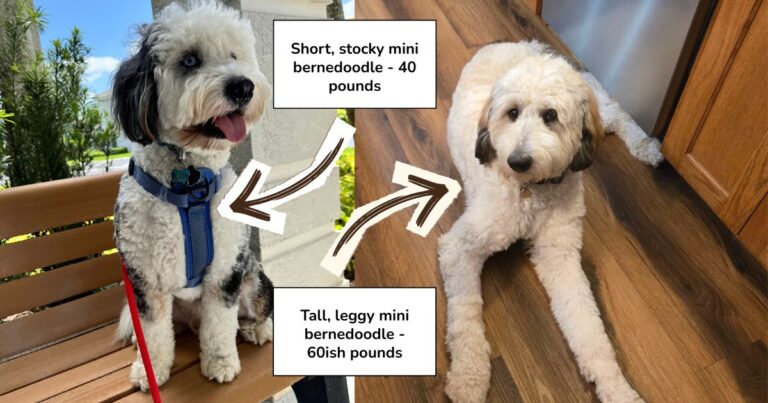
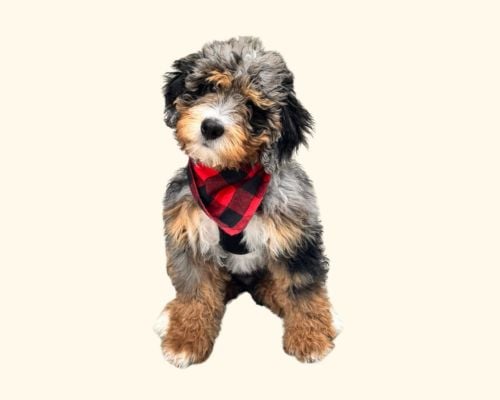
Mini bernedoodles are the most popular size category, and for good reason: they offer much of the bernedoodle temperament and look without the full footprint of a Standard. But “mini” is a relative term. A 25-pound mini and a 49-pound mini are genuinely different dogs to live with, and the range is wide enough that it’s worth pressing your breeder on where their litters typically land.
Our own mini is a useful data point.
At nearly two years old, he’s 40 pounds — right in the middle of the range, but on the stockier side. As a puppy, he had enormous paws, the kind that typically signal a much bigger dog.
We expected him to land closer to 55 pounds. Instead, he stopped growing in height around the 35-pound mark and then mostly just filled out from there. The big-paw theory, it turns out, is more fun to speculate about than it is reliable.
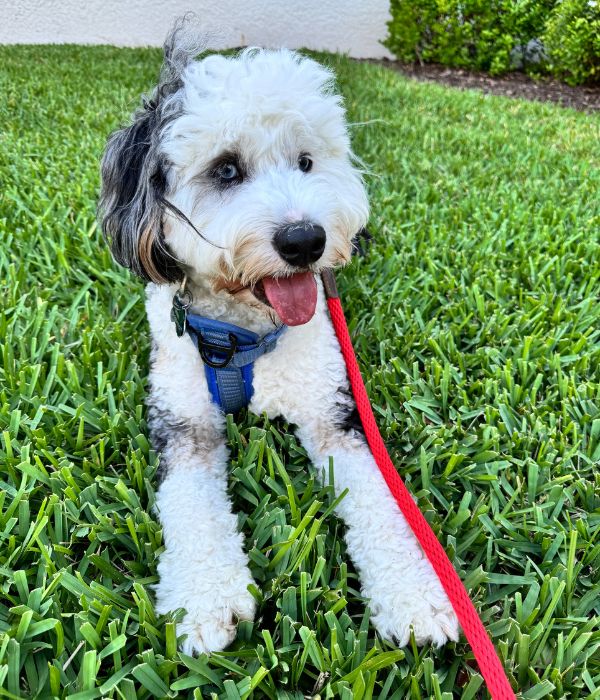
There’s also an honest reality about life at the upper end of the mini range that no one talks about much. A 40-to-45-pound dog occupies an awkward middle ground: too big to easily scoop up in an emergency, but too small to jump into a car or onto a bed without help. It’s not a dealbreaker, but worth knowing going in.
You may also see some breeders use the term “medium bernedoodle” for dogs that fall between the upper mini range and the lower standard range. This is not an official category, but it does get used when a dog ends up bigger than expected for a mini or smaller than expected for a standard.
Standard Bernedoodles
Weight: 70–100 lbs
Height: 23–29 inches
Full grown: ~18 months (height); up to 3 years (full weight)
Best for: Active families, homes with outdoor space
A Standard bernedoodle is roughly the size of a Labrador Retriever, and it’s the size that most closely captures the classic Bernese Mountain Dog look that draws people to the breed. If the tricolor coat and that unmistakably plush bernedoodle face are the whole point for you, the Standard usually delivers that most fully.
The practical considerations are real, though. Grooming costs scale with size, and for a Standard with a full coat, that can mean $200 or more per professional groom. Food costs are substantial — a growing Standard can eat six to eight cups of kibble a day. And a large, energetic dog that hasn’t been trained is a different proposition on a leash than a 40-pound mini. Standards benefit meaningfully from structured training early, ideally before they’ve reached their full size and strength.
Bloat (gastric dilatation-volvulus) is a genuine health risk in large, deep-chested breeds. It’s worth understanding the signs and prevention before bringing home a Standard. [CROSS-PILLAR: Health — bloat in large breeds]
Lifespan is also a real factor. Standards typically live 12 to 15 years. Tiny and Toy bernedoodles, by contrast, often reach 14 to 17 years. That’s not a reason to avoid a Standard — it’s a tradeoff to go in knowing about.

When Do Bernedoodles Stop Growing?
It depends entirely on size. Tiny and Mini bernedoodles typically reach their full height by 8 to 14 months. Standards continue growing in height until around 18 months, and many won’t hit their maximum weight until somewhere between age 2 and 3.
Growth in bernedoodles tends to happen in two phases: height first, then filling out. Our mini stopped gaining height at around 35 pounds and spent the next several months adding body mass. That’s typical across all three size categories — you’ll notice the vertical growth slow down before the dog reaches its full adult weight.
Here’s a rough breakdown of where each size category tends to land at different ages:
| Age | Micro/Toy | Mini | Standard |
|---|---|---|---|
| 3 months | ~50% adult weight | ~30% adult weight | ~25% adult weight |
| 6 months | ~75% adult weight | ~60% adult weight | ~45% adult weight |
| 12 months | Fully grown | Near full height | ~75% adult weight |
| 18–24 months | — | Fully grown | Fully grown |
These are averages. Individual dogs vary, and males typically track toward the higher end.
Can You Predict Your Puppy’s Adult Size?
You can get a reasonable estimate. You cannot get a precise number, and anyone who tells you otherwise is guessing.
The most reliable method is parent weights. Ask the breeder for the weight of both the sire and dam. The average of the two gives you a rough midpoint for what to expect, though individual pups in the litter will range above and below that. Even better: ask whether the breeder has produced previous litters from the same pairing. A breeder with five litters from the same two parents has real data on where those puppies land. That information is worth more than any formula.
Paw size is the popular method, and it’s not very reliable. The conventional wisdom is that big puppy paws predict a big adult dog. Sometimes that’s true. Our mini had enormous paws as a puppy and ended up well under what they suggested. Use it as a fun guess, not a planning tool.
Which Size Is Right for You?
The right size is the one that fits your actual life — not the one that looks best in photos.
One pricing note that surprises people: Minis often cost more than Standards, not less. The breeding process — typically involving a Mini or Toy Poodle stud — is more technically complex, and that’s reflected in price.
Frequently Asked Questions
Is a Mini Bernedoodle actually small?
Not necessarily. At up to 49 pounds, a mini bernedoodle is a medium-sized dog by any standard measure. The name is relative to the Standard size, not to some absolute definition of small.
Are male or female bernedoodles bigger?
Males typically run 10 to 15 percent larger than females across all size categories. If size is a concern, a female from the same litter will usually land toward the lower end of the expected range.
How big do F1B bernedoodles get?
F1B bernedoodles (75% Poodle) can skew slightly smaller than F1s, since the higher Poodle percentage influences size. But the effect is modest — parent weights are a much stronger predictor than generation.
Are bernedoodles bigger than goldendoodles?
At the Standard level, yes — Bernese Mountain Dogs are heavier than Golden Retrievers, so Standard bernedoodles tend to run larger. At the Mini level, the two breeds are comparable in size.
What does “medium bernedoodle” mean?
It’s not an official size category. Some breeders use “medium” to describe dogs that fall between the upper mini range and the lower standard range. If you see it, ask the breeder what parent sizes produced the litter — that will tell you more than the label does.
The Bottom Line
Bernedoodle size is genuinely variable, and the wide ranges you see on breeder websites exist for legitimate reasons (not because breeders are being vague).
The two parent breeds both have significant internal size variation, hybrid genetics don’t express predictably, and there’s no governing body standardizing what “mini” or “standard” actually means.
The best thing you can do as a prospective owner is get litter history from your breeder: actual weights from previous litters of the same pairing. That data is more useful than any size calculator or paw-reading method.
Related Posts
-
Are Bernedoodles Hypoallergenic?
No dog is 100% hypoallergenic, and bernedoodles are no exception. But most bernedoodles are a strong option for allergy sufferers,…
-
What Is an Ultra Bernedoodle? What to Know Before You Start Breeder Shopping
If you’ve spent any time on breeder websites lately, you’ve probably seen the term “ultra bernedoodle” thrown around alongside F1s,…
-
When Do Bernedoodles Calm Down? (Asking For A Friend)
If you’re reading this at 10pm after your bernedoodle ricocheted off the couch, stole something important, and is currently staring…
-
What Is An Australian Bernedoodle? (Including What It Is Not)
If you’ve been researching bernedoodles, you’ve probably run into the term “Australian bernedoodle” and wondered if it’s a different breed,…
-
Micro & Toy Bernedoodles: The Smallest Sizes Explained
You’re looking at two breeder websites. One says micro bernedoodles weigh 10 pounds. The other says 30. Both are using…
-
How Big Do Mini Bernedoodles Get?
If you’re here, you probably fall into one of two camps. You’re either shopping for a mini bernedoodle and trying…