How Big Do Mini Bernedoodles Get?
If you’re here, you probably fall into one of two camps. You’re either shopping for a mini bernedoodle and trying to figure out what “mini” actually means.
Or your puppy is already home, growing faster than expected, and you’re staring at huge paws wondering what you’ve signed up for.
Both of you are in the right place.
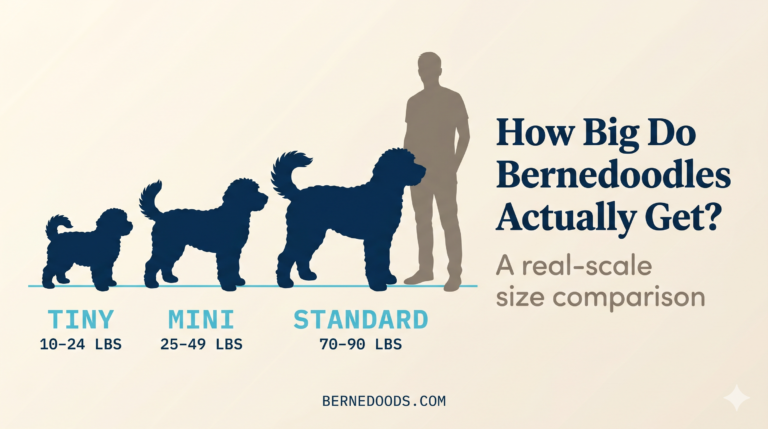
Mini bernedoodles typically weigh between 25 to 49 pounds and stand 18 to 22 inches at the shoulder, fully grown by 11 to 14 months. That’s the honest range. What you really need to know, though, is why that range is so wide and how to predict where your specific dog will land.
Mini Bernedoodle Quick Size Breakdown
Mini Bernedoodle Growth Chart by Age
Most minis follow a fairly predictable growth curve. They grow fast in the first 4 months, start slowing down between 6 and 9 months, and finish filling out by about a year.
| Age | Expected Weight |
|---|---|
| 8 weeks | 5–8 lbs |
| 12 weeks | 8–15 lbs |
| 16 weeks | 10–20 lbs |
| 6 months | 15–30 lbs |
| 9 months | 20–40 lbs |
| 12 months | 25–45 lbs |
| Adult | 25–49 lbs |
These are averages. Individual dogs land above or below, and males typically track toward the higher end.
The 16-Week Rule (It Actually Works for Minis)
Here’s the shortcut most breeders use, and it holds up surprisingly well.
Weigh your mini at 16 weeks. Double it. That’s roughly what they’ll weigh as an adult, give or take a few pounds.
It works for minis because they front-load their growth. By 16 weeks, a mini bernedoodle has already done about half the work of getting to adult size, and the remaining growth is mostly filling out rather than stretching up.
The same rule does not work for standard bernedoodles, who keep growing in height until 18 months or later.
Quick math: Mini weighs 14 lbs at 16 weeks → expect around 28 lbs as an adult.
Why “Mini” Doesn’t Always Mean Mini
A meaningful percentage of “mini” bernedoodles end up larger than the advertised range. Sometimes much larger. Walk through any bernedoodle owner forum and you’ll find a steady stream of 55-pound, 65-pound, and even 75-pound dogs that were sold as minis.
It’s not usually a breeder lying. It’s a combination of three things:

The Breeding Method Matters More Than the Label
How a mini bernedoodle is bred predicts adult size better than almost anything else. There are two common approaches, and they produce very different results.
Mini Poodle × Bernese Mountain Dog (F1 Mini)
This is the most common cross, and it’s also the least predictable.
The Bernese mom weighs anywhere from 70 to 100 pounds. The Mini Poodle dad might weigh 12 to 20 pounds. The puppies split the difference somewhere, but where they land in that range is a genetic coin flip. A litter from this pairing can produce 25-pound and 65-pound siblings, both technically “mini” bernedoodles.
If your mini ended up at 55 or 60 pounds, this is almost certainly the cross your breeder used.
Mini Bernedoodle × Mini Bernedoodle (Multi-Gen Mini)
Both parents are already mini bernedoodles, typically under 45 pounds. The puppies have a much smaller ceiling on how big they can get because neither parent contributes full-Bernese genetics.
This approach is less common and usually more expensive, but it’s the most reliable way to get a true mini. If staying under 45 pounds matters to you, ask your breeder directly: are both parents mini bernedoodles, or is one a full-size Bernese? The answer tells you more than any estimate.
What About Paw Size?
Big puppy paws do not reliably predict a big adult dog. Bernese Mountain Dog ancestry gives most mini bernedoodles disproportionately large paws as puppies, regardless of how big they’ll eventually get. Plenty of minis with enormous paws at 12 weeks finish at 35 pounds.
This was the case with our main mini bernedoodle, Max. He had enormous paws, but ended up between 37 and 40 pounds by 20 months.

Height vs. Weight: Two 40-Pound Minis Aren’t the Same Dog
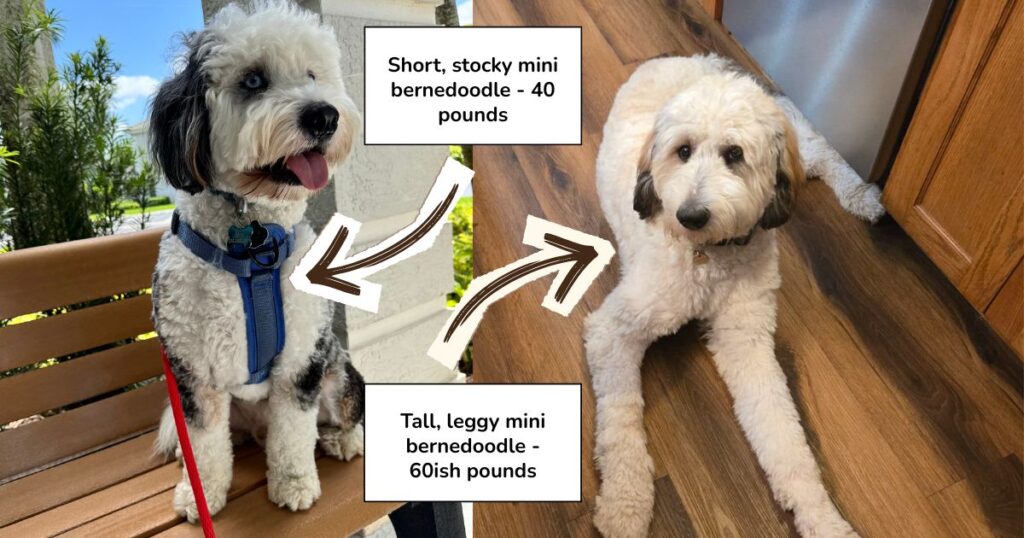
Mini bernedoodles come in two rough body shapes, and weight alone doesn’t tell the whole story.
Some minis inherit the Bernese build: short, stocky, barrel-chested, lower to the ground. Others inherit more of the Poodle frame: taller, leaner, longer-legged.
Two dogs at 40 pounds can look and move completely differently, and it affects real-world decisions like jumping into cars, crate sizing, and how easily you can lift them in an emergency.
Worth knowing before you bring one home.
When Will My Mini Stop Growing?
Growth happens in two phases.
- Height: Usually complete by 8 to 10 months.
- Weight: Fills out through 11 to 14 months.
You’ll notice your mini stop getting taller well before they stop putting on weight. That middle stretch, where they’ve hit full height but are still filling in, is normal and not a sign of overfeeding.
Frequently Asked Questions
1. How big is a full grown mini bernedoodle?
The typical range is 25 to 49 pounds and 18 to 22 inches at the shoulder. Most minis hit their full height by 8 to 10 months and finish filling out by 11 to 14 months.
2. What two dogs make a mini bernedoodle?
A mini bernedoodle is a cross between a Bernese Mountain Dog and a Miniature Poodle. Some breeders also produce minis by pairing two smaller bernedoodles together, which tends to produce more consistent sizes than the Berner-to-Poodle cross.
3. My mini is 50 pounds. Is my breeder lying?
Probably not, but they may have been overly optimistic. Oversize “minis” usually come from crossing a Mini Poodle with a full-size Bernese (70 to 100 pounds), which produces litters where some puppies stay mini and others don’t. It’s one reason to ask for actual weights from the breeder’s previous litters before committing.
4. What are the negatives of mini bernedoodles?
The main ones: size is less predictable than with standards, grooming costs are still substantial, and they often carry more energy than a Standard Bernedoodle. The 40 to 45 pound upper end also lands in an awkward middle. Too big to easily carry, too small to leap into a car unassisted.
5. Do mini bernedoodles bark a lot?
Not especially, but it varies by dog. Most minis are moderate barkers who alert to visitors or unfamiliar sounds without being constant noise-makers. Training and early socialization make the biggest difference.
The Bottom Line
Mini bernedoodles range from 25 to 49 pounds when bred true, but the label alone doesn’t guarantee the size. The parents do.
Ask your breeder for the actual adult weights of both parents and, if possible, weights from previous litters of the same pairing. That’s one piece of information worth more than every chart and calculator on the internet.
Related Posts
-
Are Bernedoodles High Energy or Calm? Activity Levels Explained
If you’ve spent any time researching bernedoodles, you’ve seen them described as “laid-back couch dogs” and “high-energy bundles of chaos”…
-
Micro & Toy Bernedoodles: The Smallest Sizes Explained
You’re looking at two breeder websites. One says micro bernedoodles weigh 10 pounds. The other says 30. Both are using…
-
Are Bernedoodles Aggressive? The Honest, Science-Backed Answer
No. Bernedoodles are not an aggressive breed. Both parent breeds (the Bernese Mountain Dog and the Poodle) sit consistently among…
-
What Is An Australian Bernedoodle? (Including What It Is Not)
If you’ve been researching bernedoodles, you’ve probably run into the term “Australian bernedoodle” and wondered if it’s a different breed,…
-
What Is a Bernedoodle? The Complete Breed Guide
A bernedoodle is a cross between a Bernese Mountain Dog and a Poodle, a combination that pairs one of the…
-
When Do Bernedoodles Calm Down? (Asking For A Friend)
If you’re reading this at 10pm after your bernedoodle ricocheted off the couch, stole something important, and is currently staring…